
High Trust Signals: Examples of Perfect Pitch Deck Simplicity
VCs don't fund effort; they fund clarity. Learn how a complex pitch deck destroys investor trust and how to master the "Rule of One" for Series A.
2.9 EXAMPLES: GOOD VS BAD PROBLEM & SOLUTION SLIDES (VC ANALYSIS)
3/3/20266 min read
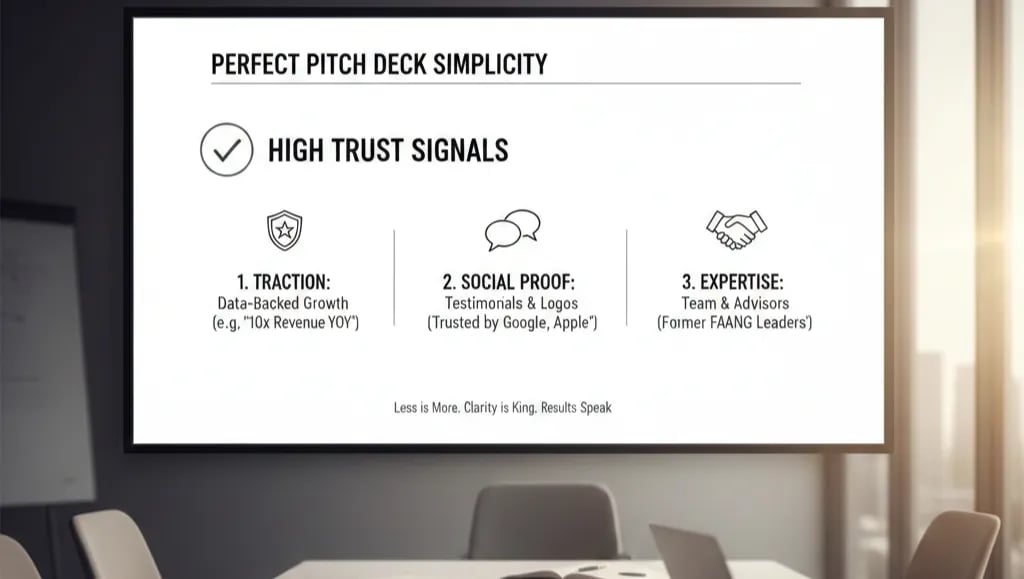
High Trust Signals: Examples of Perfect Pitch Deck Simplicity in Problem & Solution Slides
A founder raising a $4M Seed round spent eleven weeks refining her deck. Forty-three slides, six appendices, a custom data visualisation suite, and a competitive matrix that required a legend to interpret. Three top-tier firms passed in the first meeting. The feedback from one partner was four words: "We couldn't follow it." The deck did not fail because the business was weak — it failed because complexity had consumed the trust signal that simplicity would have delivered in under sixty seconds. This pattern is one of the most consistently documented failure modes in VC-graded examples of Problem and Solution Slides across funded and rejected decks. What follows is the forensic breakdown of why simplicity is not a design preference — it is a financial instrument.
Why Pitch Deck Complexity Destroys the High-Trust Signal VCs Require Before Committing Capital
Simplicity in a pitch deck is not about aesthetics. It is about cognitive authority. When a founder presents a clean, precise Problem Slide with one core insight and one supporting data point, the VC reads it as evidence of clear thinking under pressure. When a founder presents a dense, multi-layered problem statement with three sub-categories, two caveats, and a footnote, the VC reads it as evidence of a founder who cannot yet prioritise — and a founder who cannot prioritise their slide cannot prioritise their business.
The trust destruction mechanism is specific. Complexity forces the investor to do interpretive work. The moment an investor is working to understand your slide rather than evaluating it, their cognitive posture has shifted from buyer to editor. That is a relationship inversion you cannot recover from inside a forty-minute meeting.
In a deck reviewed earlier this year, a B2B logistics founder included a Problem Slide with four distinct pain points, each supported by a separate statistic from a different source — the VC firm's analyst flagged the slide as "unresolved" and the founder was asked to resubmit with a single problem thesis before a second meeting was granted. The problem was not the research. It was the absence of a point of view.
The psychological cause is almost always intellectual insecurity dressed as thoroughness. Founders add complexity to demonstrate that they have done the work, that they understand the nuance, that they are not naive. The result is a deck that proves effort while destroying clarity — and VCs fund clarity, not effort.
As of 2026, funds operating at the Series A tier in the US and UK are running initial partner reviews on decks averaging under five minutes of attention before a go or no-go on a first meeting is issued. In that window, a complex slide is not a rich slide. It is a skipped slide.
The Cognitive Load Cost of Complexity: What Every Unnecessary Element on Your Problem Slide Actually Costs You
The economics of attention in a pitch meeting are measurable. Here is the math:
Baseline attention per slide in a first-pass deck review: approximately 18–22 seconds.
Every element of complexity you add to a slide has a cognitive load cost that consumes that window:
Single, specific problem statement: 4–6 seconds to absorb.
Supporting data point (1 statistic): 3–4 seconds to evaluate.
Second problem sub-category: +7–9 seconds of re-orientation.
Competitive context on Problem Slide: +8–12 seconds—investor now confused about slide purpose.
Footnote or source citation: +4–5 seconds of distraction.
Visual complexity (multiple colours, icons, nested bullets): +5–8 seconds of parsing.
A Problem Slide with one statement and one data point consumes 7–10 seconds and leaves 8–12 seconds for the VC to form a positive judgment. A Problem Slide with two sub-categories, a competitive reference, and a footnote consumes 27–38 seconds — beyond the attention window before the investor has reached a conclusion.
The conclusion they reach when time runs out on a complex slide is not neutral. It is negative. Confusion defaults to skepticism. The investor moves to the next slide carrying a residual doubt they may not be able to articulate, but which will surface as a pass.
The Rule of One applies here with mathematical precision: one problem, one cost, one buyer, one data point. That is the entire Problem Slide. Everything else belongs in the appendix or the due diligence room.
The High-Trust Simplicity Protocol: Before and After Examples Across Problem and Solution Slides
Simplicity is not subtraction for its own sake. It is the discipline of resolving your thinking to its sharpest point before presenting it. Here is the structured method.
Step 1 — Apply the Single Thesis Test
Your Problem Slide must be reducible to one sentence without losing its meaning. If it cannot be reduced to one sentence, you do not yet have a problem thesis. You have a problem category. Those are not the same thing.
The test: Cover your slide and write the core problem in one sentence on a blank page. If that sentence contains the words "and" or "also," you have two problems. Choose one.
Step 2 — Strip to the Minimum Viable Evidence
A high-trust Problem Slide requires exactly one data point. Not three. Not a range. One. The data point must quantify the cost of the problem for the specific buyer you named. Every additional statistic signals that you did not trust the first one — which means the investor will not trust any of them.
Weak Version — Problem Slide
"Retailers face multiple operational challenges including inventory mismanagement, supply chain disruption, shrinking margins, and poor demand forecasting. Industry studies show losses ranging from 10%–30% of revenue depending on segment, with technology adoption rates still lagging across mid-market players."
This slide has four problems, a range that spans 20 percentage points, a vague segment reference, and no named buyer. A VC reading this does not know what company they are looking at. Every sentence added beyond the first eroded trust rather than building it.
VC-Ready Version — Problem Slide
"Independent fashion retailers with 5–20 locations write off an average of $340,000 per year in unsold seasonal inventory. Current buying tools were built for enterprise volume, not the weekly cash flow constraints of an owner-operator."
Named buyer. Quantified cost. Specific reason current solutions fail. One problem. Thirty-seven words. That slide takes eight seconds to read and twelve seconds to believe.
Weak Version — Solution Slide
"Our integrated platform uses machine learning, real-time POS data integration, and predictive analytics to provide retailers with actionable insights across inventory planning, supplier management, demand forecasting, and margin optimisation — all in one unified dashboard."
This is a feature list. It is not a solution proof. A VC reading this cannot identify what problem is being solved, for whom, or whether it works. The word "unified" is doing no work.
VC-Ready Version — Solution Slide
"We connect directly to the retailer's existing POS system in under two hours — no integration work required — and flag overstock risk by SKU fourteen days before the markdown window closes. Across our 22 live customers, average annual write-off reduction is $190,000 in year one."
Mechanism. Deployment speed. Specific outcome. Proof. That is four trust signals in three sentences, and none of them required a dashboard screenshot or a feature matrix.
The High-Trust Simplicity Equation
Apply this as a final filter before the deck leaves your hands:
Trust Signal Score = (Specificity of Buyer) × (Precision of Cost) × (Clarity of Mechanism) ÷ (Number of Competing Elements on Slide)
Increase the numerator. Reduce the denominator. That is the entire formula.
Three Simplicity Mistakes Founders Make That Collapse the High-Trust Signal
1. Confusing proof with volume. Adding more data points does not strengthen a claim — it dilutes it. One precisely sourced statistic from a primary source outperforms three statistics from three different industry reports. The investor has to reconcile conflicting figures; that reconciliation work destroys trust in all of them simultaneously.
2. Simplifying the Problem Slide but over-building the Solution Slide. The simplicity discipline must be applied consistently across both slides. A one-sentence problem paired with a twelve-feature solution matrix creates a structural imbalance that signals the founder is more confident in the product than the insight. At Series A, that is the wrong signal.
3. Mistaking minimalism for absence of evidence. Simplicity is not sparseness. A slide with one sentence and no supporting data is not simple — it is unsubstantiated. The discipline is one precisely chosen claim, supported by one precisely chosen proof. That is not thin. That is surgical.
The Simplicity Premium: What High-Trust Problem & Solution Slides Add to Your Pre-Money
Founders who present simple, high-trust decks do not just get more meetings. They negotiate from a different position. When an investor has processed your Problem and Solution Slides without friction — when they have understood your business in under ninety seconds — they arrive at the financial conversation with conviction rather than residual doubt. That conviction has a dollar value. It is the difference between a $22M pre-money and a $26M pre-money on the same business, because the investor's confidence in the founder's judgment is priced into the term sheet. Build the complete system using the Problem and Solution Slide framework that shows exactly how high-trust simplicity is constructed across every funding stage.
The 16 VC-Quality AI Prompts inside the $5K Consultant Replacement Kit are built specifically to strip your Problem and Solution Slides to their highest-trust, minimum-viable form — eliminating every element that adds cognitive load without adding conviction. The full Kit is $497. Use the AI prompt system that builds high-trust pitch deck simplicity without losing the evidence VCs require.
Funding Blueprint
© 2026 Funding Blueprint. All Rights Reserved.