
Product Differentiation: Show (Don't Tell) in Your Pitch Deck
Stop telling VCs you are "unique." Assertions kill your credibility. Master the Proof Architecture framework to show structural differentiation instead.
2.3 HOW TO FRAME THE SOLUTION SLIDE (WITHOUT OVERCLAIMING)
2/19/20265 min read
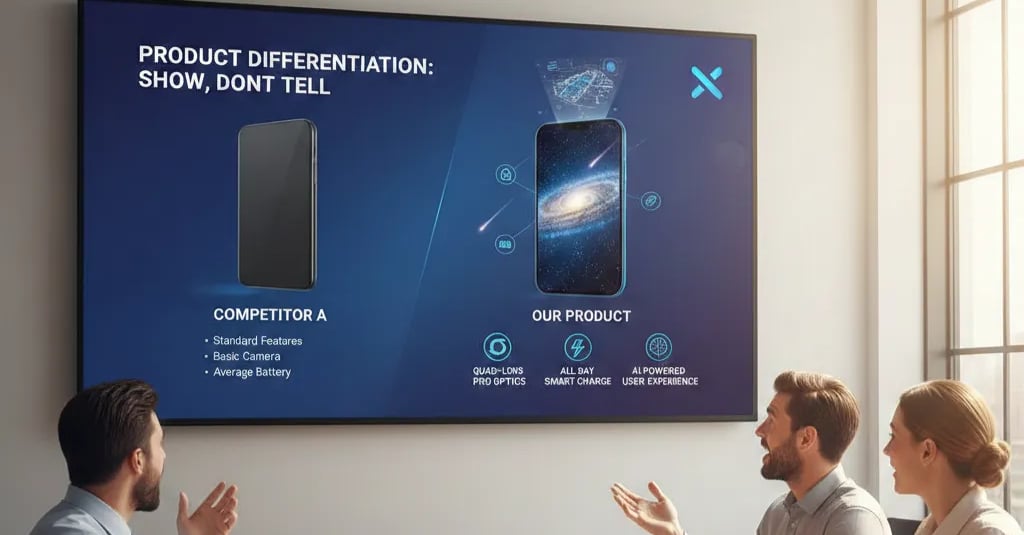
Product Differentiation: Show (Don't Tell) in Your Pitch Deck
A B2B SaaS founder at the pre-Series A stage raised $1.8M in seed funding, built a genuinely differentiated product, walked into four Series A partner meetings, and received zero term sheets. The product worked. The customers were real. The NPS score was 71. The problem was the Solution Slide — specifically, the three words that appeared in every version of it: "unlike our competitors." Those three words are a signal, not an argument. Every VC in those rooms heard the same claim twelve times that week. None of those founders proved it. This post is part of the core framework for framing the Solution Slide without overclaiming — the distinction between stating differentiation and demonstrating it is precisely where Series A pitches collapse.
Why "We Are Different" Is the Most Expensive Sentence in Your Pitch Deck
Telling a VC you are differentiated is the pitch equivalent of a job candidate describing themselves as a hard worker. The claim is unverifiable, ubiquitous, and immediately discounted. What registers instead is the VC's internal counter-question: Prove it — and prove it in a format I can take to a partner meeting.
The failure runs deeper than word choice. When founders use assertion language — "best-in-class," "proprietary," "unique approach" — they are transferring the burden of proof to the investor. The investor does not accept that transfer. They close the mental file on the claim and move to the next slide looking for something they can verify.
In a deck I reviewed last quarter, a vertical SaaS founder used the phrase "differentiated architecture" four times across three slides without a single concrete proof point — the VC firm passed after the screening call and cited "unclear competitive moat" in their feedback. The architecture genuinely was differentiated. The slide failed to show it. As of early 2026, top-tier US funds at the Series A stage are running formal competitive landscape analyses in-house before the second meeting — often using their own analysts to map the category independently. That means your differentiation claim will be tested against external data whether you prove it or not. If your slide does not pre-empt that analysis with evidence, the analyst's memo will define your competitive position for you, and it will not be generous.
The psychological driver is that founders experience their differentiation as obvious. They have lived inside competitor products, read every G2 review in the category, and talked to sixty customers. That research does not make it onto the slide. The conclusion does, stripped of the evidence that made it credible.
What Happens in the First 30 Seconds
The math here is attentional, not financial — but it has direct financial consequences.
A VC reviewing a pitch deck at the pre-partner-meeting stage spends an average of 2.7 minutes on a first pass, according to DocSend's longitudinal pitch deck engagement data. The Solution Slide receives disproportionate attention — but only when it resolves a question the Problem Slide created. If the Solution Slide opens with assertion language, it fails to resolve that question. The VC's attention does not increase. It drops, because there is nothing to process.
Here is the cognitive load breakdown of two differentiation approaches:
"Our AI is more accurate than legacy tools."
What the VC Processes: An unverified claim
Cognitive Output: Skepticism; mental discount applied
"Our model hits 94% diagnostic accuracy vs. 71% industry baseline — validated across 3 health system pilots."
What the VC Processes: A specific, falsifiable claim with a benchmark
Cognitive Output: Active engagement; due diligence instinct triggered
"Unlike competitors, we offer a seamless experience."
What the VC Processes: Marketing copy
Cognitive Output: Slide dismissed; VC moves on
"Customers switch from [Competitor X] after an average of 2.3 months — driven by [specific friction point] our architecture eliminates by design."
What the VC Processes: A behavioral proof point with a causal mechanism
Cognitive Output: Competitive moat question partially answered
The second column in each row is not semantics. It is the difference between a VC who asks a follow-up question and one who writes "undifferentiated" in their notes.
The Show-Don't-Tell Equation:
Differentiation = Specific Benchmark + Causal Mechanism + Verifiable Source
All three components must be present. A benchmark without a mechanism is a number without a story. A mechanism without a source is an assertion with extra steps.
Rebuilding Your Differentiation Slide From the Evidence Up
This is where founders recover the meeting — and more importantly, the partner presentation.
Weak Version (What Most Decks Contain):
"Our platform delivers superior results through our proprietary AI engine, providing a seamless, enterprise-grade solution that outperforms legacy tools on every dimension."
Zero of those words are verifiable. A VC cannot take that sentence to a partner meeting. It does not survive a single analyst question.
VC-Ready Version (What Advances to Due Diligence):
"Across our first 12 enterprise customers, average time-to-value dropped from 14 weeks (category baseline) to 6 days. That gap exists because we eliminated the integration layer every competitor relies on — we ingest directly from [specific data source], which requires the domain expertise our founding team built at [credible prior employer or institution]."
Now the VC has three things they can verify, stress-test, and present internally: a quantified outcome, a structural mechanism, and a credibility signal. That is not a better sentence. That is a fundable argument.
The Proof Architecture Framework — applied in four steps:
Identify your single strongest verifiable proof point. Not your best story. Your most defensible number. CAC payback period vs. category average. Retention rate vs. public comps. Accuracy benchmark vs. published baseline. One metric, precisely sourced.
Name the structural reason the proof point exists. This is your mechanism. It must be specific to your architecture, your data, or your team's domain expertise — not your product roadmap or your vision.
Connect the mechanism to a switching cost or replication barrier. Why does the mechanism compound over time? Data accumulation, customer workflow embedding, regulatory certification, proprietary training sets — name it explicitly.
Map your proof point directly back to the Problem Slide's stated constraint. If your Problem Slide quantified a pain point, your differentiation evidence must reduce that exact measurement. Any mismatch breaks the investment thesis at the narrative level.
Before vs. After applied to slide structure:
Weak structure: Claim → Feature list → Generic benefit statement
VC-ready structure: Proof point (with source) → Mechanism → Replication barrier → Direct connection to problem
Three Differentiation Death Traps to Avoid When Rebuilding This Slide
1. Using customer quotes as proof of differentiation. Testimonials belong in the traction section. A quote from a happy customer does not prove competitive superiority — it proves you have at least one happy customer. Investors already assumed that.
2. Benchmarking against the wrong competitor set. Comparing your product to a legacy incumbent when the real competitive threat is a well-funded Series B startup two categories over is a due diligence failure waiting to happen. VCs know the category. If your competitive framing is selective, they will flag it — and it will cost you credibility on every other claim in the deck.
3. Conflating differentiation with innovation. A technically novel approach that customers do not pay a premium for is not a defensible differentiator — it is an engineering achievement. Differentiation is defined by what customers choose and why, not by what your team built and how.
The Revenue Impact of a Differentiation Slide That Actually Proves Its Claim
A Solution Slide that demonstrates differentiation through evidence — rather than asserting it through adjectives — does not just survive due diligence. It compresses it. When a VC can verify your competitive position before the partner meeting, they arrive as a buyer, not an interrogator. That shift in dynamic changes the negotiation. It affects pre-money. It affects whether you get the meeting at all. For the complete narrative architecture that connects your Problem Slide's claim to a Solution Slide that closes the logical loop, the full system is documented in the Series A Problem and Solution Slide framework.
Founders who have used the Slide-By-Slide VC Instruction Guide inside the $5K Consultant Replacement Kit go into partner meetings with a differentiation frame that already matches what the VC's analyst will check against. The guide specifies exactly which proof point formats trigger due diligence versus which ones get mentally discounted — built from pattern analysis across funded and rejected decks. That is not a small edge in a category where every competitor is making the same assertion claims you are. The full Kit is $497, available at the pitch deck system designed to replace $5,000 in consultant fees.
Saying you are different costs nothing and proves nothing. Showing why you are structurally irreplaceable is what a term sheet is built on.
Funding Blueprint
© 2026 Funding Blueprint. All Rights Reserved.