
Pitch Deck Teardown: Great Problem Slides Ruined by Bad Solutions
A great Problem slide ruined by a vague Solution slide kills Series A deals instantly. See exact pitch deck teardowns that fix the credibility gap.
2.9 EXAMPLES: GOOD VS BAD PROBLEM & SOLUTION SLIDES (VC ANALYSIS)
3/2/20267 min read
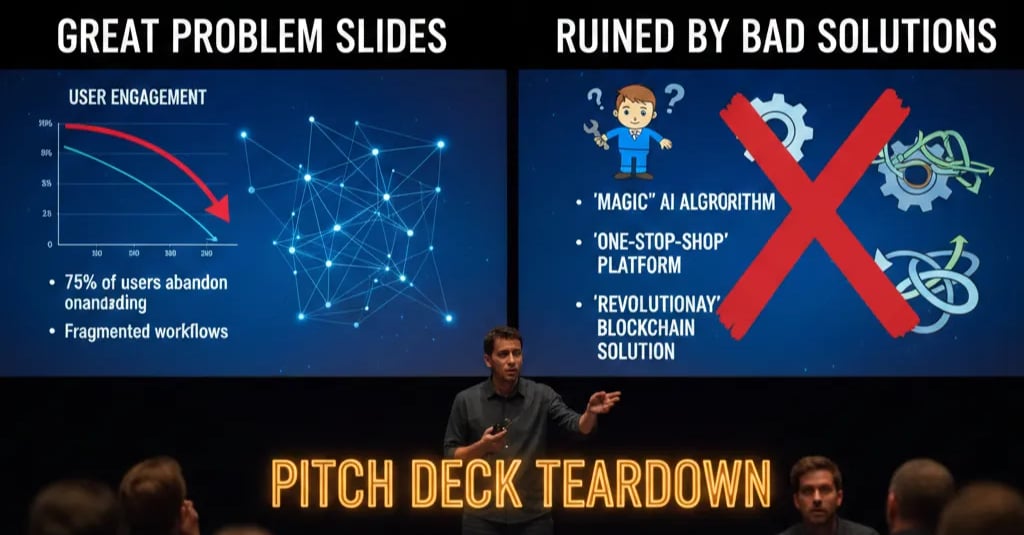
Pitch Deck Teardown: Great Problem Slides Ruined by Bad Solutions
You will not get a second meeting. And the brutal irony is that your Problem Slide was the strongest in the room that day.
That is the specific failure pattern this teardown addresses — founders who do the hardest work correctly, build a Problem Slide that is precise, evidenced, and credible, and then detonate it with a Solution Slide that is vague, feature-heavy, or structurally disconnected from the proof they just built. The VC's trust, earned over three slides, evaporates in four seconds. What follows is not confusion — it is a quiet, permanent withdrawal of conviction that no Q&A will recover. This breakdown runs alongside the VC analysis of good vs. bad Problem and Solution Slides and focuses specifically on the anatomy of a great problem destroyed by a weak solution — with real examples of what each version looks like and why one closes doors the other opened.
Why a Strong Problem Slide Makes a Weak Solution Slide More Damaging, Not Less
This is the counterintuitive mechanics of the failure. Most founders assume that a strong Problem Slide gives them goodwill — a credit balance they can spend across the rest of the deck. The opposite is true. The stronger your problem proof, the higher the VC's solution expectation. You have raised the bar. Now you have to clear it.
When a VC reads a Problem Slide that names a specific ICP, quantifies a verified cost, and traces the failure to a precise mechanism, their internal analyst logic activates at full intensity. They are no longer passively receiving information — they are constructing a hypothesis about what the solution must look like to be fundable. That hypothesis is specific. It has a shape. And when the Solution Slide does not match that shape, the mismatch is not interpreted as a minor gap. It is interpreted as a signal that the founder does not fully understand what they built — or who they built it for.
The "red flag" version is this: A founder opens with a Problem Slide proving that independent insurance brokers lose an average of $47K annually in unbilled renewal premiums due to a manual, spreadsheet-driven client tracking process — backed by 19 customer interviews. Then the Solution Slide reads: "[Product] is an intelligent client relationship platform for insurance professionals, powered by AI to deliver smarter workflows and better client outcomes." The last three founders who brought a solution framing this generic into a partner meeting following a problem this specific were all asked to resubmit after a substantial redraft — none progressed to a second call from that meeting. The problem was surgical. The solution was a brochure.
The psychological root is almost always a drafting sequence problem compounded by feature anxiety. The founder built a credible Problem Slide through customer discovery — real, disciplined work. Then, when writing the Solution Slide, they shifted from customer language to product language, importing marketing copy from the website rather than maintaining the forensic register they had just established. The result is a tone collapse that a VC reads as a competence signal.
The Credibility Destruction Equation: What a Mismatched Solution Costs You Mathematically
The damage is not abstract. It has a measurable structure, and it runs through every subsequent slide in your deck.
Stage 1 — The problem establishes a value claim. A Problem Slide that proves $47K in annual unbilled revenue per broker implicitly sets the minimum value threshold your solution must credibly recover. The VC is now calculating: "If this product works, what is the recoverable value per customer, and does that justify the price point and the TAM?"
Stage 2 — A vague Solution Slide breaks the value chain. If your solution is described as a "smarter workflow platform," the VC cannot complete the calculation. They cannot tie "smarter workflows" to "$47K in recovered premiums" with any defensible logic. The value chain, which your Problem Slide established with precision, is severed.
Stage 3 — The financial model loses its anchor. As of 2025, top-tier US Series A funds are stress-testing burn multiples at or below 1.5x — meaning every dollar of net new ARR must be acquirable for no more than $1.50 in net burn. A vague solution makes it impossible for the analyst to validate your CAC assumptions, because they cannot confirm what specific outcome your product delivers that a customer would pay to receive. A broken value chain produces a broken financial model audit.
The three-point cost breakdown:
Valuation compression: A solution without a quantified outcome cannot be priced against a recoverable value — forcing the VC to apply a conservative revenue multiple rather than a value-based one
Diligence stall: The analyst cannot write a crisp investment memo without a clear problem-solution value statement; the deck goes into a holding pattern rather than advancing to a partner discussion
Competitive positioning failure: A vague solution cannot be differentiated from competitors — the VC defaults to assuming you are a feature, not a company
The Solution Slide Reconstruction Protocol: Teardown and Rebuild
Three real-pattern teardowns, each showing a strong Problem Slide followed by its weak Solution Slide — and the VC-ready reconstruction.
Teardown 1 — The Feature List Collapse
Strong Problem Slide: "B2B SaaS sales teams at companies with 20–80 AEs lose an average of 31% of their active pipeline to stalled deals caused by a single failure point: no standardised next-step commitment captured after discovery calls. Confirmed across 24 customer interviews."
Weak Solution Slide: "[Product] gives sales teams AI-powered pipeline management with deal scoring, activity tracking, real-time forecasting, CRM integration, and automated follow-up sequences."
What the VC sees: Six features, zero mechanism closure. The problem identified one specific failure point — no next-step commitment captured post-discovery. The solution lists six capabilities, none of which are explicitly described as the fix for that failure point. The founder has answered a broader question than the one they asked.
VC-Ready Reconstruction: "[Product] inserts a 90-second structured commitment capture into every discovery call — automatically logging the agreed next step, owner, and deadline directly into the CRM, with an automated hold if the step is missed. Pipeline stall from uncommitted next steps: eliminated at the source."
One mechanism. One outcome. Direct correspondence to the failure point named in the problem.
Teardown 2 — The Aspiration Drift
Strong Problem Slide: "Mid-market D2C brands running paid social at $80K–$300K monthly ad spend lose an average of 23% of that budget to creative fatigue — identified as the leading cause of CPM inflation in campaigns running beyond 14 days without creative rotation. Source: 17 internal media buyer audits."
Weak Solution Slide: "[Product] empowers marketing teams to create better, faster, and more impactful content at scale using AI — reducing creative production time and helping brands stay relevant in a competitive landscape."
What the VC sees: "Better, faster, more impactful" are aspirations. "Staying relevant" is a brand positioning statement. Neither addresses creative fatigue, CPM inflation, or the 14-day rotation failure point. The problem was an audit. The solution is a tagline.
VC-Ready Reconstruction: "[Product] generates and deploys creative variants on a 72-hour rotation cadence — automatically triggered before the 14-day fatigue threshold — reducing CPM inflation by an average of 19% across managed accounts. Media buyers set the brief once. The rotation runs without manual intervention."
Teardown 3 — The Category Error
Strong Problem Slide: "NHS-contracted community care providers in the UK lose an average of £38K per quarter to unapproved care plan deviations that are only identified at month-end audit — caused by a real-time documentation gap between care workers and clinical supervisors."
Weak Solution Slide: "[Product] is a digital care management platform that connects care workers, supervisors, and families — improving transparency, compliance, and outcomes across the care journey."
What the VC sees: "Transparency, compliance, and outcomes" are category descriptors — they describe the market, not the mechanism. The problem identified a real-time documentation gap causing a £38K quarterly loss. The solution describes a connectivity platform that might address that, somewhere, somehow.
VC-Ready Reconstruction: "[Product] captures care plan deviations at the point of delivery — flagging unapproved changes to the supervising clinician within 4 hours, not 30 days. The documentation gap closes in real time. The £38K quarterly audit loss closes with it."
The Framework — The Solution Reconstruction Test:
Pull the three core elements from your Problem Slide: Mechanism / Cost / Victim. Your Solution Slide must name all three — in reverse. How the mechanism is closed / What cost is eliminated / Who experiences the recovery. If your Solution Slide introduces vocabulary not present in your Problem Slide, it has drifted.
Three Reconstruction Traps That Reintroduce the Problem After You Think You Have Fixed It
Trap 1 — Fixing the headline but leaving the body copy vague. The solution headline is now precise. But the three bullet points underneath it revert to feature language — "AI-powered," "seamless integration," "scalable architecture." The VC reads the body, not just the headline. Every line is audited.
Trap 2 — Quantifying the solution outcome without tying it to the problem cost. The solution claims "reduces processing time by 60%." The problem stated a $47K annual cost. If those two numbers are not explicitly connected — either on the slide or in the verbal walkthrough — the VC cannot validate whether a 60% time reduction actually recovers $47K or only $8K. Unconnected metrics do not compound; they cancel.
Trap 3 — Solving the problem completely on the Solution Slide and leaving no room for the product. Over-engineering the Solution Slide so that it reads as a product spec sheet collapses the narrative arc. The Solution Slide should close the problem loop and create curiosity about how — the product slide answers the how. Keep the solution at the outcome level, not the feature level.
What Rebuilding This Slide Recovers at the Term Sheet Stage
A Solution Slide that closes the problem loop precisely does not just improve your pitch — it restructures the entire post-meeting dynamic. The analyst's memo writes itself. The partner's IC question becomes "how large is the market?" rather than "what does this product actually do?" That shift in question quality is the difference between a 10-week diligence cycle and a 16-week one — and in a capital environment where runway is the primary existential constraint, six weeks is not a minor variable.
Founders who lock this slide consistently report that partner meetings move faster, diligence requests are more targeted, and term sheet conversations begin from a position of established conviction rather than exploratory doubt. The full architecture for building both slides into a fundable sequence is in the Series A pitch deck Problem and Solution Slide system.
Founders who have used the Slide-By-Slide VC Instruction Guide inside the $5K Consultant Replacement Kit go into partner meetings with a Solution Slide that has already been stress-tested against the exact reconstruction logic a VC analyst applies before the deck reaches a partner. That is not a marginal advantage — it is the difference between a deck that advances and one that stalls at the first internal review. The full Kit is $497. Rebuild your Solution Slide against the standard that matters at the Series A pitch deck system that replaces a $5K consultant.
Funding Blueprint
© 2026 Funding Blueprint. All Rights Reserved.