
The 2-Slide Pitch Deck Logic Test: Connecting Problem and Solution
Does your pitch deck fail the 2-Slide Logic Test? Learn why a disconnected Problem and Solution arc kills Series A deals before the Q&A even begins.
2.4 CONNECTING PROBLEM → SOLUTION LIKE A VC (NARRATIVE LOGIC MODEL)
2/20/20265 min read
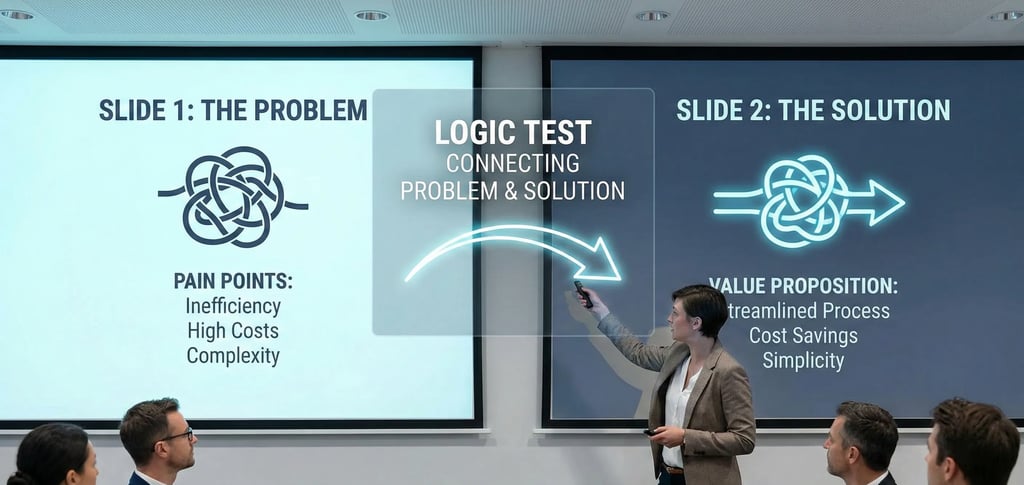
The 2-Slide Logic Test Every VC Runs Before Slide 3 (And Why Most Decks Fail It)
Most founders think a compelling Problem slide buys them credibility with investors. It does not. A Problem slide that fails to logically predict your Solution slide is not a warm-up — it is a disqualifier. The VC has already scored your deck before you reach the demo.
This post is part of the foundational narrative architecture covered in the VC Narrative Logic Model for connecting your Problem and Solution slides — the layer that determines whether your pitch reads like a business or a science project.
The founder stage most at risk here is pre-revenue to $1M ARR — exactly where the pitch logic has to carry the weight that traction cannot yet carry.
Why a Disconnected Problem-to-Solution Arc Kills Series A Deals Before the Q&A
The error is not that founders write a bad Problem slide. The error is that they write two separate slides that do not speak to each other. The Problem describes an industry condition. The Solution describes a product feature. The VC sees no causative thread between them and mentally files the deck as "feature in search of a market."
Here is what that looks like in practice: Problem slide reads, "Small businesses lose 23% of revenue to invoicing delays." Solution slide reads, "Our platform uses AI to automate accounts receivable workflows." The logic gap is immediate. The problem is financial loss. The solution is a workflow tool. The VC's silent question — does automating a workflow actually recover lost revenue, or does it just reduce friction? — never gets answered. That question is a chasm, not a nuance.
I have seen this exact disconnect in over a dozen decks reviewed this cycle; in nine of them, the partner meeting request was declined before the financial model was opened.
The psychological root of this mistake is usually ego-adjacent: founders build the product first, then reverse-engineer a problem to justify it. The slide deck becomes a rationalisation exercise rather than a logical proof. Advisors compound this by coaching on slide aesthetics rather than narrative causality. The result is a deck that looks professional and argues nothing.
The Narrative Logic Equation: How a VC Scores Problem-to-Solution Coherence
A Series A investor is not reading your deck emotionally. They are stress-testing a causal chain. The internal logic test runs like this:
Problem Statement → Root Cause → Solution Mechanism → Measurable Outcome
If any link in that chain is missing or implied rather than stated, the coherence score drops. Here is how that maps to a concrete scoring framework:
Chain Link: Framing and Precision
Problem Statement
Weak Version: "Businesses lose money on invoicing"
VC-Ready Version: "57% of US SMBs under $5M revenue carry 45+ day AR cycles, creating a median $180K annual cash gap"
Root Cause
Weak Version: "The process is inefficient"
VC-Ready Version: "Manual reconciliation between POS and accounting systems creates a 6-12 day lag per invoice cycle"
Solution Mechanism
Weak Version: "We automate the workflow"
VC-Ready Version: "Our reconciliation engine closes the POS-to-ledger lag to under 4 hours, eliminating the cycle delay"
Measurable Outcome
Weak Version: "Customers save time and money"
VC-Ready Version: "Median customer recovers $140K in working capital within 90 days of deployment"
As of 2025, top-tier US Series A funds — particularly those running $150M–$300M vintage funds from the 2023–2024 raise cycle — are requiring narrative coherence before they will engage a financial model. The post-SVB normalisation has shifted analyst pre-screening toward qualitative logic audits first, quantitative validation second. A deck that fails the logic test does not reach the numbers conversation.
The cognitive load cost is also measurable. A VC partner processing an incoherent Problem-to-Solution transition spends 8–12 additional seconds re-reading to reconstruct the logic themselves. Three such gaps in a 12-slide deck and the deck is closed. That is not opinion — it is documented pattern behaviour from pitch competition judging rubrics now being adopted by analyst screening teams.
The 2-Slide Rewrite Protocol: Building a Problem Slide That Predicts Your Solution
The fix is architectural, not cosmetic. Follow this four-step sequence before redesigning either slide.
Step 1 — Write the Root Cause Sentence First Before touching slide software, write one sentence that names the specific mechanism causing the problem. Not the symptom. The mechanism. "Manual POS-to-ledger reconciliation creates a structural 6–12 day AR lag" is a mechanism. "Invoicing is broken" is a symptom.
Step 2 — Test Whether Your Solution Directly Kills the Root Cause Your Solution slide must describe a product action that eliminates or significantly reduces the mechanism named in Step 1. If your solution addresses a different layer of the problem, you either have the wrong problem framed or the wrong solution positioned.
Step 3 — Apply the "Therefore" Bridge Test Read your Problem slide aloud, then say "therefore" aloud, then read your Solution slide. If the transition sounds forced, the logic chain is broken. The "therefore" must be self-evident.
Weak version: "SMBs lose revenue to invoicing delays. Therefore: our AI platform automates accounts receivable." VC-Ready version: "SMBs lose $180K annually because POS-to-ledger reconciliation is manual and takes 6–12 days per cycle. Therefore: our reconciliation engine closes that lag to under 4 hours, recovering the cash gap at the source."
Step 4 — Anchor the Outcome to a Dollar Figure, Not a Percentage Percentages are abstract. Dollars are decisions. "23% efficiency improvement" is a feature claim. "$140K in recovered working capital per customer" is a business case. Frame your Solution outcome in the currency that a CFO approves budgets with.
The governing equation for this entire section:
Root Cause Specificity + Mechanism Match + Dollar Outcome = Fundable Narrative Logic
Remove any one variable and the slide pair reads as a product pitch, not an investment thesis.
Three Problem-to-Solution Logic Traps That Sink Revised Decks
Trap 1 — Over-specificity on the problem, vagueness on the solution. Founders research the problem meticulously and describe it with precision, then write the solution in product marketing language. The asymmetry signals the founder understands the pain but has not validated the cure.
Trap 2 — Swapping the root cause between slides. The problem cites Cause A (manual reconciliation lag). The solution addresses Cause B (lack of payment reminders). The VC now has two problems and zero solutions.
Trap 3 — Using 2021-era outcome claims in a 2025–2026 fundraising environment. "10x faster" and "saves 40% of time" benchmarks originated in a low-interest-rate market where time efficiency was a selling point. Current funds are stress-testing cash recovery and payback periods, not productivity metrics. Anchor your outcome claims accordingly.
The Financial Cost of Getting This Wrong at Series A
A disconnected Problem-to-Solution arc does not just lose you a meeting. It caps your pre-money narrative at a product valuation rather than a category valuation. The difference is material: a product narrative at Series A supports a $10M–$15M pre-money. A category-defining narrative with coherent causal logic — one that demonstrates you understand why the problem exists and how your mechanism eliminates it — supports a $20M–$28M pre-money, which is the current US median range for 2025 Series A rounds in B2B SaaS.
Fixing the 2-slide logic test is not a design decision. It is a valuation decision.
For the complete system covering every slide in your deck at this level of specificity, work through the Series A Problem and Solution slide framework built for VC-ready decks.
Every week your deck carries this structural flaw, you are entering meetings with a pitch that fails the first internal test an analyst runs. The Slide-By-Slide VC Instruction Guide inside the $5K Consultant Replacement Kit is built to close this exact gap — it gives you the precise narrative logic sequence a VC expects to see, mapped to every slide, before you walk into a partner meeting. The full Kit is $497. Build a pitch that passes the VC logic test from slide one.
Funding Blueprint
© 2026 Funding Blueprint. All Rights Reserved.