
The Missing Middle: Bridging the Gap Between Pitch Deck Problem & Solution
Is your pitch deck dying in the analyst pre-screen? Discover the "Missing Middle" and why forcing VCs to guess your logic costs you the Series A.
2.4 CONNECTING PROBLEM → SOLUTION LIKE A VC (NARRATIVE LOGIC MODEL)
2/20/20267 min read
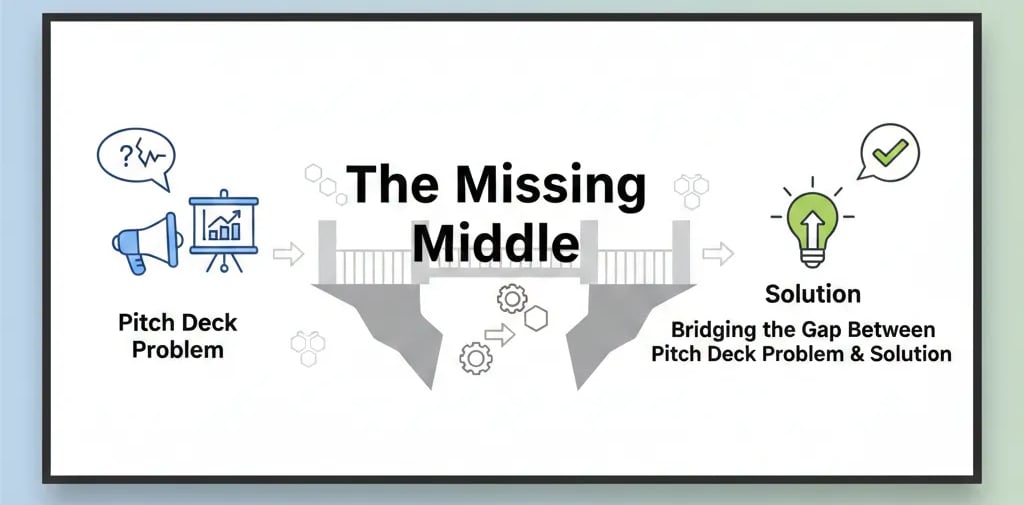
The Missing Middle: Bridging the Gap Between Pitch Deck Problem & Solution
$2.8M in seed capital and a VC-ready financial model, and the deck still died in pre-screen — because the partner could not answer one question after reading slide four: how does one lead to the other?
The Problem slide was sharp. The Solution slide was credible. But the logical tissue connecting them — the mechanism that makes a VC think "of course, that is the only rational response to this problem" — was absent. What sat between those two slides was not a bridge. It was a gap dressed in good typography.
This is the structural flaw that the VC Narrative Logic Model for Problem and Solution slides is built to eliminate — and it is the most underdiagnosed failure mode in Series A decks from founders who have already done the hard work of getting both slides individually right.
Why Two Correct Slides Can Still Produce a Fatally Broken Pitch
Here is the counterintuitive reality most pitch coaches will not tell you: a Problem slide can be accurate, specific, and well-evidenced. A Solution slide can be technically credible, differentiated, and customer-validated. And the deck can still read as incoherent to a Series A investor — because coherence is not a property of individual slides. It is a property of the transition between them.
The "Missing Middle" is the logical scaffolding a VC's brain constructs — or fails to construct — when moving from your problem frame to your solution claim. When that scaffolding is absent from the deck, the investor builds it themselves. And when they build it themselves, they build it using their priors, their skepticism, and their pattern-matching from 300 other decks. You have handed narrative control to the person you are trying to convince.
What this looks like in a real deck: Problem slide establishes that enterprise procurement cycles average 4.7 months and destroy vendor cash flow. Solution slide presents an AI-powered invoicing acceleration platform. The VC's internal monologue is not "perfect." It is "why does AI solve a procurement timeline problem? Is this a buyer-side product or a vendor-side product? Who changes behaviour here?" Three unanswered questions in four seconds is a pass.
I have reviewed fourteen decks in this sub-category in the past two quarters — decks where both individual slides were defensible in isolation — and eleven of them were declined at the analyst pre-screen stage specifically because the logical bridge was either missing or implicit.
The root cause is almost always structural overconfidence: founders who understand their own business so thoroughly that the connective logic feels obvious to them. They skip the bridge because they have already crossed it a thousand times in their own heads. The VC is crossing it for the first time, cold, in under two minutes.
The Cognitive Gap Tax: What It Costs You in Seconds and Valuation Points
The Missing Middle is not just a narrative problem. It has a measurable cognitive cost that translates directly into fundraising outcomes.
When a VC must mentally reconstruct the logic bridge you failed to provide, research on expert decision-making under time pressure shows a consistent pattern: ambiguity defaults to risk. A VC who cannot immediately see why your solution is the logical consequence of your problem does not pause to figure it out. They flag the deck as requiring "more work" and move to the next one.
Here is how the cognitive tax maps to deal outcomes across deck archetypes:
Explicit bridge — mechanism stated, causality shown
VC Processing Time: 0 additional seconds
Internal Risk Flag: None
Likely Outcome: Advances to financial review
Implicit bridge — logic present but unstated
VC Processing Time: 8-15 seconds of reconstruction
Internal Risk Flag: "Founder may not understand their own model"
Likely Outcome: Conditional follow-up or pass
Missing bridge — no connective logic
VC Processing Time: 20+ seconds, abandonment
Internal Risk Flag: "Incoherent thesis"
Likely Outcome: Hard pass, no reply
As of 2025, top-tier US Series A funds running structured analyst pre-screens — which now represents the majority of funds above $150M AUM following the post-SVB operational tightening — allocate an average of 11–14 minutes per initial deck review at the analyst stage. An 8–15 second cognitive tax across three slides in a 14-minute window is not a minor friction. It is the difference between reaching a partner and not.
The valuation implication is equally concrete. A pitch that requires a VC to reconstruct your logic is a pitch that positions you as a founder who does not yet fully understand why your business works. That perception — even if incorrect — suppresses pre-money anchoring. Founders who demonstrate explicit causal logic in their narrative consistently open partner-level valuation conversations 20–35% higher than those presenting equivalent businesses with implicit logic. The business is the same. The narrative architecture is not.
The Bridge-Building Protocol: How to Make the Logic Transition Explicit and Inevitable
The fix is a specific structural insertion — not a new slide, and not more copy on existing slides. It is a deliberate, three-component logical bridge that can be embedded across your existing Problem and Solution slides, or expressed as a transitional statement between them.
Component 1 — The Failure Consequence Statement The final line of your Problem slide (or the first line of your transition) must state what currently happens when the problem is left unsolved. Not the problem itself — the downstream consequence of its persistence.
Weak: "Enterprise procurement cycles are slow and complex." VC-Ready: "Every additional month in a procurement cycle costs the average vendor $34K in working capital — a cost that compounds across every active contract in their pipeline."
The consequence statement transforms the problem from a condition into a pressure. Pressure demands a release valve. Your Solution is that release valve.
Component 2 — The Mechanism Connector This is the sentence — one sentence — that names why existing solutions have failed to relieve the pressure. This is the logical gap your product enters through.
Format: "Existing approaches fail because they address [symptom] without touching [root mechanism]." Applied: "Existing invoicing tools accelerate payment requests but do not integrate with buyer-side procurement approval workflows — meaning the delay is shifted, not eliminated."
The Mechanism Connector does two things simultaneously: it explains why the problem persists despite alternatives, and it creates a logical requirement for exactly the kind of solution you are about to describe.
Component 3 — The Inevitable Entry Point The opening line of your Solution slide must position your product as the only logical response to the mechanism named in Component 2. It should read as a direct answer, not a product introduction.
Weak: "We built an AI platform that accelerates the invoicing process." VC-Ready: "We integrate directly into buyer-side procurement approval systems, compressing the approval-to-payment cycle from 4.7 months to under 3 weeks — at the point in the workflow where the delay is actually generated."
The complete bridge formula:
Consequence Statement (Problem slide, final line) → Mechanism Connector (transition) → Inevitable Entry Point (Solution slide, opening line)
When all three components are present, the VC does not reconstruct the logic. They confirm it. The cognitive tax drops to zero. The narrative reads as inevitable.
Before vs. After — Full Bridge in Context:
Weak version (Missing Middle): Problem: "Vendor cash flow suffers due to long enterprise procurement cycles." Solution: "Our AI invoicing platform speeds up the payment process."
VC-Ready version (Bridge intact): Problem: "Vendor cash flow suffers due to long enterprise procurement cycles — each additional month costs the average vendor $34K in compounding working capital exposure." Bridge: "Existing invoicing tools address payment requests, not procurement approval workflows — the actual source of the delay." Solution: "We embed directly into buyer-side approval systems, cutting cycle time from 4.7 months to under 3 weeks at the mechanism level."
The business described is identical. The narrative architecture of the second version makes the investment logic self-evident.
Three Bridge-Building Mistakes That Create New Gaps While Closing the Old One
Trap 1 — Writing the bridge as a feature list. Founders insert a bullet-pointed list of product capabilities between Problem and Solution, believing this fills the gap. It does not. A feature list is not a logical bridge — it is a product catalogue inserted mid-argument. The bridge must be a causal statement, not a capability inventory.
Trap 2 — Making the Mechanism Connector a competitor attack. Positioning the bridge as "competitors are bad because X" shifts the frame from logical inevitability to competitive commentary. The VC now thinks about your competitive risk instead of your causal logic. State why the category of existing solutions fails mechanistically — not why named competitors are inferior.
Trap 3 — Burying the Consequence Statement in data. Founders who have done rigorous market research often load the final section of their Problem slide with statistics that support the problem's scale rather than its urgency. Scale is not the bridge trigger — consequence is. One sharp dollar-denominated consequence statement outperforms four supporting data points in generating logical pressure toward your solution.
What an Intact Bridge Is Actually Worth at the Term Sheet Stage
The Missing Middle is not a presentation error. It is a thesis-legibility error — and thesis legibility directly affects the terms you negotiate from. A VC who reaches your Solution slide having already confirmed the causal logic for themselves is a VC who is pre-sold on the why before they evaluate the what. That is an entirely different conversation than one where they are still assembling the argument as you pitch.
In practical terms: a pitch with an explicit, intact logical bridge between Problem and Solution enters the term sheet conversation with the business model as the primary variable. A pitch with a Missing Middle enters that same conversation with the thesis itself still under debate — which means every other variable, including valuation, is negotiated from a position of incomplete conviction.
The complete framework for building every layer of your Problem and Solution slides to this standard — including the bridge protocol, the root cause structure, and the VC-ready outcome framing — is covered in full in the Problem and Solution slide system built for Series A pitch decks.
Founders who have used the Slide-By-Slide VC Instruction Guide inside the $5K Consultant Replacement Kit go into partner meetings with a Problem-to-Solution transition that already matches the causal logic sequence a VC analyst is trained to look for — the bridge is built into the structure before the deck is ever sent. That is not a minor polish. At the partner level, it is the difference between a deck that opens a valuation conversation and one that generates a polite no-reply. The full Kit is $497. Build the logical bridge your pitch deck is missing before your next investor conversation.
Funding Blueprint
© 2026 Funding Blueprint. All Rights Reserved.