
The VC Pitch Deck Framework: How Investors Judge Problem & Solution
VCs don't read your pitch deck; they triage it in under 4 minutes. Master the 4-Gate VC Judgment Framework to survive the Series A analyst screen.
2.9 EXAMPLES: GOOD VS BAD PROBLEM & SOLUTION SLIDES (VC ANALYSIS)
3/3/20266 min read
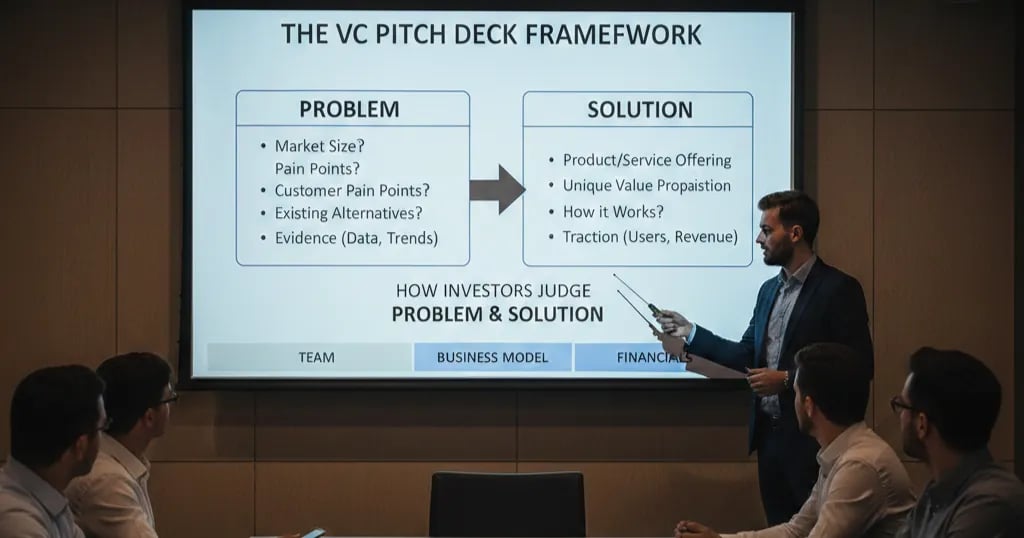
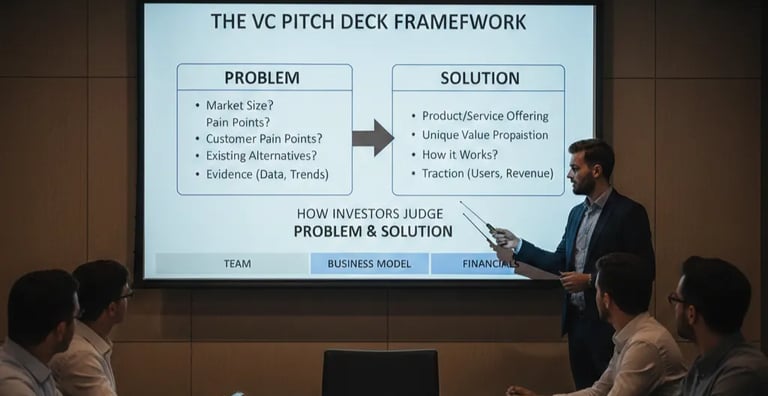
The VC Pitch Deck Framework: How Investors Actually Judge Your Problem & Solution Slides
Most founders think a stronger solution makes their pitch more fundable. It does the opposite — if the Problem Slide that precedes it has not already done its job. The solution is irrelevant until the investor has felt the weight of the problem. VCs do not evaluate your deck as a product brochure; they run it through a specific judgment framework that scores your Problem and Solution Slides against a set of internal criteria most founders have never seen. This framework is the analytical backbone behind VC-graded examples of Problem and Solution Slides showing exactly what passes and what gets archived. Understanding how that judgment works — mechanically, not theoretically — is what this post covers.
The Internal Scoring Framework VCs Use to Judge Problem & Solution Slides Before You Leave the Room
VCs do not read pitch decks the way founders write them. Founders write sequentially — building toward a reveal. Investors read diagnostically — scanning for the presence or absence of specific signals in a specific order. When a partner or analyst opens your deck, they are running an unconscious checklist before they have consciously decided to engage with your narrative.
That checklist has four gates, and they are applied to your Problem Slide first, your Solution Slide second. If your Problem Slide fails gate one, the Solution Slide is never seriously evaluated. This is not a figure of speech. In a deck reviewed last quarter, a Series A-stage B2B founder had built one of the most technically elegant Solution Slides I had seen — the VC firm passed at screening because the Problem Slide failed to establish market urgency, and no one reached the solution. The clinical term for this is premature closure: the investor's mental model shuts before the evidence is presented.
The psychological mechanism is simple. A VC sees hundreds of decks per quarter. Their cognitive economy demands rapid triage. The moment a Problem Slide reads as generic, unvalidated, or disconnected from a specific buyer in pain, the investor's posture shifts from evaluating to looking for a reason to exit cleanly. Every slide after that point is read through a skeptical lens, not an open one.
As of early 2026, top-tier US and UK funds at the Series A stage are reporting average first-pass screening times of under four minutes per deck — down from approximately seven minutes during the 2021–2022 vintage cycle. Your Problem and Solution Slides are doing more work in less time than at any previous point in the fundraising cycle.
The Four-Gate VC Judgment Framework: What Each Gate Tests and What Failure Costs You
This is the internal logic VCs apply, reconstructed from pattern analysis across funded and rejected decks. Map your own slides against each gate before your next send.
Gate 1 - Problem Existence: Is This Real and Is It Costing Someone Money?
The investor is not asking whether the problem is large. They are asking whether it is provably real and whether it has an attached dollar cost that makes solving it commercially rational.
What passes: Specific customer archetype + quantified cost + evidence of validation (interviews, pilots, churn data from existing solutions).
What fails: Category-level pain statements with no ownership. "Companies struggle to retain talent" fails Gate 1. "Head of People at Series B SaaS companies with 80–200 employees spends 11 hours per week on manual onboarding coordination — a workflow that costs approximately $2,600/month in loaded HR labor and contributes to a 34% first-90-day attrition rate in their engineer cohort" passes Gate 1.
Cost of failure: The deck is mentally downgraded to "interesting but early." The VC continues reading, but their valuation anchor has already compressed.
Gate 2 - Problem Urgency: Why Is This Being Solved Now?
A real problem that has existed for fifteen years without a dominant solution requires an explanation. The VC wants to know what has changed — technically, regulatorily, or behaviourally — that makes right now the correct moment to build this company.
What passes: A specific triggering condition. New API infrastructure, a regulatory deadline, a workforce shift, a cost curve crossing a threshold.
What fails: The implicit assumption that the problem's existence justifies the timing. Existence is not urgency.
Cost of failure: The investor asks "why now?" in the meeting. If you do not have a crisp answer on the slide, you are spending credibility to recover ground you should have already held.
Gate 3 - Solution Fit: Does the Solution Address the Specific Problem Described?
This gate is where stage-mismatched and mistargeted decks collapse entirely. The VC draws a straight line from the problem defined in Gate 1 to the solution presented here. If the line bends — if the solution addresses a slightly different customer, a slightly different pain point, or operates at a different level of the stack than the problem implies — the investor flags a strategic inconsistency.
What passes: A solution that solves the exact cost or friction identified in the Problem Slide, for the exact buyer described, using a mechanism that could not have existed before the "why now" trigger in Gate 2.
What fails: A solution that is technically impressive but solves a broader or different version of the stated problem. This signals that the founder has a technology looking for a problem, not a problem demanding a solution.
Gate 4 - Defensibility Signal: Can This Company Own This Problem?
The final gate is not about moat in the traditional sense. At Problem and Solution Slide level, it is a simpler question: does this team have earned insight into this problem that a well-funded competitor could not quickly replicate?
What passes: Founder proximity to the problem (prior operator experience, proprietary data access, existing relationships with the target customer). Even at pre-seed, this signal must be visible.
What fails: A slide that could have been written by anyone who spent three hours reading industry reports. Generic problems + generic solutions + no stated right to win = Gate 4 failure.
Building Problem & Solution Slides That Pass All Four Gates: The Before and After
The Framework Equation
Before writing a single word of your Problem or Solution Slide, apply this:
Fundable Problem Slide = [Named Buyer in Pain] + [Quantified Cost] + [Validated Evidence] + [Timing Trigger]
Fundable Solution Slide = [Mechanism That Removes the Specific Cost] + [Proof It Works for This Buyer] + [Why You Own This Solution]
If either equation has an empty variable, the slide is not ready.
Weak Version - Problem Slide
"Supply chain inefficiencies cost businesses billions annually. Existing tools are fragmented and difficult to integrate."
This fails Gates 1, 2, and 4 simultaneously. There is no named buyer, no specific cost, no timing trigger, and no defensibility signal.
VC-Ready Version - Problem Slide
"Procurement managers at US-based contract manufacturers with 200–800 employees lose an average of 22 hours per month resolving supplier invoice discrepancies across disconnected ERP and email workflows — a reconciliation cost of approximately $4,100/month per manager. Post-2024 supply chain volatility has increased average discrepancy volume by 40%, making manual resolution operationally unsustainable at current growth rates."
This passes all four gates: named buyer, quantified cost, validated mechanism, and a specific timing trigger tied to a real market condition.
Weak Version - Solution Slide
"Our AI-powered platform streamlines supply chain operations through intelligent automation and real-time visibility."
This could describe forty companies. It answers none of the four gate questions. It is a product description, not a solution proof.
VC-Ready Version - Solution Slide
"We sit inside the existing ERP workflow — no rip-and-replace — and auto-reconcile supplier invoices against purchase orders in under 90 seconds. Across our 18 live customers, average monthly discrepancy resolution time dropped from 22 hours to 1.4 hours. Net revenue retention at six months is 114%."
Mechanism, proof, specificity, and a retention signal that implies the solution is working. That is a slide a VC analyst can build a model from.
Three Framework Application Mistakes That Undermine VC-Ready Problem & Solution Slides
1. Passing Gates 1 and 2 on the Problem Slide but reverting to generic language on the Solution Slide. The specificity must be consistent across both slides. A precise problem paired with a vague solution signals a product that is still underdeveloped — or a founder who does not yet understand what they have built.
2. Using retention data without context. 114% NRR means nothing if the cohort is three customers over sixty days. State the cohort size and the time window. Without those qualifiers, the metric invites scrutiny rather than confidence.
3. Confusing the "why now" trigger with a market size claim. "The market is growing at 18% CAGR" is not a timing trigger. A timing trigger is a specific structural change — regulatory, technological, or behavioral — that makes this solution viable today when it was not viable two years ago.
The Four-Gate Framework Is the Difference Between a Pass and a Partner Meeting
A deck that clears all four gates on its Problem and Solution Slides does not just get a second meeting — it reframes the entire investor conversation from "should we consider this" to "how do we get involved." That shift is worth more than any design upgrade, any financial model polish, or any team credential you can add to the deck. The complete system for building Problem and Solution Slides that pass institutional-grade scrutiny is inside the Problem and Solution Slide framework built for founders raising from pre-seed through Series A in the US, UK, and Canada.
You can reverse-engineer this four-gate framework manually across 40 hours of iteration and ten rejected drafts, or you can use the Slide-By-Slide VC Instruction Guide inside the $5K Consultant Replacement Kit to build slides that clear every gate in a single session. The Guide maps exactly what evidence is required at each gate, for each funding stage, before you submit a single deck. The full Kit is $497. Access the VC instruction system that builds fundable Problem and Solution Slides from the first draft.
Funding Blueprint
© 2026 Funding Blueprint. All Rights Reserved.