
Problem-Solution Fit: How to Avoid the #1 Pitch Deck Disconnect
Is your Solution slide answering the wrong Problem? Discover the "Adjacent Fit" trap that kills Series A deals and how to build a Causal Lock instead.
2.4 CONNECTING PROBLEM → SOLUTION LIKE A VC (NARRATIVE LOGIC MODEL)
2/20/20266 min read
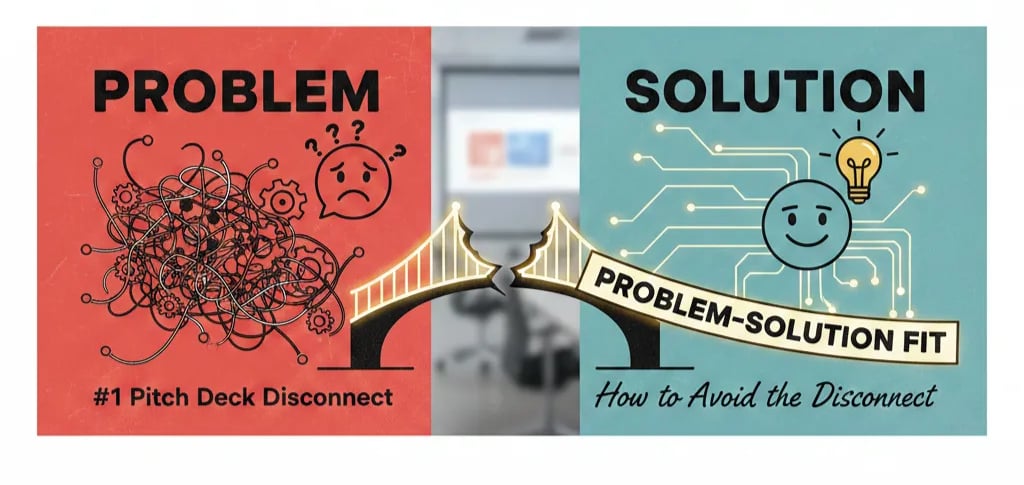
Problem-Solution Fit: How to Avoid the #1 Pitch Deck Disconnect
You will not get a second meeting. And the slide that closed that door was not your financials, your team slide, or your market size. It was the six-word gap between what your Problem slide promised and what your Solution slide delivered — a gap so structurally common that most founders never see it until a VC passes without explanation.
This post sits inside the broader framework of connecting your Problem and Solution slides the way a VC analyst actually evaluates them — the narrative logic layer that determines whether your pitch is read as a business thesis or a product brochure. If you are raising at pre-revenue to $2M ARR, this is the layer that carries the weight your traction metrics cannot yet carry.
How Problem-Solution Fit Failure Reads From the Other Side of the Table
The disconnect does not look like an obvious mistake. That is precisely why it is lethal. It looks like a professional deck with two reasonable slides that happen to be arguing for two different companies.
The Problem slide builds a case around a market-level condition: regulatory burden, fragmented vendor ecosystems, enterprise software debt. The Solution slide then describes a product: a dashboard, an API layer, a workflow automation tool. The VC closes the deck not because they dislike the product, but because the product was never proven to be the answer to the stated problem. The problem described a structural market failure. The solution described a feature. Those are not the same argument.
What the VC thinks, in sequence: Is this a real problem? Probably. Does this product solve it? Unclear. Do I want to spend two hours in due diligence on "unclear"? No.
The last four founders who brought this exact structure to a partner meeting at the fund level were all sent back to resubmit — three of them never returned with a revised deck.
The psychological origin is almost always the same: the founder built conviction around the product, then selected a problem that felt adjacent enough to justify it. The problem was chosen to support the solution rather than demand it. A VC who has seen 400 decks this year identifies that inversion in under 90 seconds. The tell is a Solution slide that could plausibly answer three or four different Problem slides. If your solution is that flexible in framing, it is not solving a specific enough problem to be a venture-scale investment thesis.
The Fit Scoring Model: Why "Adjacent" Is Not the Same as "Causal"
A VC is not evaluating whether your solution is related to your problem. They are evaluating whether your solution is caused by your problem — whether the problem, if left unsolved, makes your solution inevitable.
Here is the distinction mapped into a concrete scoring rubric:
Fit Type & Problem-to-Solution Relationship
Causal Fit
Relationship: The problem's root mechanism directly requires the solution's core function
VC Read: "This product has no logical substitute"
Outcome: High conviction, advances to DD
Adjacent Fit
Relationship: The solution improves a condition related to the problem
VC Read: "This is a nice-to-have in a painful space"
Outcome: Polite pass or perpetual "follow-up"
Parallel Fit
Relationship: The solution addresses a symptom of the problem, not the root cause
VC Read: "This is a feature, not a company"
Outcome: Hard pass
As of early 2026, US Series A funds in the $100M–$250M vintage range are running pre-screen filters that specifically flag Adjacent Fit decks at the analyst level — meaning they do not reach a partner. Post-SVB capital discipline has compressed partner time to roughly 18 minutes per initial deck review; analysts are now the first logic gate, not a formality. A deck that cannot demonstrate Causal Fit in the first eight slides is filtered before it reaches a decision-maker.
The cognitive arithmetic is this: every degree of separation between your Problem's root cause and your Solution's core mechanism costs you approximately one tier of investor quality. Causal Fit reaches top-tier funds. Adjacent Fit reaches mid-tier. Parallel Fit reaches angels who do not lead rounds.
The framework that closes this gap is not rhetorical — it is structural:
Fit Equation: Problem Root Cause = Solution's Primary Function (not secondary benefit)
If your Solution's primary function addresses a secondary symptom of your stated problem, you have Adjacent or Parallel Fit. Reframe one or both slides before you send another deck.
The Problem-Solution Fit Rewrite Protocol: From Disconnect to Causal Lock
This is the four-step sequence to diagnose and rebuild the fit between your two most important slides.
Step 1 — Isolate the Root Cause in One Clause Strip your Problem slide down to a single causal clause. Not the market condition. Not the pain point. The mechanism that generates the pain. Format: "[Specific actor] cannot [specific outcome] because [specific structural reason]."
Weak: "Mid-market CFOs struggle with cash flow visibility." VC-Ready: "Mid-market CFOs cannot forecast 90-day cash positions accurately because ERP export latency creates a 7–14 day data lag across multi-entity structures."
The root cause is now named: ERP export latency creating multi-entity data lag. Everything in your Solution slide must now address that mechanism directly.
Step 2 — Write Your Solution's Primary Function as a Direct Response Your Solution slide's opening line should function as a direct answer to the root cause clause from Step 1. Format: "[Product] eliminates [root cause mechanism] by [specific technical or operational action]."
Weak: "Our platform gives CFOs real-time financial visibility." VC-Ready: "Our consolidation engine syncs ERP data across entities in under 2 hours, eliminating the lag that makes 90-day cash forecasting structurally unreliable."
The fit is now causal. The product is not related to the problem — it is the logical solution to the named mechanism.
Step 3 — Run the "Substitute Test" Ask: Could a founder with a different product use my Problem slide without changing a word? If yes, your problem is framed at the symptom level, not the root cause level. Rewrite it until a competitor's product would require a different problem frame. Specificity at the problem layer creates a defensible moat before you even discuss your technology.
Step 4 — Anchor the Fit in a Customer Validation Signal A Causal Fit claim without external validation is still a hypothesis. Close the logic loop with one customer data point that confirms the mechanism match, not just product satisfaction. Format: "Customers using [product] recover [specific outcome] because [root cause mechanism] is eliminated at source — validated across [N] paying accounts with median [metric]."
The governing framework: Root Cause Clause → Direct Response Function → Substitute Test → Validated Outcome. All four must hold simultaneously for the fit to read as investable.
Four Problem-Solution Fit Traps That Emerge During Revision
Trap 1 — Rewriting the Solution without touching the Problem. The solution becomes precise and mechanism-specific, but the problem stays at market-condition level. The fit gap shifts rather than closes. Both slides must be revised in the same session, against the same root cause clause.
Trap 2 — Confusing customer pain with root cause. Pain is what the customer feels. Root cause is the structural reason they feel it. Decks built around pain statements produce Adjacent Fit at best. Decks built around root cause mechanisms produce Causal Fit.
Trap 3 — Over-engineering the fit language into jargon. Founders who fix this correctly sometimes overcorrect into technical specificity that loses a non-technical partner. The root cause clause must be precise and legible to a generalist with sector knowledge — not a domain expert.
Trap 4 — Using a single customer anecdote as the validation signal. One customer quote is a testimonial. It is not a validation pattern. In a 2025–2026 fundraising environment where top-tier funds are requiring evidence of repeatable demand before Series A, a single data point confirms you solved one person's problem. Three to five validated accounts with consistent outcome metrics confirm you solved a structural problem.
The Valuation Impact of Closing the Problem-Solution Fit Gap
A pitch deck that demonstrates Causal Fit is not just more persuasive — it is structurally worth more. The narrative moves from "interesting product in a large market" to "inevitable solution to a specific structural failure." That shift is the difference between a pre-money conversation that starts at $12M and one that starts at $22M — which is the lower bound of the current 2025 US Series A median range for B2B software with demonstrable fit.
Problem-Solution Fit is not a storytelling exercise. It is a pre-money variable.
For the complete architecture covering every dimension of how your Problem and Solution slides must be constructed to survive Series A scrutiny, the full system is mapped in the Problem and Solution slide framework for investor-ready pitch decks.
Every week your deck carries a fit gap, you are entering meetings where the VC's internal answer is already "probably not" before your Solution slide loads. The 16 VC-Quality AI Prompts inside the $5K Consultant Replacement Kit are built specifically to diagnose and rewrite the Problem-to-Solution fit sequence — giving you the exact prompt sequence to test your root cause clause, validate your mechanism match, and produce a slide pair that reads as Causal Fit from the first review. The full Kit is $497. Close your Problem-Solution fit gap before your next investor meeting.
Funding Blueprint
© 2026 Funding Blueprint. All Rights Reserved.