
Pitch Deck Narrative Flow: Why VCs Demand Problem-Solution Congruence
Are your Problem and Solution slides two separate arguments? Stop forcing VCs to reconstruct your logic. Master narrative congruence to win the room.
2.4 CONNECTING PROBLEM → SOLUTION LIKE A VC (NARRATIVE LOGIC MODEL)
2/20/20268 min read
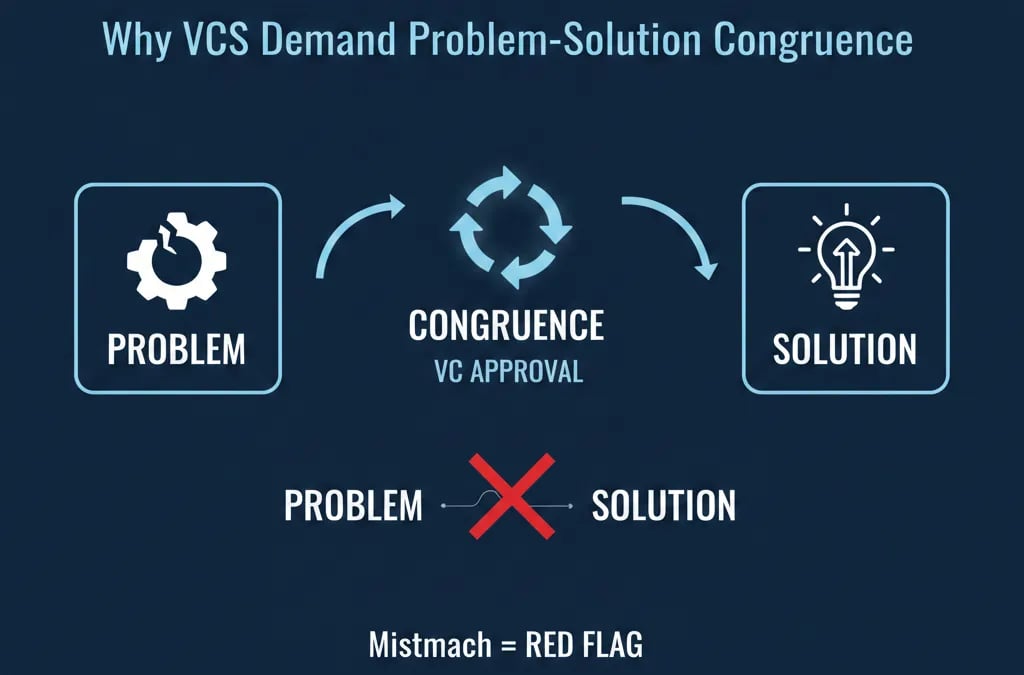
Pitch Deck Narrative Flow: Why VCs Demand Problem-Solution Congruence
$340K in annual revenue, a 94% gross margin, and a co-founder with a prior exit — and the deck still did not generate a second meeting at three of the top five funds it reached. The post-mortem was not about the numbers. It was about the experience of reading the deck: a VC partner described it, in direct feedback, as "two separate arguments that happen to share a slide deck." The Problem was making a case for market intervention. The Solution was making a case for a product. Neither was making a case for the same company.
That is a narrative congruence failure — and it is the structural flaw that kills more credible Series A pitches than weak traction, incomplete teams, or aggressive valuations combined.
This post is part of the VC Narrative Logic Model for connecting Problem and Solution slides — the framework that determines whether a VC experiences your pitch as a single coherent argument or as two slides that are merely adjacent to each other.
Why Narrative Congruence Is Not a Storytelling Skill — It Is a Due Diligence Signal
The term "narrative flow" sounds like presentation coaching. It is not. At the Series A level, narrative congruence between your Problem and Solution slides is a diligence signal that a VC's pattern-matching engine processes before they consciously evaluate any individual claim you make.
Here is the mechanism: an experienced investor has reviewed enough pitches that they have internalised a structural expectation for how a fundable thesis reads. Problem establishes a specific market failure with verifiable cost. Solution eliminates that specific failure through a defined mechanism. The logical thread between them is unbroken. When that expectation is met, the VC's cognitive processing shifts into evaluation mode — they begin assessing the quality of your claims. When that expectation is violated — when the narrative thread breaks — the VC's processing shifts into reconstruction mode. They are no longer evaluating your business. They are trying to reassemble your argument. And reconstruction mode is where conviction dies.
Congruence failure is not perceived as a presentation problem. It is perceived as a founder problem. The implicit read is that a founder who cannot construct a logically coherent two-slide argument either does not fully understand their own business model, has not achieved genuine product-market fit, or is papering over a thesis gap with production quality. None of those reads lead to a term sheet.
I have seen this pattern appear in nine decks this year from founders with legitimate operating metrics — in four of those cases, the fund's internal pass note cited "unclear strategic coherence" rather than any specific metric failure, meaning the numbers never received serious scrutiny because the narrative disqualified the deck first.
The psychological origin of congruence failure is almost always sequential construction: founders build their Problem slide, then build their Solution slide, then move on to market size. The two slides are written in different sessions, often by different contributors, with no explicit test applied to whether the logical thread between them is intact. By the time the deck reaches a VC, the founder has read it so many times that the thread feels obvious. It is not obvious. It was never written.
The Congruence Scoring Model: Four Dimensions a VC Processes Simultaneously
Narrative congruence is not a single variable. It is a composite of four distinct logical dimensions that a VC's pattern recognition processes in parallel during the first pass through your deck. Failure on any single dimension breaks the overall congruence read.
Here is how each dimension is scored and what failure looks like in practice:
Causal Alignment
What the VC Is Testing: Does the Solution mechanistically address the root cause named in the Problem?
Failure Signal: Solution addresses a symptom; Problem named a mechanism.
Pass Signal: Solution function directly eliminates the Problem's stated root cause.
Scope Symmetry
What the VC Is Testing: Is the scale of the Solution proportional to the scale of the Problem?
Failure Signal: Problem is enterprise-wide; Solution is a workflow feature.
Pass Signal: Solution addresses the full scope of the Problem's stated impact.
Stakeholder Consistency
What the VC Is Testing: Is the same actor suffering the Problem the actor your Solution serves?
Failure Signal: Problem cites CFO pain; Solution sells to IT procurement.
Pass Signal: The same buyer experiencing the Problem is the primary buyer of the Solution.
Outcome Continuity
What the VC Is Testing: Does the Solution's stated outcome directly reverse the Problem's stated consequence?
Failure Signal: Problem measures lost revenue; Solution measures time saved.
Pass Signal: Solution outcome is denominated in the same unit as the Problem's cost.
The fourth dimension — Outcome Continuity — is the most frequently broken and the least frequently discussed. It is the dimension that produced the "$340K ARR, four passes" case that opened this post. The Problem slide measured customer revenue loss in dollar terms. The Solution slide measured operational efficiency in time terms. The VC's brain encountered a unit mismatch at the conclusion of the argument and registered an incoherence flag. A deck that frames the problem in dollars and the solution in hours is not making a congruent argument. It is making two arguments with no shared conclusion.
As of 2025, analyst pre-screening frameworks at several top-tier US funds running $150M–$400M vintage vehicles have formalised this type of congruence scoring into structured pre-screen rubrics — meaning narrative congruence is now evaluated against an explicit checklist before a partner sees the deck. Founders who fail the congruence rubric at the analyst layer do not receive partner feedback explaining why. They receive a form decline. The gap never gets named.
The Congruence Construction Protocol: Building a Narrative Thread That Holds Across Both Slides
The fix is applied in three stages. Each stage operates on a specific congruence dimension and produces a testable output before the next stage begins.
Stage 1 — The Unit Standardisation Pass (Outcome Continuity)
Before revising any slide copy, audit every metric on both your Problem and Solution slides. Every quantitative claim must be denominated in the same unit category. If your Problem is measured in dollars lost, your Solution outcome must be measured in dollars recovered. If your Problem is measured in time wasted, your Solution outcome must be measured in time saved or time-to-value.
Map your current metrics into this table before touching slide software:
Problem slide primary metric: ____ [unit] Solution slide primary outcome: ____ [unit] Are they the same unit category? Yes / No
If the answer is No, you have an Outcome Continuity failure. Do not proceed to Stage 2 until the unit is standardised.
This is a ten-minute audit that the majority of founders have never conducted. It is also the single fastest way to identify a congruence failure before a VC does.
Stage 2 — The Stakeholder Consistency Check
Read your Problem slide and write down, explicitly, the job title of the person experiencing the pain. Then read your Solution slide and write down the job title of the person who would initiate a buying decision for your product. If they are different people, your narrative has a stakeholder congruence gap.
This gap is more common than it appears because founders often identify pain at one level of an organisation (the operator level) and sell at a different level (the executive level) without explicitly bridging the two in their narrative. A VC reading that gap does not see a sophisticated GTM strategy — they see a founder who has not decided who their customer is.
The fix is not to change your GTM. It is to make the stakeholder relationship explicit on the Problem slide:
Weak: "Operations teams waste 18 hours per week on manual compliance reporting." VC-Ready: "Operations teams waste 18 hours per week on manual compliance reporting — a cost that surfaces in the CFO's P&L as $2,200 per week in unbudgeted overtime, and in the CEO's board pack as a persistent audit risk line item."
The same problem is described. But now it lands on the desk of every stakeholder involved in your buying process, creating a coherent chain from operational pain to executive buying authority.
Stage 3 — The Congruence Thread Test
With both slides revised through Stages 1 and 2, apply the Congruence Thread Test as a final quality gate. Write out the following four sentences using only content that already exists in your revised slides:
"The specific problem is: [root cause mechanism from Problem slide]."
"The cost of this problem to [named stakeholder] is: [dollar-denominated figure from Problem slide]."
"Our solution eliminates this problem by: [primary function from Solution slide]."
"The outcome for [named stakeholder] is: [dollar-denominated result from Solution slide, in same unit as sentence 2]."
If you cannot complete all four sentences using existing slide content — without adding new claims — your narrative thread is incomplete. The missing sentence identifies the exact congruence gap to fix.
Before vs. After — Full Congruence Test Applied:
Weak version (congruence failures present): Problem: "Mid-market HR teams spend excessive time managing multi-state payroll compliance. Non-compliance fines are increasing across the US." Solution: "Our platform automates payroll compliance workflows, reducing processing time by 60% and eliminating manual errors."
Congruence failures: Unit mismatch (fines vs. time saved), Outcome Continuity broken, Stakeholder ambiguous.
VC-Ready version (congruence intact): Problem: "Mid-market HR teams in multi-state operations absorb an average of $94K annually in non-compliance penalties and remediation costs — driven by manual payroll processes that cannot track real-time regulatory changes across state jurisdictions simultaneously." Solution: "Our compliance engine monitors real-time regulatory changes across all active state jurisdictions and automatically updates payroll rules at point of processing — eliminating the $94K annual penalty exposure at its structural source."
Congruence thread: Same stakeholder (HR/finance), same unit (dollars), same mechanism (regulatory tracking failure), same outcome frame (penalty elimination). All four dimensions hold.
The governing equation:
Same Unit + Same Stakeholder + Mechanism Match + Outcome Continuity = Narrative Congruence
All four variables must be satisfied simultaneously. Satisfying three is not a pass. A VC's pattern recognition does not award partial credit.
Three Congruence Fixes That Introduce New Failures
Trap 1 — Standardising units by inflating the Solution outcome. Founders who identify a unit mismatch sometimes respond by adding a dollar figure to the Solution slide without grounding it in customer data. A fabricated or extrapolated dollar outcome on the Solution slide is worse than a unit mismatch — it is a claim a VC's analyst will attempt to verify and cannot. Use only dollar figures you can defend with customer data or third-party research.
Trap 2 — Forcing stakeholder consistency by narrowing the Problem scope. Some founders resolve a stakeholder gap by rewriting the Problem slide to match only the executive buyer, removing the operational pain layer entirely. This produces stakeholder consistency but destroys the evidence architecture that makes the problem feel real and urgent. The correct fix is to expand the Problem framing upward through the organisation, not to narrow it.
Trap 3 — Treating congruence as a one-time fix. Narrative congruence breaks every time a slide is updated in isolation. Founders who fix their Problem-Solution congruence in one session and then revise their Solution slide two weeks later based on customer feedback — without returning to test the congruence thread — will present a broken narrative without realising the break has occurred. Build the four-sentence Congruence Thread Test into every deck revision cycle, not just the initial build.
The Compounding Cost of a Congruence Failure Across a Full Fundraise Process
A single congruence failure does not cost you a single meeting. It costs you the compounding return on every meeting it prevents across your entire raise cycle. At a typical Series A process involving 40–60 initial outreaches, a 15–20% first-meeting conversion rate, and a 3–4 month timeline, a narrative congruence failure that suppresses first-meeting conversion by even five percentage points represents two to three fewer partner-level meetings across the raise. At current 2025 US Series A pre-money medians of $22M–$28M, each partner meeting that does not happen is a competitive offer that does not arrive — and competitive offers are the primary mechanism through which founders negotiate above the median.
Congruence is not a narrative virtue. It is a negotiating lever.
The complete system for constructing every layer of your Problem and Solution slides — including unit standardisation, stakeholder mapping, the bridge protocol, and urgency framing — is covered in full in the Problem and Solution slide framework built for Series A fundraising.
Founders who have used the 16 VC-Quality AI Prompts inside the $5K Consultant Replacement Kit go into partner meetings with a Problem-to-Solution narrative that has already been stress-tested against each of the four congruence dimensions — unit alignment, stakeholder consistency, mechanism match, and outcome continuity — before the deck leaves their hands. That is not a presentation advantage. It is a structural advantage that shows up in meeting conversion rates and opening valuation anchors. The full Kit is $497. Test your pitch deck's narrative congruence before a VC analyst does it for you.
Funding Blueprint
© 2026 Funding Blueprint. All Rights Reserved.