
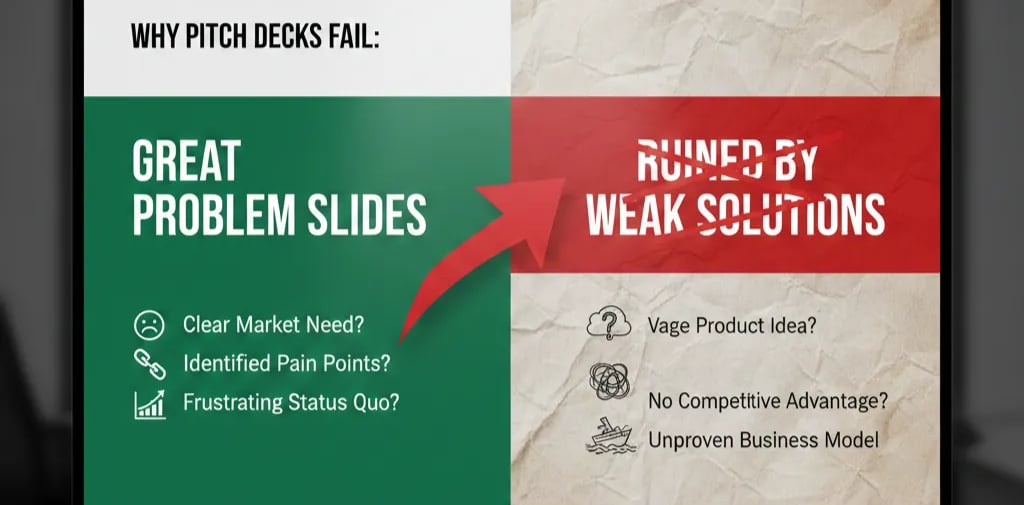
Why Pitch Decks Fail: Great Problem Slides Ruined by Weak Solutions
Did your great Problem slide just ruin your pitch? Learn why an asymmetric Solution slide is a Series A red flag and how to fix your credibility gap now.
2.4 CONNECTING PROBLEM → SOLUTION LIKE A VC (NARRATIVE LOGIC MODEL)
2/21/20266 min read
Why Pitch Decks Fail: Great Problem Slides Ruined by Weak Solutions
A Series A SaaS founder in Austin raised $1.8M in seed, built a product with genuine enterprise traction, and walked into a partner meeting with a Problem Slide that stopped the room. Thirty seconds later, the Solution Slide ended the conversation.
The VC's exact words, relayed through the intro: "The problem framing was the best we'd seen in that category this quarter. The solution didn't belong in the same deck." The round did not close. The founder spent four months rebuilding before getting a second look from a different fund — at a lower valuation anchor than the original ask. That outcome is not bad luck. It is a structural failure with a specific cause, and it is covered in detail within the VC narrative logic model for connecting Problem to Solution with investor-grade precision. The cause is almost always the same: founders treat the Problem and Solution Slides as separate creative tasks instead of a single logical unit.
The Asymmetric Slide Problem: Why a Strong Problem Slide Makes a Weak Solution Slide Worse
This failure pattern is more damaging than a uniformly weak deck — and that is not intuitive, so it is worth explaining precisely. When a VC sees a weak Problem Slide, they discount the entire deck early and their expectations reset accordingly. When they see a strong Problem Slide, their analytical threshold rises. They are now invested in the argument. They have accepted the pain as real, the market as material, and the founder as credible. Then the Solution Slide arrives and fails to match the standard the Problem Slide set — and the contrast is brutal.
A weak solution after a strong problem does not read as a gap. It reads as a red flag. The VC's revised interpretation is not "this founder needs to refine their product story" — it is "this founder understands the problem but does not have a credible answer to it." That is a fundamentally different signal than a uniformly underdeveloped deck, and it raises a harder question: if they know the problem this well, why is the solution this vague?
In a deck reviewed earlier this year, a climate-tech founder had built one of the most precise Problem Slides seen in that vertical — quantified emissions gap, clear policy failure mechanism, specific enterprise buyer pain — and then presented a Solution Slide that described their product as "an AI-powered platform that helps organisations manage their sustainability obligations more effectively." The VC passed within twenty-four hours. The Problem Slide had set a bar the Solution Slide couldn't clear.
The psychological cause is almost always a split in the founding team's confidence. Founders who have spent months in customer discovery become expert at articulating the problem — they have heard it in dozens of interviews and refined the language accordingly. The solution, by contrast, is still evolving. So they describe it in hedged, general terms to avoid over-committing. That epistemic caution is reasonable in a product development context. In a pitch deck, it reads as unreadiness.
The Credibility Gap Equation: Measuring the Distance Between Your Problem and Solution Slides
As of Q1 2026, leading US Series A funds with dedicated platform teams are scoring decks on what some analysts are calling "slide coherence" — an informal metric that measures whether the solution's specificity matches the problem's specificity. Decks that score poorly on this metric are being returned with consistent feedback: "strong problem identification, unclear product-market fit rationale." That phrasing is diplomatic. What it means is: your Solution Slide is not answering the question your Problem Slide raised.
Here is how to measure your own coherence gap:
The Specificity Parity Test
Problem Slide
Specificity Indicator: Must contain a named user role, a quantified cost, and a described process failure.
Acceptable Standard: All three indicators must be present.
Solution Slide
Specificity Indicator: Must contain a named mechanism, a quantified outcome, and a direct reference to the process failure.
Acceptable Standard: All three indicators must be present and must match the variables established in the Problem Slide.
Coherence Score
Specificity Indicator: $\text{Number of matched variables} \div 3$
Acceptable Standard: The score must be 1.0 to pass.
Run this against your own deck. If your Problem Slide names "VP of Operations at mid-market manufacturers" as the user and quantifies "23% production downtime attributable to manual scheduling errors," your Solution Slide must name the same user, reference "scheduling," and attach a specific outcome metric. If it instead describes your product's architecture in general terms, your coherence score is below 1.0 — and the VC's confidence in your go-to-market drops proportionally.
The credibility gap formula: Perceived Product-Market Fit = (Solution Specificity) ÷ (Problem Specificity). When this ratio falls below 1.0, the VC's internal risk rating for the deal increases. When it exceeds 1.0 — when your Solution Slide is more specific than your Problem Slide — you have built forward momentum into the deck structure itself.
The Parity Protocol: How to Rebuild a Weak Solution Slide to Match a Strong Problem Slide
Do not touch the Problem Slide. It is working. The task is to bring the Solution Slide up to the standard the Problem Slide has already established.
Step 1: Extract the Three Variables from Your Problem Slide. Identify the specific user role, the quantified cost or failure metric, and the named process step where the failure occurs. Write these three variables on a separate document before opening the Solution Slide. These are your matching requirements — every element of your Solution Slide must map back to at least one of them.
Step 2: Rewrite the Solution Headline as a Direct Answer. Your Solution Slide headline is not a product tagline. It is a response to the specific claim your Problem Slide made. If your Problem Slide headline reads: "Operations managers at logistics firms lose $420K annually to manual route recalculation after driver dropouts" — your Solution Slide headline must read like a direct resolution: "We eliminate manual recalculation at the point of dropout — automated rerouting in 90 seconds, recovering an average of $380K annually across current customers."
Weak Version: "Our intelligent logistics platform uses AI to optimise last-mile delivery operations for enterprise fleets."
VC-Ready Version: "When a driver drops out mid-route, our system recalculates and reassigns in 90 seconds — without dispatcher intervention. Current fleet customers report $380K in annual recovery on routes previously lost to manual delay."
The second version uses the same variables the Problem Slide introduced. The VC's brain completes the match. The logical chain closes.
Step 3: Match the Visual Register. If your Problem Slide used a process diagram, your Solution Slide must return to the same diagram — resolved. If your Problem Slide used a data visualisation, your Solution Slide must show the same metric after your product's intervention. Visual continuity is logical continuity. Breaking the visual register between the two slides breaks the argument even if the language is correct.
Step 4: Apply the "Same Sentence" Test. Write one sentence that contains both the problem and the solution. If you cannot write a coherent sentence that connects them — where the solution is the grammatical consequence of the problem — the slides are still misaligned. "Because operations managers lose $420K to manual rerouting, we automated that single step and recover $380K of it" is a sentence that connects. "Operations managers face logistics challenges, and our platform improves efficiency" is not.
The equation: Matched Variables (User + Metric + Process Step) + Visual Continuity + Direct Response Headline = Parity.
How Founders Damage Good Problem Slides While Trying to Fix the Solution
1. Weakening the Problem Slide to match the Solution Slide. This happens more often than it should. Founders feel the gap, conclude the Problem Slide is "too specific," and dilute it. This is the wrong direction. The Problem Slide is the asset. Bring the Solution up; never bring the Problem down.
2. Adding social proof to the Solution Slide as a substitute for specificity. Dropping in a customer logo or a quote does not resolve a specificity gap — it papers over it. A VC reviewing a vague solution with three enterprise logos does not conclude the product works; they conclude the founder is hoping the logos do the work the argument should be doing.
3. Over-correcting into technical detail. Founders who recognise their Solution Slide is weak sometimes respond by adding product architecture, integration diagrams, or technical specifications. This resolves the wrong problem. The issue is not depth — it is specificity on the outcomes your product produces for the user the Problem Slide named. More technical detail without outcome specificity makes the gap wider, not narrower.
What Slide Parity Is Worth in a Live Partner Meeting
A deck with matched Problem-Solution specificity changes the opening question in the partner meeting from "How does your product actually solve this?" to "What does the expansion motion look like after initial deployment?" That transition — from justification to commercial discussion — is where term sheet momentum is built. Founders who close the parity gap spend partner meeting time on market size and defensibility, not on re-explaining their own product. In a fundraising environment where the median US Series A pre-money sits at $22M–$28M and top-tier funds are averaging 90-plus days from first deck to term sheet, compressing that justification phase has a direct impact on the valuation conversation you get to have.
The full system for engineering parity across every layer of your Problem and Solution Slides is in the Problem and Solution Slides framework for founders raising Series A.
Founders who have used the Slide-By-Slide VC Instruction Guide inside the $5K Consultant Replacement Kit go into partner meetings with a Solution Slide that already mirrors the specificity standard their Problem Slide set — built against the exact coherence criteria VC analysts are checking in current vintage decks. That is not a marginal improvement. It is the difference between a justification meeting and a terms meeting. The full Kit is $497. Access it at the Series A pitch deck system built to close the problem-solution parity gap.
Funding Blueprint
© 2026 Funding Blueprint. All Rights Reserved.