
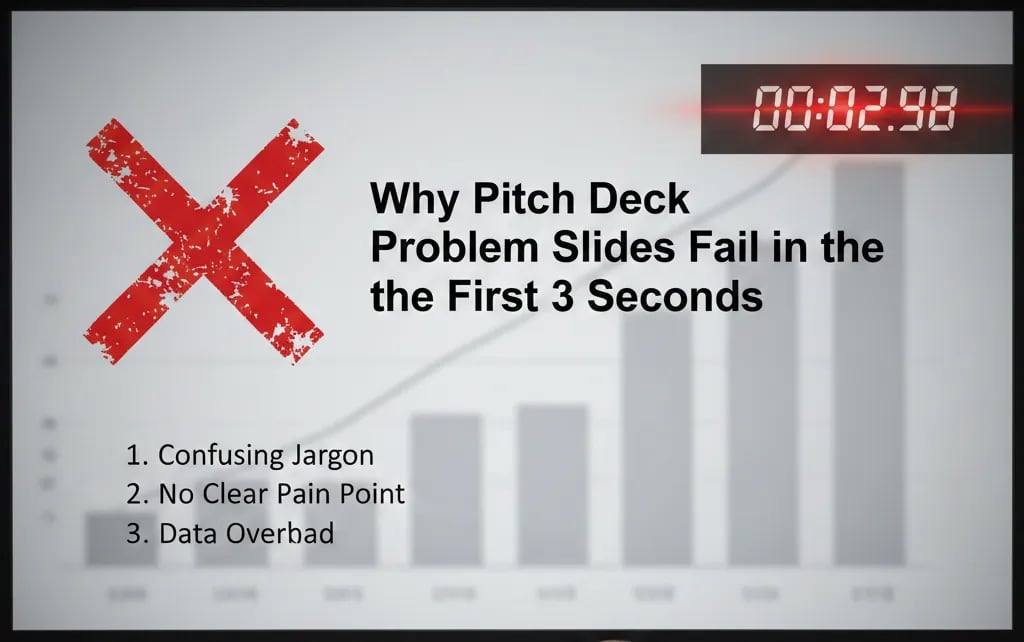
Why Pitch Deck Problem Slides Fail in the First 3 Seconds
93% of Problem Slides die in 3 seconds. Stop describing symptoms and start proving "economic wounds" to avoid the $2M pre-money penalty today.
2.1 WHAT MAKES A REAL PROBLEM SLIDE (HOW INVESTORS ACTUALLY JUDGE IT)
2/14/20265 min read
Why 93% of Pitch Deck Problem Slides Die in the First 3 Seconds
You've raised $300K on a SAFE. You're building the deck for your Series A. You open with a Problem Slide that describes "fragmented workflows" and "lack of visibility." The VC closes your deck at slide 2. You never find out why.
Here's the truth: Your Problem Slide didn't fail because the problem wasn't real. It failed because you described a symptom, not a wound. Investors don't fund solutions to inconveniences—they fund solutions to financial hemorrhages. This failure mode is so predictable that it's become the foundational layer of pitch deck forensics. Understanding what actually constitutes a real problem in the eyes of institutional investors is the difference between a 12-minute meeting and a term sheet.
Why Vague Problem Framing is a $2M Pre-Money Penalty
The average VC reviews 400+ decks per quarter. They allocate 90 seconds to your Problem Slide. If they can't extract three pieces of data—who is bleeding, how much blood, and why the tourniquet failed—your deck enters the "No Clear Thesis" graveyard.
The Red Flag Scenario: Your slide says, "Small businesses struggle with inventory management." The VC thinks: Struggle how? Lost revenue? Excess capital tied up? Spoilage? And why didn't QuickBooks, NetSuite, or Excel solve this? Without specificity, they assume you haven't done customer discovery. Worse, they assume your TAM analysis is fiction.
The Psychological Audit: Founders make this error because they confuse customer complaints with economic damage. A customer saying "this is frustrating" is not the same as "this costs me $47K per year in write-offs." You're optimizing for empathy when you should be optimizing for quantified pain. The other failure mode? You're terrified of narrowing your TAM. So you describe a problem so broad (e.g., "communication is broken") that it applies to every human with a smartphone. VCs call this "boiling the ocean." It signals you don't know your ICP.
The 3-Second Cognitive Load Test: Why Your Brain Architecture is Killing You
Investors process Problem Slides through a predictive engine. Within 3 seconds, they're asking:
Is this a top-3 budget item for the customer? If inventory errors cost a retailer $12K/year but their rent is $240K, you're not a priority.
Is the current solution economically irrational? If they're paying $8K/year for a Salesforce module that half-solves this, why would they rip-and-replace for your $15K product?
Is this problem getting worse or better? If AWS just launched a feature that competes with you, your problem is dying.
Here's the math that kills founders:
Cognitive Load Budget: 3 seconds to parse the problem.
Weak Slide Word Count: 45 words describing "inefficiencies" and "pain points."
Mental Processing Speed: 250 words per minute = 4.2 words per second.
Result: The VC reads 12 words, absorbs zero financial signal, and moves to the next deck.
The Lethal Pattern: You spent 6 weeks validating the problem with 40 customer interviews. But you summarized it with consultant-speak ("suboptimal resource allocation") instead of the actual quote: "We wrote off $83K in expired inventory last year because our system updates once per week." The VC never sees the $83K. They see a solution looking for a problem.
The Investor-Grade Problem Slide Protocol: Building the "Bleeding Patient" Framework
This is the surgical reconstruction. Follow this sequence exactly.
Step 1: Open With the Economic Wound (Not the Symptom)
Weak Version: "Retailers struggle to track inventory across multiple locations."
VC-Ready Version: "Mid-market retailers write off $124K annually in expired inventory due to 7-day reconciliation lag between POS and warehouse systems."
The difference? $124K is a CFO-level line item. It's auditable. It's a board-level metric. The VC now knows this problem has executive sponsorship.
Step 2: Name the Failed Incumbent (and Why It's Structurally Broken)
VCs assume every problem has been attacked. Your job is to explain why the current solution is economically or technically unfixable.
The Framework:
Identify the Incumbent: "Today, retailers use a combination of Excel exports from their POS (Square, Clover) and manual weekly counts."
Expose the Structural Flaw: "This system requires 18 hours of labor per week ($27K/year fully loaded) and still produces 14-day-old data—too stale to prevent spoilage."
Show the Lock-In: "Switching to enterprise ERP (NetSuite) costs $80K upfront + $35K/year, pricing out 91% of the TAM."
You've now proven three things: (1) the problem is expensive, (2) the current solution is a band-aid, and (3) there's a budget gap your product can fill.
Step 3: Deploy the "Quantified Persona" Snapshot
Don't say "small businesses." Give the VC a financial profile:
ICP: "Retailers with $2M–$8M in annual revenue, 2–4 locations, 1,200–3,500 SKUs."
Spend Authority: "Operations Manager (signs up to $15K annually without board approval)."
Existing Budget Allocation: "Currently spending $22K/year on inventory labor + $8K on POS software."
This is a buyer blueprint. The VC can now model your CAC, payback period, and sales cycle velocity. Without this, they're guessing.
Step 4: Insert the "Why Now" Catalyst
Every fundable problem has a forcing function—a regulatory shift, cost spike, or technology unlock that makes the pain unbearable right now.
Examples:
"USDA traceability mandates (effective Q1 2026) require lot-level tracking, which Excel cannot support."
"Food inflation increased COGS by 19% YoY, compressing margins to 4.2%—retailers can no longer afford $124K write-offs."
"Stripe's new POS API (launched Oct 2025) enables real-time inventory webhooks for the first time, eliminating the technical moat that protected legacy ERP."
This is your timing wedge. VCs back companies that ride macro tailwinds. Without a catalyst, you're just another "better mousetrap."
The Three Death Traps Founders Hit While Fixing This
Death Trap 1: Over-Indexing on Emotional Storytelling
You open with a 4-paragraph narrative about a founder who lost their bakery due to spoilage. The VC skips to slide 3. Emotion without economics is a seed-stage tactic. At Series A, lead with the CFO's spreadsheet, not the founder's tears.
Death Trap 2: Citing 2021 Market Conditions as Current Pain
Your slide references supply chain chaos and labor shortages. It's February 2026. Those tailwinds are dead. If your problem only existed during COVID, you don't have a problem—you had a moment.
Death Trap 3: Describing a "10X Better" Problem Without Proving the "10X"
You claim your ICP is "desperate" for a solution, but your traction slide shows 8-month sales cycles and 22% close rates. The VC sees the contradiction. If the problem were truly acute, customers would buy faster. Your traction must validate your problem severity.
Why This Single Slide Determines Your $8M–$12M Pre-Money Range
Here's the financial reality: If your Problem Slide forces the VC to assume the pain is real, you've added 40% dilution risk to your round. They'll discount your valuation to account for "unproven need." Fix the slide, and you shift from "interesting concept" to "fundable execution risk."
The Problem Slide is not an introduction—it's a financial proof statement. Master it, and every subsequent slide (Solution, Traction, Go-to-Market) becomes 10X easier to defend. Ignore it, and even a $3M ARR company will get No's. This failure mode, along with 11 others, is dissected in the full Problem and Solution Slides execution framework—the only system that shows you the actual VC rubric.
The Efficiency Hack: You can spend 40 hours reverse-engineering Series A decks from Sequoia's portfolio, or you can plug into the system that's already done it. The $5K Consultant Replacement Kit includes the Slide-By-Slide VC Instruction Guide—the exact rubric VCs use to score Problem Slides, with before/after examples from 23 funded decks. It's $497 to filter out founders who aren't serious about institutional capital. Deploy the full institutional-grade pitch architecture here.
Funding Blueprint
© 2026 Funding Blueprint. All Rights Reserved.