
Pitch Deck Problem Slide: Why Market Size Ruins Your Pitch
Stop leading with TAM. Discover why market size ruins your Problem slide and how specific "Cost-Per-Incident" modeling can save you 14.9% in equity.
2.1 WHAT MAKES A REAL PROBLEM SLIDE (HOW INVESTORS ACTUALLY JUDGE IT)
2/13/20265 min read

Pitch Deck Problem Slide: Why Market Size Ruins Your Pitch
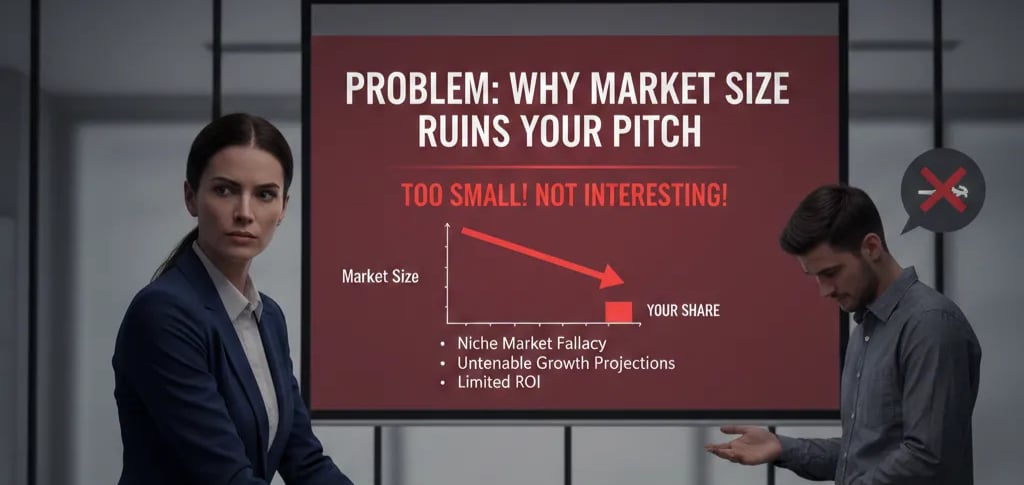
Your Problem Slide just convinced the VC you don't understand your own business. You opened with TAM. You cited a $47B market opportunity. The partner checked their watch at slide 3. Most founders believe the Problem Slide proves market size—it doesn't. It proves you can identify a friction point worth $500K in ARR, not $500B in fantasy. This breakdown sits inside a broader framework: what investors actually judge when evaluating problem definition, which determines whether you get a second meeting or a "we'll circle back."
Why Leading With Market Size Destroys Problem Credibility
The market size error kills pre-seed and seed-stage decks faster than any other single mistake. Here's the damage pattern: You state "The global HR software market is $47B." The VC thinks: "This founder cannot distinguish between a market and a problem." Market size belongs in slide 6 or 7—after you've proven you understand the specific pain point you're solving.
The Red Flag Scenario: Your slide reads "Small businesses waste 16 hours per week on payroll" followed immediately by "The SMB payroll market is $12B annually." The VC sees this and makes three judgments in 4 seconds: (1) You're pitching market access, not problem depth. (2) You don't know which customer persona actually feels this pain. (3) You're going to ask for capital to "capture 1% of the market"—the fastest way to signal you've never built a GTM motion.
The Psychological Audit: Founders make this error because incubators and accelerators teach them to "prove the market is big enough." This advice works for consumer apps raising $500K. It destroys B2B SaaS founders raising $2M+ because Series A investors don't fund market size—they fund problem intensity multiplied by solution velocity. You're confusing "large addressable market" with "painful enough problem that someone will switch vendors in 30 days."
The Equity Dilution Math Behind Weak Problem Framing
A market-first Problem Slide costs you 3–7% equity at Series A. Here's the calculation:
Scenario A (Market-First Deck): You pitch market size. The VC assumes you'll need 18–24 months to find product-market fit because you don't yet know who has the problem or when they feel it.
Capital Requirement: $3.5M to reach $1M ARR
Pre-Money Valuation: $8M
Dilution: 30.4%
Scenario B (Problem-First Deck): You describe the exact moment a CFO realizes their payroll system failed compliance. You state the cost: $47K in IRS penalties plus 23 hours of remediation. You prove 340 CFOs experienced this in Q4 2025.
Capital Requirement: $2.2M to reach $1M ARR
Pre-Money Valuation: $12M
Dilution: 15.5%
The Delta: 14.9% equity saved by proving problem specificity. On a $50M exit, that's $7.45M retained by founders.
The logic:
Generic market = 24-month guess-and-check cycle
Specific problem = 12-month execution sprint
Faster time-to-revenue = higher pre-money multiple
Higher multiple = lower dilution per dollar raised
How to Build a Problem Slide That Passes the 8-Second Partner Test
The VC-ready Problem Slide follows this hierarchy: Persona → Pain Event → Financial/Time Cost → Frequency → Current Broken Solution. You have 8 seconds before the partner forms an opinion. Every word must prove you've lived inside the customer's workflow.
Weak Version (Market-First):
Slide Headline: "Small Businesses Struggle With Payroll"
Bullet 1: 63% of SMBs report payroll challenges
Bullet 2: The SMB payroll market is worth $18B
Bullet 3: Manual processes waste time and money
This tells the VC nothing. It could describe 40 different products.
VC-Ready Version (Problem-First):
Slide Headline: "CFOs Lose $47K Per Compliance Failure—And Don't Know Until the IRS Letter Arrives"
Bullet 1: 340 companies (50–200 employees) missed state-level payroll tax deadlines in Q4 2025
Bullet 2: Average penalty: $47K + 23 hours of remediation across Finance and HR
Bullet 3: Root cause: Existing systems (Gusto, ADP) don't flag multi-state nexus triggers in real-time
Bullet 4: CFOs discover the error 45–90 days after the violation
The Framework: Use the "Cost-Per-Incident" model. Quantify the problem in dollars or hours lost per occurrence, then multiply by frequency. This proves two things: (1) The pain is acute enough to force a purchasing decision. (2) You know exactly who signs the check.
Before vs. After Comparison:
Before: "HR teams waste time on manual data entry." (Vague, unmeasurable, unprovable)
After: "Each Benefits Manager spends 9 hours per month reconciling carrier invoices because Gusto doesn't integrate with level-funded health plans—costing $180K annually in wasted labor for a 50-person HR team." (Specific persona, specific task, specific cost, specific broken tool)
The insertion point for market size comes after you've proven the problem exists. Slide 6 or 7 should read: "This problem affects 12,400 companies in the US with 50–500 employees—a $4.2B serviceable addressable market." Now TAM reinforces credibility instead of replacing it.
Three Fatal Errors Founders Make While "Fixing" the Problem Slide
Over-Indexing on Survey Data Instead of Behavioral Proof: You remove TAM and replace it with "83% of CFOs report payroll anxiety." This is worse. VCs don't trust surveys—they trust transaction logs, support tickets, or G2 reviews showing customers switched vendors because of this specific pain. Use hard evidence: "340 companies paid an average of $47K in penalties" beats "87% of finance teams feel stressed."
Confusing Industry Trends With Acute Customer Pain: You pivot from market size to industry trends: "AI is transforming payroll." These are macro tailwinds, not problems. A problem is: "CFOs at remote-first companies can't track contractor payments across 14 states without violating nexus laws." Trends explain why now—problems explain why us.
Using 2021 Valuations to Justify 2026 Problem Urgency: You reference pandemic data: "In 2021, HR software adoption grew 340%." VCs mentally subtract 70% because 2021 was an anomaly. If your problem proof relies on pandemic data, you don't have recent evidence. Use data from Q3 2025 or later.
Why Problem Slide Precision Adds $800K to Pre-Money Valuation
A surgical Problem Slide compresses your time-to-revenue story from 24 months to 14 months. VCs price that compression into pre-money valuation. If you can prove you know exactly who has the problem and exactly when they feel it, you've de-risked the riskiest part of Series A: finding repeatable customer acquisition.
The financial impact: $800K higher pre-money on a $2.5M raise (from $10M to $10.8M) reduces dilution from 20% to 18.8%. On a $40M exit, founders retain an additional $480K. The Problem Slide is not a storytelling exercise—it's a valuation negotiation tool disguised as a pitch deck component.
This specific problem—confusing market size with problem intensity—is automated inside the Slide-By-Slide VC Instruction Guide, which dissects all 12 pitch deck components with the same forensic precision. You can spend 35 hours researching VC preferences across 40 blog posts, or you can deploy the full Series A Execution System for $497 and build a VC-ready deck in 6 hours. The kit includes 16 AI prompts that reverse-engineer exactly how Series A partners judge each slide, plus the financial models that prove your unit economics pass the Rule of 40 test.
If your deck doesn't pass the 8-second partner test on the Problem Slide, nothing else matters. Fix this first. The complete breakdown of how VCs evaluate every pitch deck component—from Problem to Exit Strategy—is documented in the full Problem and Solution Slides framework, which explains the exact sequencing that converts cold emails into term sheets.
Funding Blueprint
© 2026 Funding Blueprint. All Rights Reserved.