
Weak Pitch Deck Framing: Examples of Poorly Positioned Problems
Real startup problems die in pitch decks due to weak framing. Learn the 4 framing mistakes that kill Series A conviction and how to fix them.
2.9 EXAMPLES: GOOD VS BAD PROBLEM & SOLUTION SLIDES (VC ANALYSIS)
3/2/20268 min read
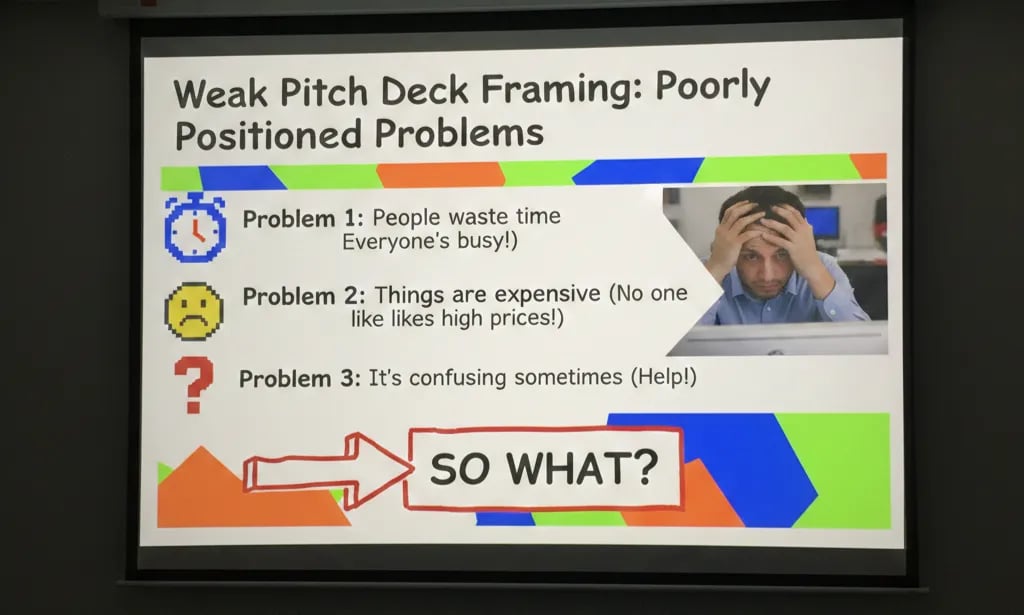
Weak Pitch Deck Framing: Examples of Poorly Positioned Problems
$1.9M in ARR, 94% gross margins, and a NRR of 109% — and the deck was dead before the financial slide was reached. The metrics were Series A-fundable. The framing was not.
Poorly positioned problem framing is distinct from overstated problems or narrative misalignment. It is a more insidious failure — the problem is real, the data is accurate, but the frame through which it is presented destroys the VC's ability to form a conviction. The problem is positioned from the wrong angle, at the wrong altitude, or against the wrong reference point. The result is a slide that is technically correct and strategically useless. This teardown sits alongside the VC analysis of good vs. bad Problem and Solution Slides and goes deeper into framing as a structural discipline — not a stylistic one. What follows is a forensic breakdown of the four most common weak framing patterns, what they cost, and how to rebuild them.
How Weak Problem Framing Dismantles Series A Conviction Before the Numbers Are Seen
Framing is not the story you tell. It is the cognitive container you hand the VC to hold your business in. A weak container does not just fail to impress — it actively distorts everything placed inside it. Metrics that should signal strength start to look ambiguous. A TAM that should look defensible starts to look speculative. The framing contaminates the read.
The four weak framing patterns that appear most consistently across underprepared Series A decks are: Industry-Level Framing (describing the problem at the market level, not the customer level), Competitor-Blame Framing (positioning the problem as a failure of incumbent products rather than a structural customer pain), Consequence-Only Framing (describing what happens when the problem occurs without identifying why it occurs), and Empathy Framing (describing how the problem feels without quantifying what it costs).
Each pattern produces a different failure mode in the VC's reading logic, but all four share a common root: the founder positioned the problem for an audience of customers — people who need to feel understood — rather than an audience of capital allocators, who need to see a falsifiable, investable thesis.
I have reviewed twenty-two decks in the past eight months where the founding team's customer discovery was genuinely strong — confirmed by the quality of their traction data — but the Problem Slide framing was so misaligned with VC reading patterns that the deck failed at the first analyst screen. The discovery was not the problem. The translation was. In 2025, with top-tier US Series A funds receiving an average of 2,000–3,000 inbound decks annually and advancing fewer than 2% to a partner meeting, a framing error at slide 3 is not a recoverable mistake inside the same process — it ends the process.
The psychological cause is a failure to distinguish between two entirely different communication objectives. Founders who have done rigorous customer discovery have been trained — correctly — to lead with empathy, to validate pain, and to make customers feel seen. That register is lethal in a VC context. A VC does not need to feel the pain. They need to price it.
The Framing Cost Model: What Each Weak Pattern Does to Your Investability Score
Each framing failure has a specific, traceable impact on how a VC processes the rest of your deck. This is not subjective — it maps directly to the decision logic analysts use during pre-screening.
Pattern 1 — Industry-Level Framing
"The global logistics industry loses $800B annually to supply chain inefficiency."
The VC's internal response: "What percentage of that is addressable by a Series A company? What is the ICP? Who is the buyer? I cannot calculate a serviceable market from this number."
The cascade: Without a serviceable market, the TAM slide becomes unverifiable. Without a verifiable TAM, the revenue projections become speculative. One framing error on slide 3 invalidates slide 9.
Pattern 2 — Competitor-Blame Framing
"Legacy ERP systems were not built for modern supply chain complexity. They are slow, expensive to implement, and create more problems than they solve."
The VC's internal response: "This describes a competitive positioning argument, not a customer problem. If legacy systems are the enemy, the problem disappears the moment someone builds a better ERP. Is that what this company is doing? Or is there a structural pain that exists independent of any software solution?"
The cascade: Competitor-blame framing signals a feature-level insight, not a market-level thesis. The VC begins evaluating whether this is a company or a module.
Pattern 3 — Consequence-Only Framing
"Operations teams are overwhelmed, deadlines are missed, and customer satisfaction scores are declining."
The VC's internal response: "Why? What is the specific mechanism producing these outcomes? If I cannot identify the root cause, I cannot evaluate whether this product actually addresses it or merely delays the consequences."
The cascade: Without a named mechanism, the solution cannot be evaluated for root-cause fit. The VC defaults to assuming the solution is symptomatic, not structural.
Pattern 4 — Empathy Framing
"Finance teams are exhausted. Month-end close is a nightmare. People are working weekends and burning out — and it is getting worse every quarter."
The VC's internal response: "I believe this is painful. But pain is not a market. What does this cost in dollars? What is the frequency? What is the recoverable value if this is fixed?"
The cascade: Empathy framing generates sympathy but not investment logic. A VC cannot present "teams are exhausted" to an investment committee as a fundable thesis. The framing leaves the analytical work undone — and the analyst will not complete it for you.
The compound cost: As of early 2026, US Series A pre-money valuations are being stress-tested against verifiable market sizing with a specificity not common in pre-2023 vintages. Funds are requiring a credible bottom-up TAM derivation from the ICP level, not a top-down industry figure. A Problem Slide that frames at the industry level provides no usable input to that calculation — which means the founding team's TAM slide must carry the entire sizing argument alone, without the narrative foundation a well-framed problem would have provided.
The Problem Reframing Protocol: Four Weak Frames Rebuilt to VC Standard
Each pattern rebuilt using the Framing Inversion Method: identify the altitude error, drop to the correct level, and reintroduce the three required elements — specific victim, quantified cost, traceable mechanism.
Rebuild 1 — Industry-Level → Customer-Level
Weak Frame: "The global logistics industry loses $800B annually to supply chain inefficiency."
VC-Ready Rebuild: "Regional 3PL operators managing 4–12 distribution sites lose an average of $290K annually to carrier invoice discrepancies — overcharges that are billed correctly 73% of the time but reconciled manually by a single AP analyst working from a spreadsheet against a 30-day invoice lag. By the time the error is caught, the dispute window has closed. Confirmed across 16 customer accounts."
What changed: The frame dropped from industry altitude to customer altitude. The $800B became $290K — a number that is smaller but verifiable and traceable to a specific operator profile. The mechanism (manual reconciliation against a 30-day lag) is now explicit. The VC can calculate serviceable market from this ICP definition. The $800B figure gave them nothing to work with.
Rebuild 2 — Competitor-Blame → Structural Pain
Weak Frame: "Legacy ERP systems were not built for modern supply chain complexity."
VC-Ready Rebuild: "When a SKU count scales past 8,000 units, mid-market distributors hit a structural inventory visibility failure that no current ERP configuration resolves without a custom integration costing $180K–$400K and taking 9–14 months to deploy. 61% of distributors in this band operate on the original out-of-the-box configuration — meaning the failure is active, unaddressed, and not a function of software age. It is a function of configuration economics."
What changed: The legacy ERP is no longer the villain — the structural economics of configuration are. That distinction is critical. A structural problem persists regardless of what software exists. A competitor-defined problem disappears the moment a competitor improves. Structural framing signals a durable market. Competitor-blame framing signals a timing bet.
Rebuild 3 — Consequence-Only → Mechanism-First
Weak Frame: "Operations teams are overwhelmed, deadlines are missed, and customer satisfaction scores are declining."
VC-Ready Rebuild: "In B2B SaaS companies scaling from $5M to $15M ARR, customer onboarding is managed through a combination of shared inboxes, manually updated spreadsheets, and ad hoc Slack threads — with no single system of record. The result is an average onboarding duration of 47 days against a contractual SLA of 30 days. The 17-day overrun generates an average of $34K in at-risk ARR per cohort from early churn triggered before value realisation. The mechanism is not headcount. It is the absence of a structured onboarding workflow that scales independently of CS team size."
What changed: The consequences (overwhelm, missed deadlines, declining CSAT) are replaced with the mechanism (no system of record for onboarding) and the quantified cost of that mechanism ($34K at-risk ARR per cohort). The VC can now evaluate whether the solution closes the mechanism — not whether it reduces overwhelm.
Rebuild 4 — Empathy → Priced Pain
Weak Frame: "Finance teams are exhausted. Month-end close is a nightmare."
VC-Ready Rebuild: "For companies between $20M–$100M in revenue operating on a standard ERP without a consolidation layer, month-end close runs an average of 11.4 days — against a best-in-class benchmark of 4 days. The 7.4-day gap costs $62K per close cycle in blended finance team labour, delays board reporting by an average of 9 days, and produces a 14% rate of material restatement within 90 days of close. Confirmed across 21 CFO interviews. The problem is not effort. It is a structural absence of automated intercompany reconciliation."
What changed: Exhaustion is priced. The nightmare has a number — $62K per cycle, a 14% restatement rate, a 9-day board reporting delay. The VC can now calculate annual cost ($744K), evaluate solution pricing against recoverable value, and begin building a defensible ROI case for the investment committee.
The Reframing Equation:
Remove: Adjectives describing experience (exhausting, complex, broken, slow) Replace with: Nouns describing mechanisms + numbers describing costs Test: Can a VC analyst put this problem into a DCF model? If not, the framing is still wrong.
Three Reframing Traps That Reintroduce Weak Positioning After the Rebuild
Trap 1 — Rebuilding the headline but leaving empathy language in the supporting bullets. The primary statement is now priced and mechanistic. But the two supporting bullets underneath it read: "Teams are stressed" and "Leadership is losing confidence in the data." The VC reads the bullets. All four framing failures can be reintroduced in supporting copy after a strong headline rebuild.
Trap 2 — Replacing industry statistics with customer statistics from a single outlier account. One customer losing $290K is an anecdote. Eight customers losing an average of $290K with a standard deviation you can defend is a market. The rebuild requires pattern evidence — minimum six to eight confirmed instances before the number is presentable as a VC-credible benchmark.
Trap 3 — Mechanism framing that is product-specific rather than problem-specific. "The problem is that no one has built an automated intercompany reconciliation tool." That is a product gap framing, not a structural problem framing. The problem must exist and be costly independent of whether your product exists. Frame the structural failure first. Let the product slide introduce the solution.
What Correct Framing Recovers in the Pre-Money Negotiation
Problem framing is not upstream of your pitch — it is upstream of your valuation. A VC-credible problem frame enables a bottom-up TAM calculation from a defensible ICP. A defensible TAM supports a higher serviceable market claim. A higher serviceable market claim justifies a stronger revenue multiple at the pre-money negotiation. Every link in that chain originates at the framing decision made on slide 3.
Founders who reframe at this level consistently find that diligence conversations shift from exploratory ("tell me more about your customer") to conviction-building ("walk me through your expansion motion"). That shift is not cosmetic — it is a signal that the VC has already accepted the problem thesis and is now evaluating the business. Getting to that stage faster is a structural fundraising advantage. The complete framework for building a fully fundable problem and solution sequence lives inside the Series A pitch deck Problem and Solution Slide system.
You can rebuild this framing manually across 40 hours of iteration, customer re-interview cycles, and partner feedback loops — or you can use the Slide-By-Slide VC Instruction Guide inside the $5K Consultant Replacement Kit to apply the Framing Inversion Method to your Problem Slide in a single working session. The Guide includes the exact reframing audit, the four-pattern diagnostic, and the rebuild protocol applied across eight verticals. The full Kit is $497. Reframe before your next meeting at the Series A pitch deck framing system built for founders who cannot afford a second chance.
Funding Blueprint
© 2026 Funding Blueprint. All Rights Reserved.