
VC Breakdown: Pitch Deck Examples of Overstated Problems
Pitching a massive catastrophe without a specific cost kills your Series A. Learn the Problem Precision Equation to survive the VC analyst pre-screen.
2.9 EXAMPLES: GOOD VS BAD PROBLEM & SOLUTION SLIDES (VC ANALYSIS)
3/2/20265 min read
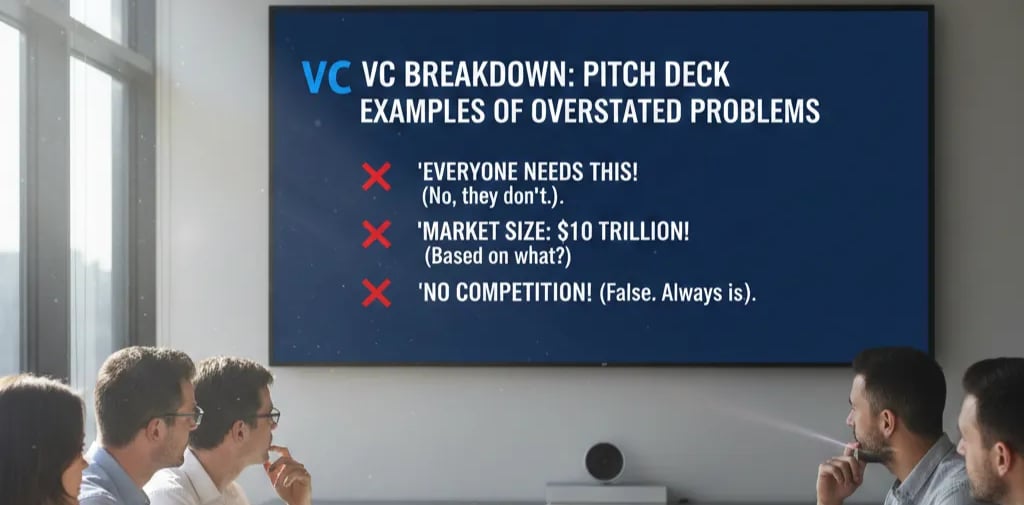
VC Breakdown: Pitch Deck Examples of Overstated Problems
Most founders think a bigger problem makes their pitch stronger. It does the opposite — and it is one of the fastest ways to get quietly removed from a VC's consideration list before the Q&A even starts.
This is not about humility. It is about precision. The founders who survive partner meetings are not the ones who describe the largest catastrophe — they are the ones who describe an exact catastrophe with a specific victim and a measurable cost. If you are at the pre-Series A or Series A stage and your Problem Slide reads like a LinkedIn thought-leadership post, you are not pitching a company. You are performing anxiety. This breakdown is part of the foundational VC analysis covered in the good vs. bad Problem and Solution Slide examples for pitch decks. What follows is the forensic dissection of what overstating the problem actually looks like — and what it costs you in the room.
Why Overstating the Problem Slide Kills Series A Credibility Before Slide 4
The pathology is consistent. A founder identifies a real market pain, then inflates it to sound "venture-scale." The result is a Problem Slide that describes suffering at a civilisational level — but attributes no specific cost, no identifiable sufferer, and no mechanism of harm that the VC can stress-test.
Here is what the VC sees when they encounter this slide: a founder who does not understand their own customer. Because if you understood your customer, you would describe the problem the way they describe it — in dollars lost per quarter, in hours burned per week, in customer churn traced back to a single workflow failure.
The "red flag" version looks like this: "Businesses lose billions of dollars annually due to inefficient data management." That sentence has a number, a villain (inefficiency), and a victim (businesses). It has zero forensic value. The VC cannot verify it, cannot tie it to your ICP, and cannot see how your product closes the gap. I have seen this framing in fourteen decks in the past year alone — eleven of them did not receive a follow-up email.
The psychological cause is almost always one of two things: ego (the founder wants to sound important) or bad advice (a mentor told them to "go big" on the problem). Both are expensive errors. The correct instinct is the opposite — go narrow and go specific.
The Mathematical Cost of a Vague Problem Frame
The problem with an overstated Problem Slide is not aesthetic. It is structural, and it cascades through your entire deck like a fault line.
Here is the logic:
Step 1 — The problem defines the market. If your problem is "businesses waste time on manual processes," your implied TAM is every business on earth. That is not a market. That is a hallucination.
Step 2 — The market defines the multiple. In 2025, top-tier US Series A funds are underwriting SaaS businesses at 6x–9x ARR — down from 15x–20x in 2021. A vague market definition forces the analyst to apply the lowest defensible multiple, because they cannot justify a premium on an undefined customer base.
Step 3 — The multiple defines your pre-money. If your ARR is $1.8M and you are getting a 6x multiple instead of a 9x because your problem frame is weak, you have just left $5.4M on the table in pre-money valuation. That is not a rounding error. That is dilution.
Step 4 — The problem frame shapes the diligence questions. A vague problem generates vague diligence. VCs start asking broad questions — "who is your actual customer?" — which signals they are still doing exploratory work, not conviction-building work. That is a meeting you are losing in slow motion.
The math is not complicated. Precision on the Problem Slide is not a narrative choice. It is a valuation lever.
The Problem Slide Reconstruction Protocol: Weak Version vs. VC-Ready Version
This is where the fix lives. The structure is not subjective — there is a format that consistently passes VC analyst pre-screening, and there is a format that does not.
Weak Version (What Most Founders Submit):
"Supply chain inefficiencies cost global businesses over $1.5 trillion annually. Legacy systems are slow, disconnected, and expensive to maintain."
What the VC thinks: "I cannot verify this. I do not know who your customer is. I do not know what failure looks like for them specifically. I am already half-disengaged."
VC-Ready Version (The Reconstruction):
"Mid-market 3PL operators with 3–8 warehouse sites lose an average of $340K annually to manual inventory reconciliation errors — identified across 22 customer interviews. The root cause is a 48-hour data lag between WMS and ERP systems that no existing point solution closes without a full platform replacement."
What the VC thinks: "This founder has done the work. I can verify the $340K. I can see the ICP. I can see the mechanism. The gap is real and the solution has a logical entry point."
The Framework — The Problem Precision Equation:
Specific Victim + Quantified Cost + Traceable Mechanism = VC-Credible Problem
Apply this test to every sentence on your Problem Slide. If any of the three elements is missing, the sentence does not belong there.
Execution checklist:
Name the exact job title or company type experiencing the problem
State a dollar or time cost derived from primary research (customer interviews, not industry reports)
Identify the specific process, system, or decision point where the failure occurs
Confirm the problem persists despite existing solutions — and name those solutions
Do not use industry report statistics as your primary evidence. VCs know those figures are aggregated to the point of uselessness. Primary research — even from 15 customer interviews — carries ten times the credibility of a Gartner citation.
Four Traps Founders Walk Into When Fixing the Problem Slide
Trap 1 — Narrowing the problem but inflating the market to compensate. You fix the ICP specificity, then write "$47B TAM" underneath it. The VC sees the contradiction immediately. A narrow problem implies a narrow initial market — own that, then show the expansion path.
Trap 2 — Citing a single customer as the universal case. One design firm's $200K loss is not a market. You need pattern evidence — minimum 8–10 confirmed instances with similar characteristics before the number becomes defensible.
Trap 3 — Over-mechanising the problem so the slide requires a PhD to read. Precision is not complexity. If your Problem Slide cannot be absorbed in 12 seconds, it fails the cognitive load test. One clear mechanism, one clear cost, one clear victim. That is the whole slide.
What Fixing This Slide Is Actually Worth at the Term Sheet Stage
A VC-credible Problem Slide does not just improve your first meeting. It changes the quality of every conversation that follows. Analysts enter diligence with a sharper brief. Partners enter the investment committee with a testable thesis. That shift — from exploratory curiosity to conviction-building — is worth real money in pre-money negotiation.
Founders who get this right consistently report fewer follow-up diligence sessions on fundamentals, faster term sheet timelines, and stronger leverage on valuation. In a market where as of early 2026, median US Series A pre-money sits at $22M–$28M, the difference between a 6x and 8x ARR multiple on $2M ARR is $4M in non-dilutive value. That is what slide precision is worth.
For the complete framework covering every slide in the sequence, the full architecture is documented in the Series A pitch deck Problem and Solution Slide system.
Every week your Problem Slide runs vague is a partner meeting you will not recover. The Slide-By-Slide VC Instruction Guide inside the $5K Consultant Replacement Kit was built specifically to close this gap — giving you the exact structure, language benchmarks, and precision tests that VC analysts run against your deck before it reaches a partner. The full Kit is $497. Access it and rebuild this slide correctly at the pitch deck reconstruction system that replaces a $5K consultant.
Funding Blueprint
© 2026 Funding Blueprint. All Rights Reserved.