
Why Investors Use Decks to Filter 90% of Founders
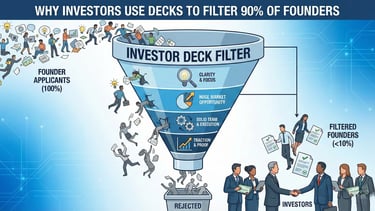
Investors don't read to say "Yes"; they scan to say "No." A forensic audit of "Negative Selection" and how to survive the 120-second "Kill Switch."
1.2: HOW INVESTORS USE PITCH DECKS INTERNALLY
1/18/20265 min read

You Are Deal Flow #143 (And That’s The Problem)
If you are a Seed or Series A founder currently fundraising, you are likely operating under a fatal delusion: you believe your pitch deck is a marketing brochure designed to tell your story. It is not. To a venture capitalist, your deck is a liability—a piece of unverified data that must be processed, audited, and likely discarded to minimize cognitive overhead.
The counter-intuitive truth of 2026 is that investors do not read decks to find reasons to say "yes." They scan them to find the fastest, most defensible reason to say "no." This is negative selection. Your deck's primary function is to survive the first 90 seconds of scrutiny without triggering an automatic rejection based on pattern recognition.
This ruthlessness isn't personal; it's structural. As detailed in our analysis of How Investors Use Pitch Decks Internally, the analyst reviewing your deck is incentivized to kill deals, not champion them. Their career depends on not looking stupid to their General Partners. If your deck requires "figuring out," you have already failed the audit. You are not "educating" the investor; you are surviving their filter.
The "kitchen Sink" Red Flag
The error that destroys 90% of fundraises is the "Kitchen Sink" fallacy. This occurs when a founder, driven by insecurity and the fear of omission, crams every possible data point, feature, and backstory into the first ten slides.
The "Red Flag" Scenario
Imagine a Slide 4 titled "Our Solution."
The Amateur Version: Contains three paragraphs of text, a complex flowchart of the tech stack, four screenshots of the UI, and a list of 12 "key features."
The VC Internal Monologue: "This founder lacks focus. They cannot prioritize high-leverage activities. If it takes this much effort to explain the product to me, their Customer Acquisition Cost (CAC) will be astronomical because the market won't understand it either. Pass."
Psychological Audit
Why do intelligent founders commit this capital offense?
The "smartest person in the room" syndrome: You assume complexity equals value. In VC, complexity equals risk.
Defensive Fundraising: You are trying to pre-answer every objection before it is raised. This signals weakness. You are negotiating against yourself before the meeting even starts.
Bad Advice: You listened to a "pitch coach" who has never sat on an investment committee. They told you to "paint a picture." We want you to paint a path to 100x liquidity.
The Cost of Cognitive Load
Let’s strip away the "art" of pitching and look at the unit economics of a Venture Capital firm’s attention span.
Deal Flow Volume: An average Series A firm reviews ~2,000 decks annually.
Analyst Bandwidth: An analyst has approximately 2,000 working hours per year.
Allocation: If they spent just 30 minutes "deep reading" every deck, that would consume 1,000 hours—50% of their total capacity—leaving zero time for due diligence, board meetings, or sourcing.
This is mathematically impossible. Therefore, the Initial Screen Time (IST) is capped at roughly 120 seconds per deck.
The "Signal-to-Noise" Equation
Your probability of securing a meeting (Pm) can be modeled as:
Pm = S
N X Tload
Where:
S = Signal (Hard traction, proprietary tech, 30% MoM growth).
N = Noise (Jargon, filler text, bad design, confusing narrative).
Tload = Time to Comprehend (Cognitive Load).
If you increase N (Noise) by adding fluff, you force the investor to increase Tload to find the Signal. As Tload exceeds 120 seconds, Pm drops to zero.
Design Drag: A poorly formatted slide costs 5 seconds of cognitive load.
Narrative Drag: A generic claim like "We are the Uber for X" without context costs 10 seconds of skepticism.
Data Drag: Unlabeled Y-axes on charts cost 15 seconds of frustration.
Cumulatively, a "bad" deck exhausts the investor's time budget by Slide 6. The math dictates they must reject you to preserve efficiency.
The Negative-Filter Defense
To survive the filter, you must build your deck backward from the investor's rejection criteria. You need a "Filter-First" Architecture.
Step 1: The "Kill Switch" Slide Optimization
Investors usually check three specific slides to decide if they should close the file. If these three fail, the rest don't matter.
1. The Problem Slide (The Market Vacuum)
Weak Version: "People struggle to find parking. It is stressful and time-consuming." (Vague, annoyance, not a hair-on-fire problem).
VC-Ready Version: "Urban logistics lose $4B/year in last-mile efficiency due to parking latency. Current solutions have a 40% failure rate." (Quantified, expensive, urgent).
2. The Traction Slide (The Validation)
Weak Version: Cumulative sign-ups graph that goes up and to the right (Vanity metric).
VC-Ready Version: Cohort Analysis showing net dollar retention (NDR) > 110% and a Burn Multiple < 2x. This proves you are printing money efficiently.
3. The Team Slide (The Execution Risk)
Weak Version: Photos of the team with "Chief Visionary" titles and logos of universities.
VC-Ready Version: Specific "unfair advantages." e.g., "CTO exited previous AI security startup to Palo Alto Networks for $200M. CEO managed $50M P&L at Uber."
Step 2: The "Rule of 40" Narrative
Every slide must pass a simple efficiency test. If a sentence does not directly support the thesis that this company will return the fund, delete it.
Framework: Use the "3-Second Rule" for every header.
The investor should be able to read only the headers of your deck and understand 90% of the business logic.
Bad Header: "Market Opportunity"
Good Header: "$12B Total Addressable Market in US Healthcare Operations, growing at 15% CAGR."
The "Death Traps": Where Founders Over-Correct
In an attempt to fix a "noisy" deck, founders often swing too far in the opposite direction, creating new reasons for rejection.
The "Mystery Box" Trap:
You make the deck too minimal. You strip out so much detail that it becomes vague. "We are stealth mode" is not a strategy for a pre-Series A company; it’s a signal you have no traction. You must show the numbers.
The "2021 Valuation" Delusion:
You optimize your deck for the "growth at all costs" era. You highlight GMV (Gross Merchandise Value) instead of Gross Margin. In 2026, capital is expensive. If your deck doesn't explicitly address unit economics and path to profitability, you are flagged as "capital inefficient."
The Fake TAM:
Never claim your market is "Everyone with a smartphone." If you calculate TAM by taking 1% of a global population, you are immediately bucketed as a novice. VCs want to see a bottom-up calculation: (Number of potential enterprise contracts) x (Annual Contract Value).
The "High-Ticket" Conclusion
The difference between a deck that gets filtered and a deck that gets funded is often not the business itself, but the clarity of the signal. By removing the noise, you reduce the perceived risk. Lower risk equals a higher pre-money valuation. Fixing your deck structure is a high-leverage activity that can literally add $1M to your paper valuation by signaling "institutional readiness."
For a comprehensive deep dive on the macro-mechanics of fundraising, read our full thesis on How VC Pitch Decks Really Work in 2026 — And Why Most Founders Get Them Wrong.
The Filter Plug
You can spend weeks A/B testing your slides against a wall, or you can use a proven framework. The $5k Consultant Replacement Kit includes "The Slide-By-Slide VC Instruction Guide"—the exact architectural blueprint used to pass the analyst filter.
We have automated the "Forensic Audit" process for you. Instead of guessing, just fill in the blanks. Price: $497. Available on the home page.
If you aren't willing to invest $497 to secure a $2M round, you have already failed the "Resourcefulness" test.
Funding Blueprint
© 2025 Funding Blueprint. All Rights Reserved.