
Pitch Deck Narrative Fit: Examples of Perfect Problem-Solution Alignment
VCs don't fund misaligned pitches. Master the Narrative Lock Equation to prove your product directly solves the exact pain you just pitched.
2.9 EXAMPLES: GOOD VS BAD PROBLEM & SOLUTION SLIDES (VC ANALYSIS)
3/2/20266 min read
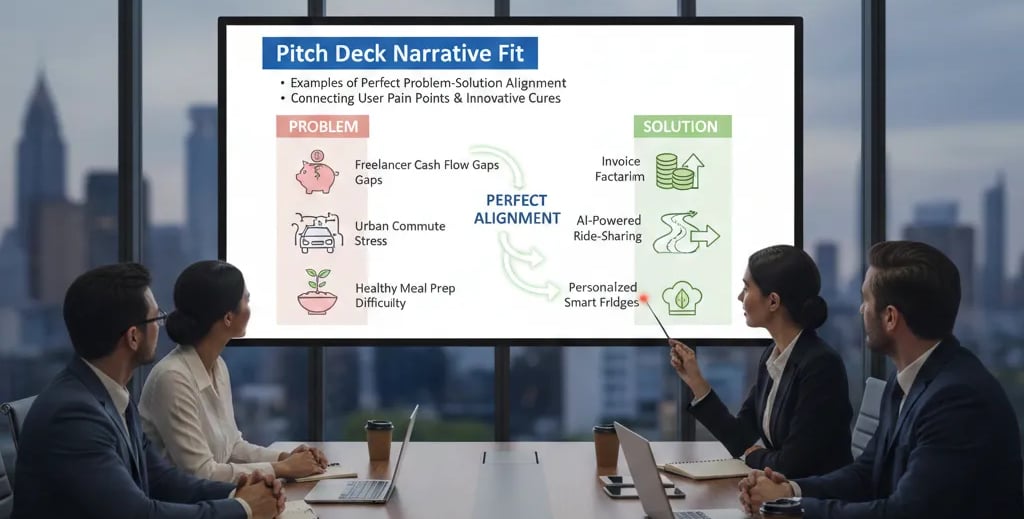
Pitch Deck Narrative Fit: Examples of Perfect Problem-Solution Alignment
A Series A SaaS founder raised $2.8M in seed funding, had $1.6M ARR, and a Net Revenue Retention rate of 118%. She walked into a partner meeting at a top-tier fund and walked out without a term sheet. The deck was clean. The metrics were real. The problem? Her Solution Slide described a product that a VC would fund — but it did not solve the problem she had just spent three slides proving existed.
That is not a design failure. That is a narrative failure. And it is more common at the Series A stage than any other structural error in a pitch deck. Narrative fit — the precise logical bridge between what you prove is broken and what you prove you have fixed — is the single highest-leverage element in your deck, and the one founders least deliberately engineer. This post is a companion breakdown to the VC analysis of good vs. bad Problem and Solution Slides, focused specifically on what alignment looks like when it works — and the exact anatomy of why it fails.
Why Problem-Solution Narrative Gaps Are a Silent Series A Disqualifier
The failure mode is almost never obvious. Founders do not walk into partner meetings with a Solution Slide that is wildly unrelated to their problem. The disconnect is surgical — a two-degree drift between what the problem implies the solution must do and what the solution claims to do.
Here is the VC's internal logic when they read a misaligned deck: "If the problem is real and the solution works, why does their solution not directly address the mechanism they just described?" That question, once triggered, does not get answered by slide 7. It becomes a filter that colours every metric, every case study, and every financial projection that follows.
The "red flag" version looks like this: A founder proves on slide 3 that mid-market HR teams lose 14 hours per week to manual compliance reporting due to fragmented data across four legacy systems. Then, on slide 5, their Solution Slide leads with an AI-powered employee engagement dashboard. Engagement is not the mechanism of failure they identified. Data fragmentation is. The solution answers a question the problem never asked. In a deck reviewed last quarter, this exact drift caused a VC partner to stop the presentation mid-deck and ask the founder to clarify what problem they were actually solving — a question no founder should be answering aloud in a partner meeting.
The psychological cause is almost always a sequencing error in how founders build decks. They build the Solution Slide first — because they are proud of the product — and then reverse-engineer a Problem Slide to justify it. The result is a problem that is adjacent to the solution rather than upstream of it.
The Cognitive Cost of a Narrative Gap: Measured in Seconds and Decisions
Narrative misalignment does not just irritate a VC. It generates measurable cognitive load that degrades the quality of attention your deck receives from that point forward.
Here is the structural breakdown:
Stage 1 — The problem creates a "solution expectation." When a VC reads a credible Problem Slide, their brain automatically forms a hypothesis about what the solution must do. That hypothesis is not conscious — it is the trained pattern recognition of analysts who have reviewed hundreds of decks. It runs in the background.
Stage 2 — The Solution Slide either confirms or breaks that expectation. A confirming solution lands in under four seconds. The VC nods, moves on, and starts evaluating how you solve it. A breaking solution triggers a cognitive halt — a half-second of confusion that converts into skepticism. In a 20-minute first meeting, you cannot afford skepticism on slide 5.
Stage 3 — The skepticism compounds. As of 2025, the median VC diligence timeline from first meeting to term sheet at US Series A sits at 8–12 weeks for funds that pass on 94%+ of initial pitches. A narrative gap at slide 5 does not just cost you that meeting — it makes the analyst's post-meeting memo harder to write in your favour, which is the document that determines whether you get a second call.
The alignment test — three binary questions:
Does the solution directly address the mechanism of failure identified in the problem, not just the category?
Does the solution use the same vocabulary as the problem — same job titles, same systems, same failure point?
Could a VC read the Problem and Solution Slides in isolation and confirm they are from the same deck, without seeing the company name?
If any answer is "no," your narrative fit is broken.
The Problem-Solution Alignment Protocol: Weak Version vs. VC-Ready Version
There is a repeatable structure for engineering narrative fit. It is not about making the slides sound connected. It is about making them logically dependent — so the solution is the only rational response to the problem you proved.
Weak Version (The Drift Pattern):
Problem Slide: "Enterprise procurement teams spend 60% of their time on manual vendor onboarding, creating bottlenecks that delay project starts by an average of 22 days."
Solution Slide: "[Product] is an AI-powered procurement intelligence platform that gives procurement leaders real-time visibility into spend, supplier risk, and compliance status."
What the VC sees: The problem is about manual onboarding time. The solution is about intelligence and visibility. Intelligence does not fix manual processes. Visibility does not recover 22 days. The solution sounds impressive but answers a different question.
VC-Ready Version (The Locked Alignment):
Problem Slide: "Enterprise procurement teams spend 60% of their time on manual vendor onboarding, creating bottlenecks that delay project starts by an average of 22 days — caused by fragmented document collection across email, PDF, and three disconnected portals."
Solution Slide: "[Product] replaces the email-PDF-portal workflow with a single automated onboarding sequence — collecting, verifying, and routing vendor documents in 4 hours instead of 22 days. No manual touchpoint required."
What the VC sees: The mechanism (fragmented document collection), the cost (22 days), and the solution (automated single-sequence workflow) are all the same language, the same actor, and the same failure point. The solution is not describing a product — it is describing the closure of the exact gap the problem opened.
The Framework — The Narrative Lock Equation:
Mechanism Named in Problem = Mechanism Solved in Solution Cost Quantified in Problem = Cost Eliminated in Solution Victim Identified in Problem = Beneficiary Named in Solution
Apply this as a literal audit. Pull the three core elements from your Problem Slide and check that each one has a direct correspondent on your Solution Slide. If the solution introduces new terminology, new actors, or new categories of value not mentioned in the problem, cut them or move them to the Product slide.
Execution checklist for alignment:
Use the same job title on both slides (not "operations teams" on one and "business leaders" on the other)
Mirror the failure mechanism with its direct inverse in the solution (fragmented → unified; manual → automated; delayed → real-time)
State the before metric from the problem and the after metric from the solution in parallel format
Do not introduce additional solution features on this slide — those belong in the product or traction section
Three Alignment Traps That Break Narrative Fit After You Think You Have Fixed It
Trap 1 — Solving a symptom instead of the mechanism. The problem identifies fragmented data as the cause of a 22-day delay. The solution addresses the delay (a faster process) but not the fragmentation (the structural cause). VCs at the Series A stage are specifically trained to distinguish between symptom-solving and root-cause-solving. The former signals a feature. The latter signals a company.
Trap 2 — Adding a second problem to justify a broader solution. A founder fixes the alignment, then adds a second problem bullet to justify additional product features. Now the Solution Slide is answering two problems, neither perfectly. One tight problem-solution pair outperforms two loose ones in every partner meeting.
Trap 3 — Using "and" in the solution headline. "[Product] automates onboarding and provides real-time compliance tracking and supplier risk scoring." Three value props, zero clarity. A VC-ready Solution Slide has one primary mechanism of value. The word "and" in a solution headline is almost always a sign that narrative fit has not been fully resolved.
What Narrative Lock Is Worth When the Term Sheet Conversation Starts
Narrative fit is not a soft metric. It directly determines whether the VC's investment thesis is easy or hard to write — and a hard-to-write thesis is a delayed or declined investment. When a VC's analyst writes the pre-IC memo, they are describing your problem, your solution, and the logical chain between them. If you have locked that chain in your deck, you have written most of their memo for them. That is an underrated structural advantage.
Founders with clean narrative alignment consistently report shorter diligence cycles and fewer "clarification" meetings — because there is nothing to clarify. The deck already answered the question. In a fundraising environment where partner attention is the scarcest resource in the room, engineering that clarity in advance is a competitive act, not a cosmetic one. The complete framework for building both slides inside a fundable deck structure is documented in the Series A pitch deck Problem and Solution Slide system.
Every week this narrative gap stays open is a second meeting you will not receive and a term sheet timeline that resets to zero. The Slide-By-Slide VC Instruction Guide inside the $5K Consultant Replacement Kit includes the exact alignment audit, before-and-after slide structures, and the narrative lock framework applied to eight industry verticals — so you walk into your next partner meeting with a deck that has already passed the analyst's pre-screening logic. The full Kit is $497. Close the gap before your next meeting at the pitch deck alignment system built for Series A founders.
Funding Blueprint
© 2026 Funding Blueprint. All Rights Reserved.