
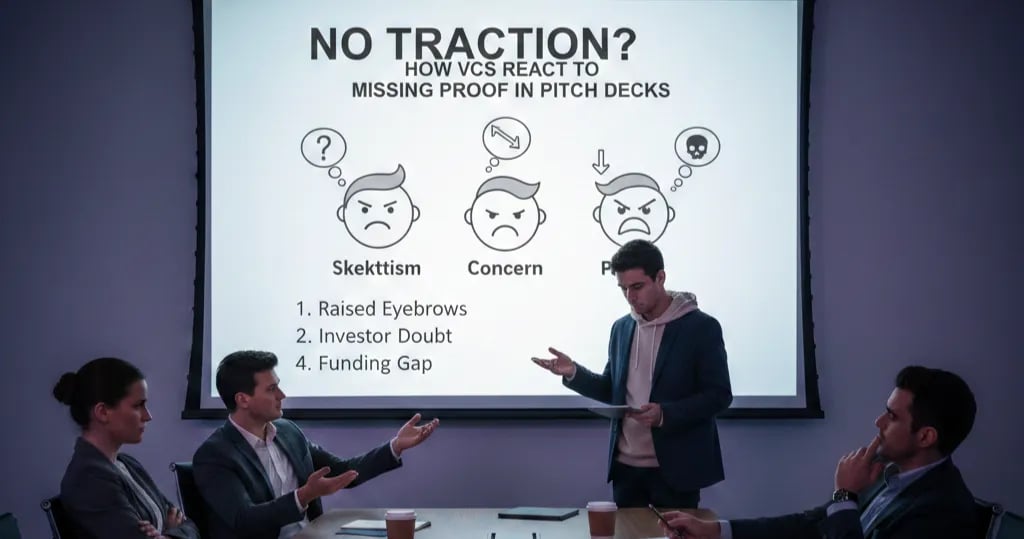
No Traction? How VCs React to Missing Proof in Pitch Decks
No traction? Don't replace it with a roadmap. Discover the 5-tier Substitution Hierarchy that replaces missing proof with a fundable Series A narrative.
2.2 HOW TO PROVE YOUR PROBLEM IS REAL (EVIDENCE, SIGNALS & PROOF)
2/17/20267 min read
No Traction? How VCs React to Missing Proof in Pitch Decks
A Series A founder in enterprise SaaS raised $1.8M at pre-seed, built a product, and walked into a top-tier fund with a deck that had seventeen slides and zero traction. Not weak traction. Not early traction. A traction slide that had been replaced with a roadmap, three customer logos listed as "in conversation," and a market timing argument. The partner meeting lasted twenty-two minutes. The follow-up email never came.
That founder was not unfundable. Their product was technically differentiated, their team was credible, and their market was real. They were unfundable at that moment because they handed a risk-averse capital allocator no evidence that the market agreed with them about any of it. Understanding what institutional investors require before they treat a Problem Slide as credible starts here — because missing traction is not a traction problem. It is a proof architecture problem, and the two require completely different fixes.
How a Missing Traction Slide Rewrites Every Other Slide in Your Deck Against You
The mechanism is not what most founders expect. VCs do not simply note the absence of traction and discount the raise accordingly. They do something more damaging: they retroactively reinterpret every prior slide through the lens of unproven assumption.
Before the traction slide, your market size looked plausible. After a traction slide with nothing on it, your market size looks like a calculation built to justify a raise, not to reflect reality. Before the traction slide, your customer quotes on the Problem Slide felt like validation. After nothing on the traction slide, those quotes look like the only evidence you were able to collect. The absence of traction does not just weaken one slide — it structurally undermines the credibility of everything that preceded it.
This is the forensic reality most founders do not model when they decide to pitch without traction: the deck is read as a system, not as individual slides. A gap in the evidentiary chain does not stay localised. It propagates backward.
The psychological error driving this decision is almost always a version of the same miscalculation: the founder believes the strength of their idea, team, or market thesis will compensate for the absence of market proof. This belief is not entirely wrong at pre-seed. It is categorically wrong at Series A, and it is increasingly wrong at late pre-seed as the capital environment has tightened. I have reviewed decks from founders at this exact stage across the past year where the traction slide was replaced with a product roadmap — in every case, the VC's first verbal response in the meeting was a variant of "walk me through your current customer evidence," and the conversation never recovered from the answer.
The psychological root is partly ego — the conviction that the idea is self-evidently valuable — and partly bad advisor guidance from pre-seed investors who funded on vision and did not recalibrate their advice as the founder approached institutional capital thresholds.
The Risk Calculus a VC Runs When There Is No Traction: A Mathematical Breakdown
When a VC sees a missing or hollow traction slide, they do not pause empathetically. They run a rapid expected-value calculation that almost always produces the same output.
Here is the logic, step by step:
For Market demand, with traction it is partially de-risked, while without traction it is a 100% unvalidated assumption.
For Pricing viability, with traction it is testable from data, while without traction it is theoretical.
For CAC estimate, with traction it has an input basis, while without traction it is speculative — range too wide to model.
For LTV thesis, with traction it is grounded in retention shape, while without traction there is no behavioral data to anchor it.
For Team execution signal, with traction it is proven against real users, while without traction it is unverified.
For Fund risk exposure, with traction it is calculable, while without traction it is open-ended.
Every cell in the right column represents a due diligence question the VC cannot answer from your deck. That is not a gap they will fund across — it is a gap they will wait for you to close before re-engaging.
As of 2025, the median Series A pre-money valuation in the US sits between $22M and $28M, with top-tier funds stress-testing a minimum of 18 months of runway and expecting burn multiples below 1.5x at the time of raise. Inside that framework, a founder with no traction is asking a fund to price a $22M–$28M bet on a completely unvalidated demand curve. The expected value of that bet, under any rational model, does not clear the return threshold a Series A fund needs to justify deployment.
The cognitive load consequence is compounding: every minute a VC spends in a no-traction meeting is a minute spent constructing the argument against funding rather than the argument for it. Absence of evidence forces the VC to imagine the worst-case scenario because they have no data to imagine anything else.
The No-Traction Recovery Protocol: What to Build, Present, and Sequence Before You Pitch
The answer is not to wait until you have traction to pitch. It is to build the minimum viable evidence stack that replaces missing traction with a structured proof narrative — and to present that narrative in a way that is analytically honest rather than defensively vague.
Step 1: Apply the Traction Substitution Hierarchy
If you do not have revenue or retention data, VCs will accept the following evidence types in descending order of credibility. Present the highest tier you can honestly claim:
Paid pilots or LOIs with named companies — Hard demand signal. Even one signed LOI at a credible company reframes the conversation.
Design partner agreements with documented co-development commitments — Behavioural signal. Someone spending time and access is more credible than someone spending words.
Beta users with measurable engagement data — Sessions, return rate, feature depth. Not sign-up counts — behavioural data.
Qualified waitlist with documented conversion architecture — Only credible if you have ICP-filtered numbers and an activation plan. (Gross sign-up counts without this are not a substitute for traction — they are a liability.)
Discovery interviews with quantified pain and documented budget authority confirmation — The floor. If this is all you have, frame it explicitly as problem validation, not traction, and explain your traction timeline with specificity.
Step 2: The "Proof Narrative" Frame — Before vs. After
Weak version: "We are pre-revenue but have strong interest from the market and are in conversations with several potential customers."
This sentence tells a VC five things, all of them bad: you have no revenue, you cannot quantify interest, "conversations" means nothing has been signed, "several" means you cannot name them, and "potential customers" means none of them have committed to anything. It is the single most common sentence in no-traction decks and the single most credibility-destroying one.
VC-Ready version: "We are pre-revenue. We have four signed design partner agreements with mid-market logistics companies (50–300 employees), two of whom have confirmed Q3 budget allocation for a paid pilot. Our beta cohort of 31 ICP-matched users shows a 68% 30-day return rate and an average of 4.2 sessions per week. We expect to reach $12K MRR within 90 days of this close."
The second version is not more optimistic — it contains the same underlying reality. It is more credible because it is specific, sequenced, and honest about the stage. A VC can work with specificity. They cannot work with vagueness, regardless of how confidently it is delivered.
Step 3: The Traction Timeline Commitment
If your traction is genuinely early, the highest-value addition to your deck is not more evidence — it is a documented, milestone-based traction timeline that shows the VC exactly what proof you will generate with their capital and when. This must be specific:
"$500K of this raise is allocated to activating our four design partners into paid pilots by Month 3, generating initial MRR data. By Month 6, we will have a 90-day retention curve from a minimum of 15 paying customers, which will form the basis of our Series A evidence package."
This converts the absence of current traction from a credibility failure into a capital deployment narrative. It also signals the one thing a no-traction founder desperately needs to signal: that they understand what proof looks like and have a systematic plan to generate it.
Step 4: Never Substitute Momentum Metrics for Demand Metrics
Press coverage, social followers, award wins, accelerator acceptances, and LinkedIn engagement are momentum signals, not demand signals. They belong in an appendix at best. Presenting them in the traction section as evidence that the market wants your product tells a VC that you either do not understand the distinction or are hoping they will not notice it. Neither reading advances the raise.
Three No-Traction Fixes That Accelerate the Rejection
1. Inflating "conversations" into implied commitments. Listing companies you have had a single discovery call with as "pipeline" is a due diligence trap. VCs will reference-check. When the named company has no memory of a substantive conversation, the founder's credibility does not recover.
2. Presenting an accelerator cohort as market validation. Being accepted to Y Combinator, Techstars, or a comparable programme is a team signal, not a demand signal. It means smart people think you are capable. It does not mean buyers will pay for your product. Conflating the two in a traction slide is a tell that reveals analytical inexperience.
3. Replacing the traction slide with a vision slide. Some founders remove the traction slide entirely and replace it with a product vision or roadmap section, hoping the VC will not notice the gap. They notice within thirty seconds. An absent traction slide is a louder signal than a weak one — it suggests the founder knew the evidence was not there and chose concealment over transparency. Transparency about early stage with a structured proof plan is always the stronger position.
The Financial Cost of Pitching Before Your Proof Architecture Is Ready
The damage of a premature raise attempt is not just a rejected term sheet — it is a compressed valuation on your next attempt, a shorter list of funds willing to re-engage, and a reputation signal that travels faster in a tight VC network than most founders expect. In the current environment, where top-tier US and UK Series A funds are taking 10–14 weeks for full due diligence and are revisiting passed deals at a lower rate than any point since 2019, burning a first meeting at a target fund without sufficient traction evidence is a strategic cost that compounds over time.
Build the proof architecture before you build the pitch. Then build the slide that presents it honestly, specifically, and in the language of demand — not momentum. The complete framework for connecting your proof evidence to your Problem, Solution, and Traction slides into a coherent institutional narrative lives inside the full Problem and Solution Slide system for Series A fundraising.
The 16 VC-Quality AI Prompts inside the $5K Consultant Replacement Kit include a dedicated prompt sequence for founders at exactly this stage — no traction or early traction — that generates a structured proof narrative, a traction timeline commitment, and a design partner outreach framework calibrated to what Series A analysts will verify in due diligence. It handles the exact problem this post diagnoses. The full Kit is $497, and you can access it through the complete early-stage pitch deck validation system at FundingBlueprint.
Build the proof first. Then open the deck.
Funding Blueprint
© 2026 Funding Blueprint. All Rights Reserved.