
Pitch Deck Evolution: How Problem and Solution Slides Must Mature
Is your pitch deck lagging behind your traction? A Seed-stage Problem slide kills Series A deals. Learn how to close the credibility deficit today.
2.5 PROBLEM/SOLUTION SLIDES BY STAGE: PRE-SEED → SEED → SERIES A
2/23/20268 min read
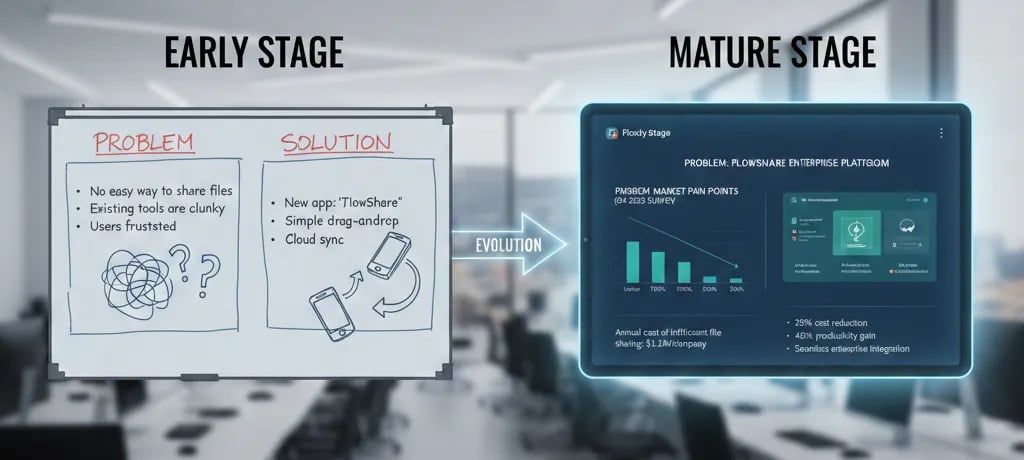
Pitch Deck Evolution: How Problem and Solution Slides Must Mature
A Series A founder in B2B SaaS raised $1.8M at Seed, built a real product, acquired 60 paying customers, and grew to $1.6M ARR in 19 months. She then lost her Series A process across four funds in eight weeks — not because the business was weak, but because her Problem and Solution slides had not matured a single structural layer since her Seed deck. Every fund said a version of the same thing: "We love the traction but aren't convinced you fully understand the market you've earned." What they were actually saying: your evidence has grown, but your slides still speak like a founder who is discovering the problem, not one who has been living inside it for two years. The maturity gap between your business and your deck is one of the most expensive mismatches in early-stage fundraising — and it is precisely what the stage-by-stage Problem and Solution slide framework from Pre-Seed through Series A is built to close. Slides that do not mature alongside the business do not just underperform. They actively contradict the traction you are trying to sell.
Why Static Problem Slides Create a Credibility Deficit That Traction Alone Cannot Repair
There is a specific psychological contract between a founder's Problem slide and the VC reading it. At every stage, the investor is running an implicit audit: does the depth of this founder's problem understanding match the evidence they claim to have? When the answer is no — when a founder with 60 customers and $1.6M ARR still frames the problem at the level of a discovery-phase hypothesis — the mismatch creates what analysts internally call a credibility deficit. The traction number says one thing. The slide says another. When those two signals conflict, the VC defaults to the more conservative interpretation: the traction is real, but the founder does not yet have the commercial understanding to scale it.
This is not a soft concern. At the analytical level, a Problem slide that has not matured signals three specific risks simultaneously: that the ICP is still loosely defined, that churn is likely undifferentiated by segment, and that GTM expansion is founder-dependent rather than system-driven. None of those risks need to be true for the signal to fire. The slide creates the impression regardless of the underlying reality.
The psychological root of this failure is what might be called earned complacency: the founder has been living inside the problem for two years and no longer feels the need to prove it on the slide because it feels self-evident to them. What is self-evident to a founder who has spoken to 200 customers is not self-evident to a partner reading a deck for the first time in 90 seconds. The slide must do the work the founder's experience cannot.
I have reviewed fourteen decks in the past six months where the founder's verbal pitch in the partner meeting was significantly more sophisticated than the Problem slide in their deck — in eleven of those cases, the VC noted the gap explicitly, and it introduced doubt about whether the founder could systematise their own knowledge into a scalable organisation.
The Maturity Curve: What Problem and Solution Slides Must Prove at Each Stage
As of early 2026, top-tier US Series A funds are conducting structured ICP audits as a standard diligence step — specifically testing whether the founder's Problem framing on the deck matches the customer segmentation data in the CRM. That alignment check did not exist as a formalised step in 2021 vintage due diligence. It does now, and decks that have not evolved their Problem slide to reflect earned customer intelligence fail that check before the data room is even opened.
Here is the maturity curve, mapped precisely by stage:
Pre-Seed — Maturity Level Required: Insight
The Problem slide must prove the founder has found a non-obvious problem through primary discovery, not assumed one from industry knowledge.
Evidence threshold: 10–20 qualitative customer or prospect conversations. Named pain, named buyer type, named workaround.
What immaturity looks like: "Businesses struggle with X" — a category statement with no field evidence and no named buyer segment.
Maturity signal: "We spoke to 17 independent freight brokers across the US Southeast. Every one of them is reconciling carrier invoices manually in Excel because every existing TMS was built for asset-based carriers, not brokers. The average reconciliation error rate is 12%. They know it and accept it because there is no alternative." That is insight. That is Pre-Seed maturity.
Seed — Maturity Level Required: Validated Demand
The Problem slide must prove the problem is acute enough for a defined buyer to change behaviour — not just acknowledge pain, but act on it.
Evidence threshold: 30–50 qualified conversations, plus behavioural proof (paid pilots, LOIs, willingness-to-pay data, or documented workaround spend).
What immaturity looks like: The same qualitative discovery framing from Pre-Seed, now accompanied by a customer logo grid that proves people paid but does not prove the problem was the reason.
Maturity signal: The Problem slide names the specific segment, quantifies the cost of the problem in the buyer's own financial terms, and references what the buyer was paying for the inferior alternative before switching. The Solution slide then maps directly to that cost, not to the product's feature list.
Series A — Maturity Level Required: Commercial Intelligence
The Problem slide must prove the founder has extracted strategic insight from operating inside the market — insight that only comes from serving paying customers at scale.
Evidence threshold: Cohort-level differentiation of who suffers most, ICP refinement based on retention data, and a problem framing that reflects competitive landscape evolution since the last raise.
What immaturity looks like: A problem statement that could have been written before the first customer signed. No segment refinement. No earned intelligence. Just a louder version of the Seed-era hypothesis.
Maturity signal at Series A: "Our original ICP assumption was mid-market HR teams broadly. Eighteen months of cohort data shows our highest NRR — 138% — comes from Series B companies scaling from 150 to 400 employees in the 90 days post-raise. That segment churns at 3% annually versus 19% for the broader mid-market. We have rebuilt our problem framing, our GTM motion, and our Solution slide architecture around that cohort." That is commercial intelligence. That is the problem understanding a Series A partner needs to see before they can believe the ARR is durable.
The Slide Maturation Protocol: Rebuilding Problem and Solution Slides at Each Stage Transition
Maturity is not a tone adjustment. It is a structural rebuild of what evidence appears, how it is framed, and what it is designed to prove. Here is the operational protocol for executing that rebuild correctly at each transition.
Transition 1: Pre-Seed → Seed
The job of this transition is to move from insight to validation. Your Problem slide must stop describing the problem and start proving that buyers have responded to it with behaviour.
Weak Version (Pre-Seed framing carried into Seed): "Small logistics companies are losing money on manual invoice reconciliation. Our platform automates the process and eliminates errors." This is a product description wrapped in a problem statement. It proves nothing about buyer behaviour.
VC-Ready Seed Version: "Manual invoice reconciliation costs independent freight brokers an average of $2,300 per month in corrected billing errors and staff time — a figure we calculated from financial records shared by 11 of our 23 pilot customers. Six of those customers were paying for a workaround solution (outsourced AP support at $1,800/month) before switching to us. The problem is not theoretical. It has a monthly invoice." The shift is from describing pain to proving it is real enough to generate financial behaviour. That is Seed maturity.
Transition 2: Seed → Series A
The job of this transition is to move from validated demand to repeatable commercial architecture. Your Problem slide must reflect what you have learned about the problem from operating inside it — not what you hypothesised before you had customers.
Your Solution slide at Series A must answer the repeatability question before the VC asks it. Structure it explicitly around:
ICP specificity: Not "mid-market ops teams" but "Series B companies in their first 18 months post-raise, 150–400 employees, with a VP of Operations hired in the last six months."
Channel-to-close documentation: How the ICP was acquired, at what CAC, through which channel, and whether that channel is repeatable by a non-founder sales hire.
Outcome-to-retention link: What result the ICP achieved, measured in their financial terms, and what the NRR is for that specific cohort.
Framework: The Maturity Stack. At each stage transition, your Problem slide must climb one rung on the following ladder:
Discovery (Pre-Seed): I found a problem others missed.
Validation (Seed): Buyers have confirmed it with behaviour.
Intelligence (Series A): I understand it better than anyone in the market, including my competitors, because I have been operating inside it.
Every slide in your deck must communicate from the correct rung. A Solution slide at Series A that is still communicating from rung one — product features, broad vision, category-level differentiation — has not made the climb. It will not pass the partner meeting filter regardless of what the Traction slide says.
The Before/After Test for Solution Slide Maturity:
Run this test on your current Solution slide. Ask: If I removed the traction data from my deck entirely, would this Solution slide still read as the work of a founder with 18 months of customer intelligence? If the answer is no — if the Solution slide only makes sense when read after the revenue number — it is not a mature slide. It is a traction-dependent narrative. That is a fragile position in a diligence process where VCs will scenario-test your GTM without the current revenue as a given.
Three Maturation Errors That Produce Slides That Look Advanced but Read as Thin
1. Dressing the slide in Series A language without Series A evidence. Adding words like "ICP," "cohort," "NRR," and "GTM motion" to a Problem slide that still contains no segment-specific data does not create maturity. It creates the appearance of maturity over the same thin foundation — and experienced analysts recognise the pattern within two slides.
2. Maturing the Solution slide without maturing the Problem slide. These two slides must evolve in lockstep. A sophisticated Solution slide — with channel data, ICP specificity, and documented repeatability — sitting on top of a vague, discovery-phase Problem slide creates a logical discontinuity. The VC's question becomes: how did you build this precise a solution to a problem you still cannot define precisely? There is no good answer to that question in a partner meeting.
3. Treating maturation as a one-time event. Founders who correctly rebuild their deck for Series A sometimes carry that same rebuilt deck into a potential Series B conversation 24 months later. The problem restarts. Deck maturation is a continuous process tied to stage transitions, not a credential earned once and held permanently. Every raise requires a fresh evidence audit from the operating data of the period since the last close.
The Valuation Premium That Mature Problem Slides Unlock
A Problem slide that demonstrates commercial intelligence — earned ICP specificity, cohort-level insight, competitive awareness updated to the current landscape — does not just pass the partner meeting filter. It removes the single largest subjective discount in early-stage valuation: the "founder hasn't yet figured out who they're really selling to" discount. In a 2025–2026 Series A environment where pre-money compression has pushed median US valuations to $22M–$28M for B2B SaaS, removing that discount through slide maturity is a concrete negotiating advantage worth $1.5M–$3M in pre-money positioning. That is the direct financial return on doing this correctly.
For the complete structural system governing how Problem and Solution slides must be built, sequenced, and matured at each stage, the full framework is in the Problem and Solution Slides master guide. That is the architecture every protocol in this post draws from.
You can build this maturation process manually across 40 hours of customer data analysis, slide iteration, and VC feedback cycles — or you can use the Slide-By-Slide VC Instruction Guide inside the $5K Consultant Replacement Kit to execute the full stage-transition rebuild in a single structured session. The Guide maps the exact evidence requirements, language tier, and structural format for Problem and Solution slides at Pre-Seed, Seed, and Series A — so the maturity is built into the architecture from the first draft, not discovered after the third rejection. The full Kit is $497, available at the stage-transition pitch deck maturation system at FundingBlueprint.
Funding Blueprint
© 2026 Funding Blueprint. All Rights Reserved.