
How Long Should a VC Pitch Deck Be in 2026?
A 40-slide deck is a "Warrant for Rejection." VCs average 2m 42s per view. A forensic audit on "Cognitive Tax" and why the 15-Slide "Kill Deck" is the only asset that survives.
1.1: WHAT A VC PITCH DECK ACTUALLY IS?
1/16/20265 min read
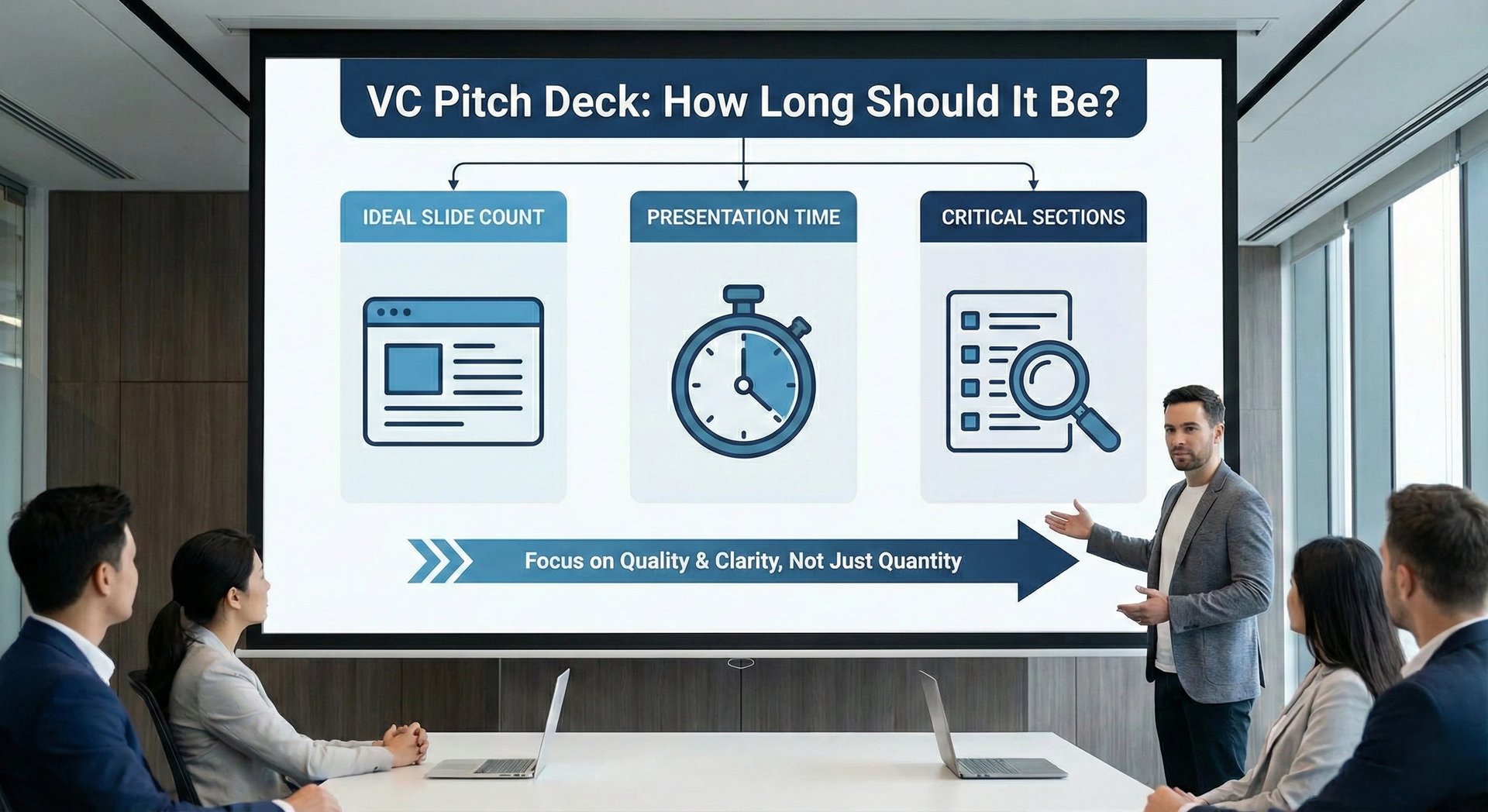
The Asymmetry of Attention: Why Your 40-Slide Deck is a Warrant for Rejection
If you are a Seed or Series A founder currently staring at a 35-slide "masterpiece," stop. You are not building a narrative; you are drafting your own rejection letter. The market has shifted violently since the capital glut of 2021. Today, attention is the scarcest asset in venture capital, scarcer even than liquidity.
Most founders operate under the delusion that "more context" mitigates investor risk. The inverse is true. In 2026, verbosity is a proxy for incompetence. To understand the physics of a fundraise, you must first understand What a VC Pitch Deck Actually Is (and What Investors Mean When They Ask for One). It is not a documentary of your startup’s history; it is a derivative instrument designed to sell the option of a second meeting. If your deck cannot execute that transaction in under 180 seconds, your length isn't just an aesthetic preference—it is a fiduciary failure.
The Forensic Diagnosis: The "Data Dump" Pathology
When we audit failed fundraising campaigns at the Series A level, the correlation between slide count and "pass" rates is nearly absolute. The "Red Flag" scenario we see repeatedly is the "Comprehensive Deck." This is a deck where the founder, paralyzed by the fear of omitting a detail, includes everything: the full bios of the junior engineering team, four slides on the history of the problem, and a screenshot of every product feature.
To a VC, this does not signal "thoroughness." It signals an inability to prioritize. It suggests a CEO who cannot distinguish between signal and noise.
The VC Internal Monologue:
When an associate opens a 40-slide PDF, they do not read it. They scrub it. They fast-forward to the Unit Economics and the Team slide. If they have to wade through 12 slides of "Macro Trends" to find your CAC, they assume you are hiding the numbers. A long deck triggers a psychological audit:
Insecurity: "The founder doesn't believe the core metrics are strong enough to stand alone."
Operational Inefficiency: "If they can't edit a deck, they can't edit a product roadmap."
Sales Incompetence: "They don't know how to close."
The error stems from Ego and Fear. The Ego says, "My work is too complex to be summarized." The Fear says, "If I don't explain X, they will say no." The reality is the opposite: You are not rejected for what is missing; you are rejected for what is boring.
The Mathematical Proof: The "Time-on-Asset" Equation
Let’s strip away the subjective arguments about "storytelling" and look at the math of capital allocation.
We track the backend analytics of deck-sharing platforms (DocSend, BriefLink). The data is lethal.
Average VC View Time (2026): 2 minutes and 42 seconds.
Average Slides Viewed: 11.
Drop-off Rate: 80% of investors never make it past slide 10.
If you submit a 30-slide deck, you are mathematically guaranteeing that 66% of your content is wasted capital. Worse, you are diluting the impact of the slides that do matter.
The Cognitive Load Calculation:
Every slide imposes a "Cognitive Tax."
Total Available Attention Budget: 162 seconds (2.7 minutes).
Scenario A (12 Slides): 13.5 seconds per slide. Enough time to parse a graph, read a headline, and internalize a metric.
Scenario B (25 Slides): 6.4 seconds per slide. This is below the threshold of comprehension for complex financial models.
The Result:
In Scenario B, the investor enters "skimming mode." They stop reading and start pattern-matching. They look for keywords. If they miss your "Moat" because it was buried on Slide 22, that is not their fault. It is a design flaw in your capital acquisition strategy.
The Logic Chain of Rejection:
High Slide Count - Low Time-Per-Slide.
Low Time-Per-Slide - Inability to Verify Logic.
Inability to Verify Logic - Perception of High Risk.
Perception of High Risk - Pass.
The "Insider" Solution Protocol: The 15+30 Structure
Do not aim for a specific number like "10 slides." That is rudimentary advice for Pre-Seed tourists. For a Series A round, where you must prove product-market fit and unit economic viability, you need a bifurcated asset strategy.
You need two documents. Not one.
1. The "Kill Deck" (The Front-End Asset)
Length: Strictly 12–15 Slides.
Purpose: Secure the Partner Meeting.
Format: High-level narrative, core metrics, team pedigree.
This deck must follow a violent efficiency protocol. Here is the Before/After audit of a specific section:
The "Weak Version" (The Market Section):
Slide 5: "History of the Industry." (Text heavy)
Slide 6: "Why Now?" (Generic quotes from Gartner)
Slide 7: "Market Size." (Top-down TAM calculated globally)
Slide 8: "Competitor Landscape." (A messy logo cloud)
Total: 4 Slides.
VC Reaction: "Fluff. Get to the numbers."
The "VC-Ready Version" (The Market Section):
Slide 5: "The Opportunity."
Headline: "A $12B Serviceable Market Growing at 22% YoY."
Graphic: A clean TAM/SAM/SOM concentric circle graph.
Data: Bottom-up calculation logic clearly visibly (e.g., "$10k ACV x 50k SMBs").
Differentiation: A 2x2 matrix positioned on the same slide showing exactly where you kill the incumbent.
Total: 1 Slide.
VC Reaction: "They know their market. Next."
2. The "Data Room Appendix" (The Back-End Asset)
Length: 20–40 Slides.
Purpose: Due Diligence Defense.
Location: Placed after the "Thank You" slide in the main PDF, or kept in a separate Notion/Data Room link.
This is where you put the detail that soothes your anxiety.
Detailed cohort analysis charts.
Full biographies of your advisors.
Technical architecture diagrams.
5-year P&L projections (never put a full P&L in the main deck).
The Framework:
Use the "Pointer Protocol." In your main 15-slide deck, use footnotes to reference the appendix.
Example on Slide 6 (Traction): "3.5x LTV/CAC Ratio (See Appendix B for full cohort retention breakdown)."
This signals to the analyst: "I value your time enough to summarize, but I am rigorous enough to have the raw data ready." That is the signal of a investable CEO.
The "Death Traps"
In your rush to optimize for brevity, do not commit the inverse error.
1. The "Teaser" Trap
Some founders send a 5-slide "teaser" lacking any financial substance, thinking it creates mystery. In 2026, mystery is annoying. If I cannot see your revenue run rate and burn multiple, I cannot model your valuation. A 5-slide deck gets deleted as quickly as a 50-slide deck.
2. The "Font Size 8" Cramming
Do not cheat the slide count by reducing font size to fit 500 words on a single slide. This increases "Time-to-Decode." If a slide takes 40 seconds to read, it counts as 3 slides in the investor's mental tally. White space is a financial instrument. Use it.
3. The "Video-Only" Pivot
Do not replace your deck with a Loom video or a cinematic trailer. VCs cannot "skim" a video. We cannot search a video for "EBITDA." We require a PDF. Do not force an investor to change their consumption workflow to accommodate your "creative expression."
The "High-Ticket" Conclusion
Optimizing your deck length is not a design exercise; it is a valuation defense mechanism. A tight, 14-slide narrative that points to a rigorous appendix signals a founder who commands their data rather than drowning in it. Fixing this asymmetry can be the difference between a "pass" and a term sheet—and in a Series A context, that difference is worth millions in equity value.
For a complete breakdown of how to structure the logic flow of these slides, review How VC Pitch Decks Really Work in 2026 — And Why Most Founders Get Them Wrong.
The Filter: You can spend weeks A/B testing which slides to cut, or you can simply execute the proven standard. We have automated this structure in the $5k Consultant Replacement Kit. specifically the "Slide-By-Slide VC Instruction Guide." It tells you exactly what goes on Slide 1 through Slide 15, preventing you from over-engineering your narrative. The kit is available for $497 on the home page. Do not waste time reinventing the wheel when you should be building the engine.
Funding Blueprint
© 2026 Funding Blueprint. All Rights Reserved.