
How VC Pitch Decks Became the Global Standard for Startup Funding
The Pitch Deck is the "SWIFT Code" of global finance. Deviation triggers a "Translation Tax." A forensic audit on why "Creative" decks are treated as "Dead Languages."
1.1: WHAT A VC PITCH DECK ACTUALLY IS?
1/16/20264 min read
The Protocol of Liquidity: How the Pitch Deck Conquered Global Finance
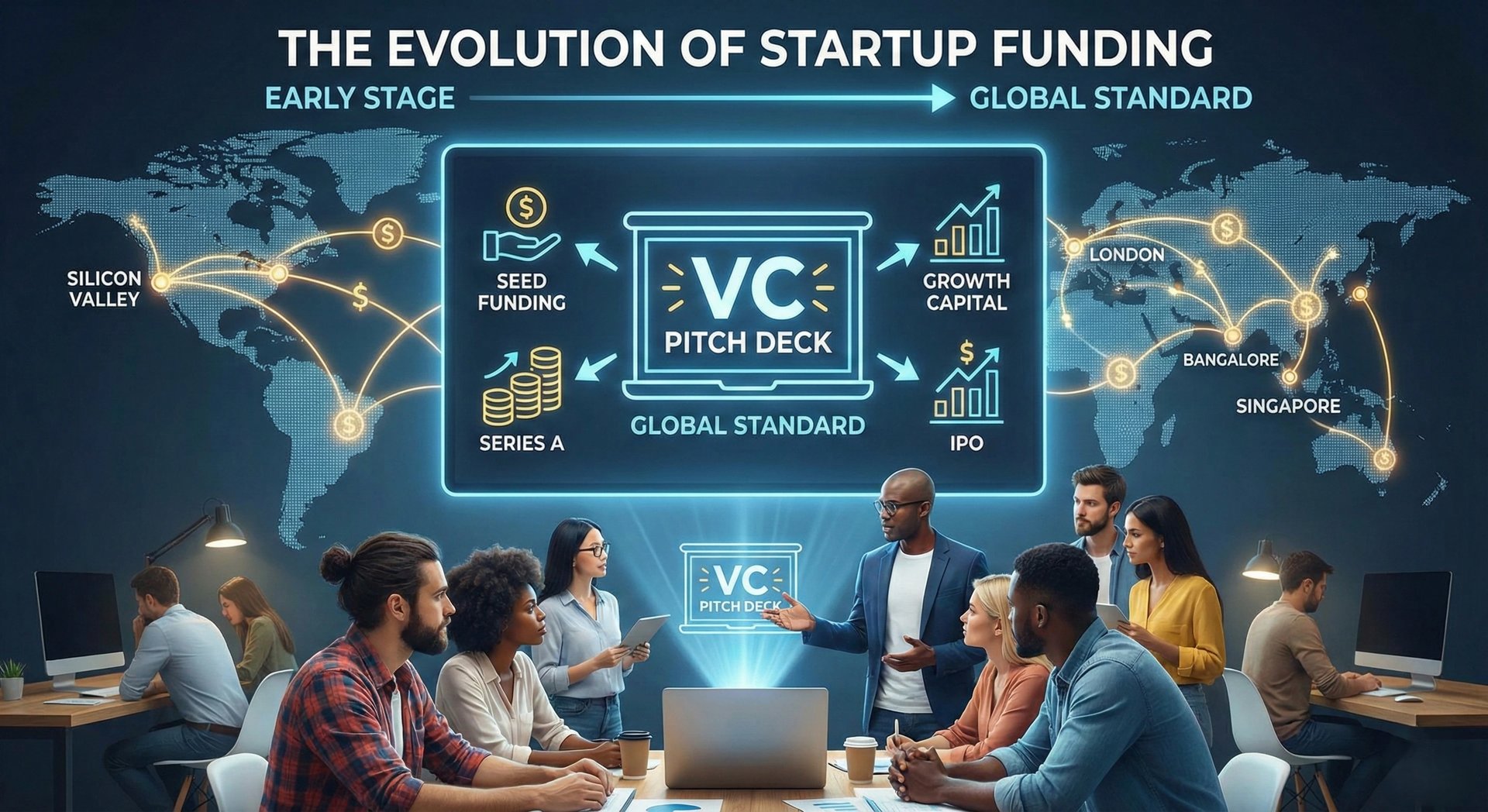
Capital has no passport. In 2026, a Series A investor in Palo Alto applies the exact same scrutiny to a SaaS company in Bangalore, Berlin, or Boston. This wasn't always the case, but the market has ruthlessly optimized itself into a single, global language. If you are trying to raise funds using a local dialect—a long-form business plan, a memo, or a "creative" video—you are effectively speaking a dead language. The "Pitch Deck" is no longer just a presentation; it is the standardized data packet for the transfer of high-risk equity. To understand why this specific format strangled all other alternatives, you must first understand What a VC Pitch Deck Actually Is (and What Investors Mean When They Ask for One). The globalization of the pitch deck is not a trend; it is the result of market forces demanding a universal interface for liquidity.
The "Tower of Babel" Problem
Before the mid-2010s, fundraising was a fragmented, high-friction mess. European founders wrote 40-page investment memorandums. Asian founders relied heavily on relationship-based "network" decks. US founders used 10-slide PowerPoint files.
The "Red Flag" Scenario
This fragmentation created massive inefficiency. A Global Macro VC looking at a deal in London had to learn a completely different information format than for a deal in San Francisco. This friction slowed down deal velocity.
When a founder today ignores the global standard to create something "bespoke," they are re-introducing this friction. The VC sees a non-standard deck and immediately diagnoses a "Translation Error."
The VC Logic: "If this founder cannot format their business into the 12-slide Silicon Valley standard, they do not read the standard literature. They are outside the information loop. They are a bad bet."
Psychological Audit: The Efficiency Imperative
The market standardized because Capital Velocity demanded it. As VCs raised larger global funds (Mega-funds), they needed to deploy capital faster. They could not afford to decipher unique formats. They needed a standardized "API" (Application Programming Interface) where they could plug in any company and get a "Yes/No" output instantly. The Pitch Deck became that API.
Network Effects and The "Sequoia Norm"
The pitch deck became the global standard through the mathematical principle of Network Effects and Standardization Arbitrage.
Think of the Pitch Deck like the Shipping Container (The TEU). Before 1956, loading ships was slow and manual. The standardized container revolutionized trade because every crane, truck, and ship in the world was built to fit one specific box size.
The Venture Capital Equivalent:
The Container: The 12-15 Slide Deck (PDF).
The Crane: The Associate/Analyst.
The Port: The Investment Committee.
The Mathematical Logic of Dominance:
The "Y-Combinator" Variable: YC and Sequoia Capital processed the highest volume of successful startups. They enforced a strict format (Problem, Solution, Traction, Team).
Pattern Recognition Velocity: Investors realized that using this specific format reduced "Time-to-Decision" by ~60%.
Old Format: 45 minutes to read a business plan.
Standard Deck: 3 minutes to scan a deck.
Global Replication: Because the US market held the most liquidity, international markets adopted US standards to access US capital.
Result: A startup in Nigeria now uses the exact same slide order as a startup in New York.
The Cognitive Load Cost:
Any deviation from this standard imposes a "Translation Tax."
Cognitive Load= Time Searching for Data + Time Analyzing Data
The Global Standard reduces "Time Searching" to near zero. If you change the format, you spike the denominator, driving the probability of funding to zero.
Mastering the "Lingua Franca"
You cannot fight the standard. You must exploit it. The Pitch Deck is the "Lingua Franca" (common language) of the asset class. To win, you must treat your deck as a compliance document, not an art project.
The Before vs. After: Alignment with Global Protocol
The Weak Version (The "Local" Approach):
Format: Varies by region or founder preference.
Content: Heavy on text, focuses on "market potential" rather than "execution proof."
Logic: "I need to explain my entire business history."
Result: The investor (who reviews 50 decks a day) cannot pattern-match. The deck is discarded.
The VC-Ready Version (The Global Standard):
Format: The "Sequoia" Flow.
Content: Data-dense, visual, high-signal.
Logic: "I need to prove I fit the specific metrics of a Series A asset."
The Protocol:
The Hook: Big Market + Acute Pain.
The Mechanism: Product + Moat.
The Proof: Traction + Unit Economics.
The Upside: Financial Projections + The Ask.
The "Universal Translator" Framework:
Your deck must function like a SWIFT Code in banking. It doesn't matter who you are; the code must work.
Slide 1 is ALWAYS the Value Proposition.
Slide 7 is ALWAYS the Competition Matrix.
Slide 10 is ALWAYS the Financials.
If you move "Financials" to Slide 2, you break the protocol. You force the investor to "re-learn" how to read your business. Do not make the money think.
The "Death Traps"
In attempting to adopt the global standard, founders often fall into "Cargo Cult" behavior—mimicking the form without understanding the function.
The "Silicon Valley Cosplay" Trap:
Using Valley jargon ("Disrupting," "Uber for X") without having Valley metrics. The standard requires the structure of a Valley deck, but the integrity of your actual data. Don't use the format to lie.
The "Template" Trap:
Downloading a generic "Canva Startup Template." These are designed by graphic designers, not fund managers. They often prioritize "About Us" slides (irrelevant) over "Unit Economics" slides (critical). The Global Standard is about information architecture, not aesthetics.
Ignoring Local Context within the Global Standard:
While the format is global, the benchmarks can be local. A Series A in India has different ARR expectations than a Series A in San Francisco. Use the Global Format, but benchmark against your specific geography's cost of capital.
The "High-Ticket" Conclusion
The Pitch Deck became the global standard because it is the most efficient method ever invented for rejecting bad businesses quickly. It is a merciless filter. By respecting this history and adhering to the format, you are signaling that you are a professional operator ready for the global stage. You are speaking the language of money.
To master the nuances of how to navigate this rigid system, read the full breakdown: How VC Pitch Decks Really Work in 2026 — And Why Most Founders Get Them Wrong.
The Filter: You can spend weeks studying the history of venture capital to understand what belongs on Slide 6, or you can simply use the Slide-By-Slide VC Instruction Guide, a critical component of our $5k Consultant Replacement Kit.
This tool doesn't just give you a template; it forces your business logic into the globally recognized "SWIFT Code" format that investors demand, stripping away the guesswork.
Secure the Consultant Replacement Kit for $497 on the home page. Speak the language of capital fluently, or don't speak at all.
Funding Blueprint
© 2026 Funding Blueprint. All Rights Reserved.