
First-Impression Bias: Nailing Your Pitch Deck Problem and Solution
VCs judge your startup in the first 8 seconds. Learn how First-Impression Bias works and how to engineer your Problem slide to survive the Series A scan.
2.8 INVESTOR PSYCHOLOGY BEHIND PROBLEM & SOLUTION SLIDES
3/1/20267 min read
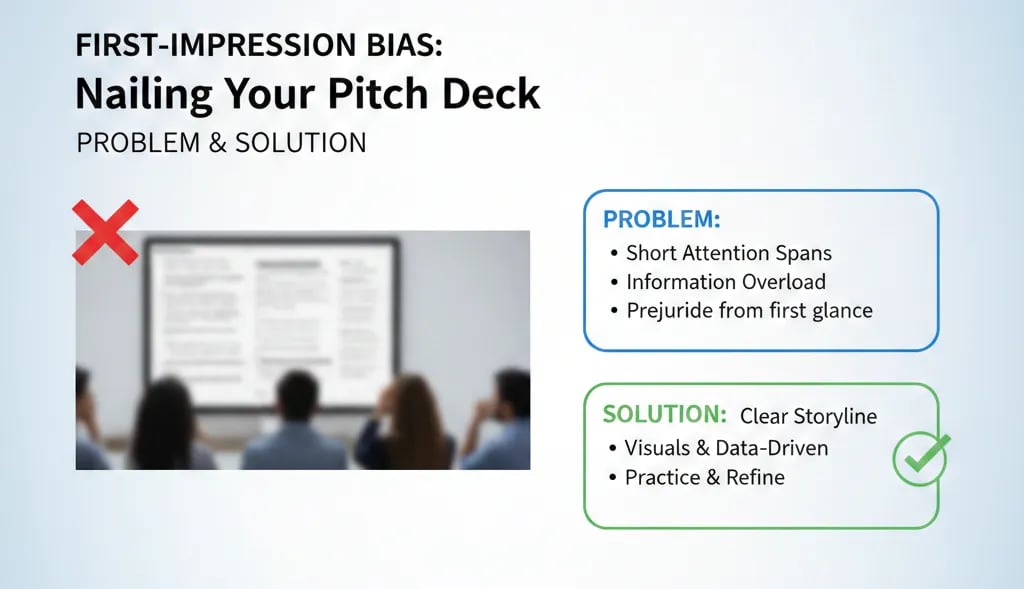
First-Impression Bias: Nailing Your Pitch Deck Problem and Solution
You will not get a second meeting. The decision was made in the first 90 seconds — before your traction slide, before your financial model, before you finished explaining what the product actually does. The partner across the table has already written a single word in their meeting notes. That word is not about your market or your team. It is about whether your Problem slide made them lean forward or start mentally drafting their decline email.
First-impression bias is not a soft behavioural quirk that affects unsophisticated investors. It is a hard cognitive mechanism that runs in every partner's evaluation process, and it is disproportionately activated by the first substantive claim your deck makes. In a Series A environment where a single partner may review 200+ decks per quarter, the heuristic is not laziness — it is load management. The consequence is structural: your Problem and Solution slides are not two slides among many. They are the psychological contract you either establish or forfeit in the opening minutes of every meeting. This dynamic sits at the centre of the investor psychology framework behind high-conversion Problem and Solution slides.
Why the First-Impression Window on Your Problem Slide Closes in Under 8 Seconds
The cognitive science behind this is not contested. First-impression formation in high-stakes evaluations follows a "thin-slice" pattern — decision-relevant judgments are made from minimal information exposure, typically within the first 5–10 seconds of encountering new input. For a VC reviewing a deck, this means the visual hierarchy, the claim structure, and the framing precision of your Problem slide are processed and partially judged before the full content is read.
This is not about aesthetics. It is about signal density. A Problem slide that opens with a broad category statement — "Healthcare is broken" — signals to the VC's pattern-matching system that the founder has not done the work to isolate the specific failure. The brain files it as a generic entry and applies a prior probability of success based on every other generic healthcare pitch the partner has seen. That prior is not kind.
The specific failure mode looks like this: a founder with a genuinely differentiated solution wraps it in a generic problem frame because they want to establish market size before specificity. The logic is understandable. The result is catastrophic. The VC's first-impression anchor is set at "undifferentiated" before the differentiation evidence appears, and confirmation bias does the rest — every subsequent slide is evaluated against the initial negative anchor rather than on its own merits.
In three decks reviewed this quarter, founders with sub-12-month payback periods and net revenue retention above 115% failed to advance past the first meeting solely because their Problem slide framing triggered a generic-pitch anchor in the first 8 seconds — the financial metrics never got the attention they deserved.
The psychological root is almost always sequencing logic imported from the wrong context. Founders who have pitched to accelerators or angel networks learn to open broad and narrow down — a structure that works when the audience has patience and limited deal flow. At Series A, the audience has neither. The VC's attention is the scarcest resource in the room, and your Problem slide either earns more of it immediately or surrenders it permanently.
The Anchor Cost: What a Weak First Impression Mathematically Removes From Your Deal
First-impression anchoring has a direct financial expression in Series A deal outcomes. The mechanism works through confirmation bias — once an initial judgment is formed, subsequent information is filtered through it rather than evaluated independently. For a VC whose initial read is negative, positive traction data does not reverse the anchor. It gets discounted against it.
Here is the quantified impact across the deal funnel:
Generic problem frame, no cited mechanism
VC Cognitive State Entering Slide 3: "Seen this. Undifferentiated."
Likely Deal Outcome: Polite decline within 48 hours
Specific problem frame, no commercial signal
VC Cognitive State Entering Slide 3: "Interesting. But why now, why them?"
Likely Deal Outcome: Second meeting conditional on resubmission
Specific problem frame + cited failure mechanism + commercial signal
VC Cognitive State Entering Slide 3: "I need to understand this better."
Likely Deal Outcome: Diligence conversation opens
In 2025, median US Series A pre-money sits at $22M–$28M, and top-tier funds are averaging 3.2 competitive deals reviewed per partner per week in active sectors. In that volume environment, the first-impression filter is not applied consciously — it is automatic. A deck that does not clear the initial anchor test inside the first two slides is competing against the VC's next scheduled meeting from the moment the Problem slide loads.
The cost is not just a lost meeting. A negative first-impression anchor affects reference dynamics. Partners talk. A deck that circulated with a weak problem frame and was declined by two funds in the same city has already shaped the informal market perception of the company before the founder has spoken to 30% of their target list.
The First-Impression Capture Protocol: Engineering Your Problem and Solution Slides for the 8-Second Window
This is the mechanical fix. It requires restructuring how your Problem slide delivers its first claim, and how your Solution slide inherits the credibility that claim establishes.
Step 1 — Lead With the Failure Mechanism, Not the Category. Your Problem slide's first sentence must identify the specific mechanism of failure — not the sector, not the size of the market, not the emotional impact on end users. The mechanism. Why is the status quo structurally broken, and what is the precise point of failure?
Weak Version: "Small business lending is slow, opaque, and inaccessible for underserved entrepreneurs." This is a category statement. It activates the generic-pitch anchor in under 3 seconds. The VC has heard this framing from 40 decks this year.
VC-Ready Version: "Community banks — which hold 60% of small business loans under $250K — declined applications at a 74% rate in 2024 due to manual underwriting processes built for borrower profiles that represent less than 20% of current applicants (FDIC Small Business Lending Survey, 2024). The underwriting model has not changed. The borrower pool has." This version leads with the failure mechanism (outdated underwriting model), cites the specific institution type and failure rate, and closes with a tension statement that forces the VC to ask "so what changed?" That question is the first-impression capture — the VC is now leaning forward before your second sentence.
Step 2 — Apply the "Inference Pull" Test. Before finalising your Problem slide, read only the first two sentences aloud and ask: Does this framing make a senior VC automatically want to know what comes next? If the answer requires them to already believe your thesis, the framing has failed. The Inference Pull test is passed when the problem statement generates a logical question the Solution slide answers. Problem and Solution slides that pass this test function as a single cognitive unit — the VC experiences them as a connected argument rather than two separate pitches.
Step 3 — Carry the First-Impression Signal Into Your Solution Slide. The Solution slide's first claim must directly reference the failure mechanism established in the Problem slide. Not loosely — precisely. If your Problem slide identified a specific failure point, your Solution slide must open by naming that exact failure point and stating what your product does to it. This continuity is what converts a positive first impression into a sustained attention signal across the first four minutes of the meeting.
The Framework — First-Impression Capture Equation: Specific Failure Mechanism (cited) + Tension Statement (why the status quo cannot self-correct) + Inference Pull (the VC's brain asks the question your Solution slide answers) = First-impression anchor set at "differentiated and evidenced."
Step 4 — Audit Your Solution Slide for Anchor Inheritance. Run this test: cover your Problem slide and read only your Solution slide to someone unfamiliar with your company. If they cannot identify the specific problem being solved from the Solution slide alone, your slides are not functioning as a connected argument — they are functioning as two independent claims. Independent claims require the VC to do cognitive work your deck should be doing for them. Every unit of cognitive work you transfer to the VC is attention transferred away from your thesis.
Three First-Impression Fixes That Create New Problems
1. Opening with a customer quote instead of a failure mechanism. Testimonials humanise a problem but they do not establish mechanism. A VC who reads "our customers told us they were drowning in manual processes" has received an emotional signal without a structural one. Emotional signals do not close uncertainty loops — they open empathy responses that have no place in a risk model.
2. Using design intensity as a substitute for claim precision. A visually polished Problem slide with a vague central claim does not produce a positive first impression. It produces a well-designed negative anchor. The VC notices the production quality and then notices the absence of precision — and the contrast makes the vagueness more visible, not less.
3. Front-loading the solution vision before the problem mechanism is established. Founders who open their Problem slide with a hint of the solution — "we saw this problem and knew there had to be a better way" — collapse the tension that makes the Solution slide land with impact. The VC needs to feel the weight of the unsolved problem before they can experience the Solution slide as a resolution. Remove all forward-leaning language from your Problem slide. The problem must feel genuinely unresolved until the Solution slide appears.
What Engineering the First 8 Seconds Is Actually Worth at Term Sheet
The first impression your Problem slide sets is the valuation anchor your entire meeting is negotiated against. A VC who enters your traction slide carrying a "differentiated and evidenced" anchor evaluates your metrics as confirmation of a thesis they are already building. A VC carrying a "generic and unverified" anchor evaluates the same metrics as insufficient evidence against lingering doubt. The numbers are identical. The pre-money outcomes are not.
In a market where the spread between the conservative and aggressive end of a Series A pre-money range is $5M–$8M, the first-impression anchor your Problem slide sets is not a soft impression variable. It is a hard valuation input. Founders who treat slide sequence as a narrative choice rather than a psychological engineering problem are pricing themselves out of the top of their range before the meeting begins.
The full architecture for how every slide in your deck either builds or undermines the psychological contract established in the first 90 seconds is covered in the complete Problem and Solution Slides framework.
You can reconstruct this Problem slide structure manually across 40 hours of iteration and test it against whatever feedback your warm intros generate, or you can deploy the Slide-By-Slide VC Instruction Guide inside the $5K Consultant Replacement Kit in a single working session — with each slide instruction built around the exact cognitive sequence a VC runs from the moment your Problem slide appears. The full Kit is $497, and it is available at the pitch deck system engineered to capture VC attention in the first 8 seconds.
Your Problem slide is not the beginning of your story. It is the only moment in the entire pitch where you control the anchor the VC will carry through every slide that follows. Treat it accordingly.
Funding Blueprint
© 2026 Funding Blueprint. All Rights Reserved.