
Why the First 30 Seconds Decide Whether Investors Continue Reading
Investors do not "read" your deck; they scan for a "No." A forensic audit of the 30-Second Kill Switch that triggers an automatic rejection before Slide 4.
1.1: WHAT A VC PITCH DECK ACTUALLY IS?
1/16/20265 min read
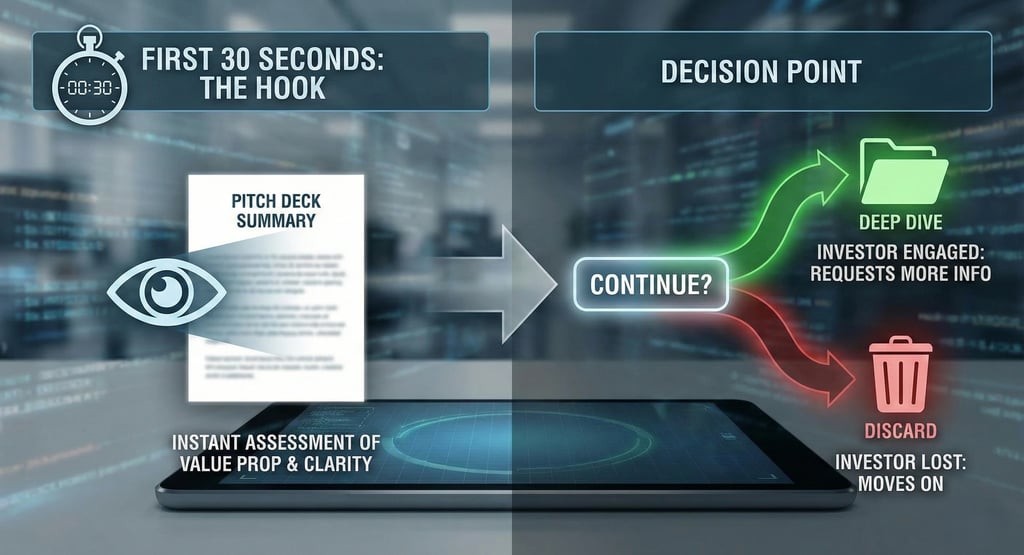
The 30-Second Kill Switch
If you believe a Venture Capitalist reads your pitch deck, you have already lost the round. Pre-Seed and Series A founders operate under the fatal delusion that investors are "exploring" opportunities. They are not. They are looking for a reason to say "No" so they can clear their inbox and go home. Your deck isn't a brochure; it is a hostile environment where your survival is determined in the time it takes to sip an espresso.
This is a foundational concept in What a VC Pitch Deck Actually Is (and What Investors Mean When They Ask for One). If you do not capture the narrative control within the first 30 seconds—specifically the first three slides—you trigger an automatic pattern-matching rejection. We don't stop reading because the business is bad; we stop reading because the signal-to-noise ratio is too low to justify the cognitive expense of digging further. The clock starts the moment the PDF opens. You are not fighting for a check yet; you are fighting for the permission to exist in our mental RAM for another two minutes.
Anatomy of an Immediate Pass
When a pitch deck fails in the first minute, it is rarely due to the product. It is a failure of information architecture.
The "Red Flag" Scenario
Here is exactly what happens on my screen. I open a deck. Slide 1 is a logo with no tagline. Slide 2 is a "Mission Statement" about democratizing access to something vague. Slide 3 is a "Problem" slide containing three paragraphs of 11-point text describing a macroeconomic trend I already know about.
My Verdict: "Pass."
The VC Internal Monologue: "This founder cannot prioritize information. They lack executive presence. If they pitch a customer like this, the sales cycle will be infinite. They don't respect my time."
I haven't even looked at your revenue, your team, or your market size. I have simply determined that you are a high-friction asset. I am looking for outliers; you have presented yourself as average noise.
Why Founders Commit Suicide on Slide 1
Why do smart technical founders build decks that act as sedatives?
The "Biopic" Fallacy: Founders view the startup as their life's work, so they want to tell the story chronologically. First we had an idea, then we met in a coffee shop... Investors are buying the future cash flows, not the history channel documentary.
Insecurity Masked as Verbosity: You fear your traction isn't enough, so you overcompensate with text, explaining every nuance of the industry to prove you are an expert. This signals the opposite: true experts simplify.
Academic Conditioning: You were taught in university to build an argument from the ground up. In Venture Capital, you must state the conclusion first (The Exit/The Opportunity) and then provide the data to back it up.
The Cost of Cognitive Load
Let’s strip away the "art" of pitching and look at the Unit Economics of Attention.
A General Partner (GP) at a tier-1 fund might see 1,000 decks a year to make 2-4 investments.
Total Decks: 1,000
investments: 4
Selection Rate: 0.4%
The GP’s time is the scarcest asset in the fund model. If a GP values their time at a blended rate of $1,000/hour (a conservative estimate considering carry potential), every second spent on a "No" is dead money.
The Cognitive Load Equation
We process decks using Heuristic Scanning. We are not reading; we are pattern-matching against successful exits we have seen before.
T (Time Allowed): 30 Seconds.
E (Effort per Slide): Should be < 3 seconds to grasp the core insight.
C (Cognitive Tax): Every undefined acronym, every generic stock photo, and every paragraph longer than two lines increases $C$.
If I have to read a sentence twice to understand what you sell, your Cognitive Tax is too high.
High Signal: "We automate SQL query generation for non-technical PMs." (Instant comprehension. 0.5s processing time).
Low Signal: "Leveraging next-gen LLMs to unlock data democratization paradigms across the enterprise stack." (Zero meaning. 5s processing time. Frustration ensues).
The math is binary. If you force the investor to do the mental labor of figuring out what you do, you have flipped the Burn Multiple of the meeting to negative. You are asking for capital and mental energy. You can only ask for one.
The 30-Second Hook Architecture
To survive the filter, you must invert the structure. You need a "Cold Open"—a narrative structure that delivers the highest value information before the investor has time to scroll.
Step 1: The "BLUF" (Bottom Line Up Front) Title Slide
Stop wasting Slide 1 on just a logo. Slide 1 is prime real estate.
Weak Version: Logo + "Pitch Deck 2026" + Date.
VC-Ready Version: Logo + "The Operating System for Commercial Plumbing" + "Current ARR: $1.2M | YoY Growth: 300%".
Result: I now know exactly what you do and that you have traction before I even hit "next."
Step 2: The Executive Summary (The "Cheatsheet")
Slide 2 is not "The Team" or "The Mission." It is the Executive Summary. This slide allows the lazy investor (me) to get the entire download in 15 seconds.
The "Power of 3" Framework:
Divide Slide 2 into three horizontal columns:
The Massive Gap: "Commercial plumbing supply chains lose 40% margin on inventory inefficiencies." (The Pain).
The Mechanism: "We built the first AI-driven inventory ledger that integrates with legacy ERPs." (The Product).
The Proof: "Signed 3 of the top 10 distributors. $500k ARR. $4T TAM." (The Traction).
Step 3: The Narrative Bridge
Slide 3 transitions to the deep dive. Do not go back to zero.
Weak Version: "Agenda" slide listing what we are about to see. (Useless).
VC-Ready Version: "Why Now." "Legacy ERPs are sunsetting in 2027, forcing a mandatory migration for 80% of the market."
Result: You have established Urgency and Inevitability.
The "Before vs. After" Comparison
The Weak Founder Deck:
Seconds 0-10: Logo slide.
Seconds 10-20: Photo of the founder looking pensive. Text: "I started this company because..."
Seconds 20-30: Definition of the market problem using generic Gartner stats.
VC Reaction: "This is a lifestyle business. Next."
The Forensic Grade Deck:
Seconds 0-10: Title Slide with "30% MoM Growth" stamped in the corner.
Seconds 10-20: Executive Summary. High-density metrics. clear value prop.
Seconds 20-30: "The Problem" slide, but framed as a "Market Fracture" that only this specific technology can heal.
VC Reaction: "Okay, the metrics are real. The problem is sharp. Let's look at the Unit Economics on slide 8."
The "Death Traps"
In an attempt to fix the first 30 seconds, founders often swing the pendulum too far into "Marketing Mode." Avoid these lethal errors:
The "Hype-Cycle" Trap: Do not stuff the first 30 seconds with "AI," "Blockchain," and "Quantum" unless you have a PhD on the team and a patent pending. If you claim to be an "AI Platform" but you are actually a GPT-wrapper, a forensic audit will expose you on Slide 4, and your reputation will be torched.
False Urgency / FOMO: "Round closing in 48 hours!" on Slide 2. If you are emailing me a cold deck, the round is not closing in 48 hours. Lying about demand signals that you are untrustworthy.
The "Logo Salad" Mistake: Putting 50 client logos on Slide 2 when 48 of them are free-tier users or "beta partners" who pay nothing. If I call one of them during diligence and they don't know who you are, the deal is dead. Only list logos that pay.
The "High-Ticket" Conclusion
Mastering the first 30 seconds does not guarantee funding, but it guarantees consideration. It moves you from the "Auto-Delete" pile to the "Partner Meeting" pile. In valuation terms, passing the 30-second test effectively adds $1M to your pre-money implied valuation because it positions you as a professionalized asset rather than a risky project.
For the complete architectural breakdown of a fundable deck, review the main pillar: How VC Pitch Decks Really Work in 2026 — And Why Most Founders Get Them Wrong.
The Filter
You can attempt to guess the correct information hierarchy, or you can use the Slide-By-Slide VC Instruction Guide included in our $5k Consultant Replacement Kit. This isn't a "template"; it is a forensic protocol that tells you exactly what data points belong on Slide 1, 2, and 3 to bypass the VC filter.
The kit is priced at $497 to filter out hobbyists. Available on the home page.
Funding Blueprint
© 2026 Funding Blueprint. All Rights Reserved.