
How Decks Move Through the Deal Flow Pipeline
Analysts are optimized for "Rejection Velocity," not discovery. A forensic audit of the "Pass the Potato" game and why 99% of decks die in the Deal Flow Pipeline.
1.2: HOW INVESTORS USE PITCH DECKS INTERNALLY
1/18/20264 min read

How Decks Move Through the Deal Flow Pipeline
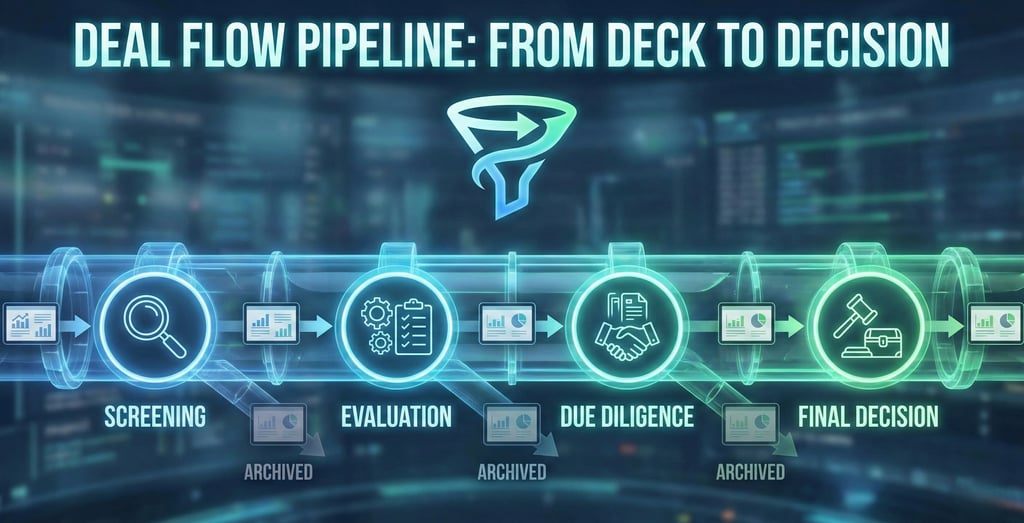
Your pitch deck is not a document; it is a filtration device, and currently, it is likely filtering you out before a decision-maker ever sees it. Most Series A founders hallucinate that a General Partner reviews their slides with a glass of scotch and an open mind. In reality, your deck is being aggressively screened by a 24-year-old analyst whose primary KPI is rejection velocity, not discovery. To understand why 99% of deal flow dies in the inbox, you must understand How Investors Use Pitch Decks Internally. If your narrative does not survive the brutality of an analyst’s 30-second triage on a mobile screen, your unit economics are irrelevant. You are not fighting for funding yet; you are fighting for permission to be processed.
The Forensic Diagnosis
The structural failure destroying your fundraise is the assumption that VCs read decks linearly. They do not. They audit them forensically.
The "Red Flag" Scenario
The analyst opens your deck. They immediately jump to Slide 4 (Market Size) and Slide 9 (Traction). If these two variables do not immediately triangulate to a "Venture Scale" return profile (i.e., 100x potential), the deck is closed.
The VC Internal Thought: "This is a lifestyle business masquerading as a venture case. The TAM is capped at $500M. Pass."
The Artifact: A deck with 20 slides of "Problem/Solution" fluff but vague financials.
Psychological Audit
Why do founders build decks this way? Narcissism and Fear. You are in love with your product nuances, so you front-load the deck with technical specifications. Simultaneously, you fear the "churn" of rejection, so you obfuscate the hard numbers (Burn Rate, CAC, LTV) hoping to explain them "on the call."
This is fatal. There is no call. By hiding the metrics, you signal incompetence or dishonesty. The analyst does not have the political capital to push a confusing deck up the chain to a Principal. Their job is to protect the Partner’s time. A confusing deck is a liability to their career, so they kill it.
The Mathematical Proof
The "Deal Flow Funnel" is not an artistic process; it is a probability function governed by time decay.
Let’s look at the Time-Allocation Math of a Tier-1 VC Firm:
Inbound Volume: 2,000 decks per year per partner.
Partner Capacity: ~2 deal slots per year.
Throughput Rate: To clear the queue, an analyst must process ~40 decks a week.
Cognitive Load Budget: They have approximately 120 seconds of initial attention per deck.
The "Cost of Confusion" Equation:
Probability of Meeting = Signal Clarity
Time to Comprehension
If your Business Model slide takes 45 seconds to decipher:
Time Remaining: 75 seconds for the rest of the business.
Friction Penalty: The analyst assumes the business itself is complex/unscalable.
Result: Rejection.
Every second of cognitive load reduces your pre-money valuation because it signals operational inefficiency. If you cannot articulate the mechanism of value capture in 10 seconds, the market won't buy it, and neither will the VC.
The "Insider" Solution Protocol
You must restructure your deck to survive the "Pass the Potato" game played internally at VC firms. The goal is to make it mathematically impossible for an analyst to say "No" without looking negligent.
The "Before vs. After" Comparison
The Weak Version (Founder Logic):
Slide 1: Vague Mission Statement ("Democratizing X").
Slide 2-5: Detailed backstory of the founder's "Aha!" moment.
Slide 20: Financials buried at the end.
Result: The analyst gets bored by Slide 3. The narrative arc is flat.
The VC-Ready Version (Insider Logic):
Slide 1 (The Executive Summary): Hard metrics upfront. "We are at $1.2M ARR, growing 15% MoM, with 110% NRR."
Slide 2 (The Wedge): Immediate definition of the specific market failure you are exploiting.
Navigation: Every slide title is a declarative sentence stating the conclusion (e.g., instead of "Competition," use "We are the only SOC-2 compliant solution in the mid-market").
The "Deal Velocity" Framework
To accelerate your deck through the pipeline, implement the "Triage-First" Protocol:
The 3-Slide Check: Ensure your Team, Market, and Traction slides can stand alone without audio. If I extract just these three, do I still want to buy equity?
The "Kill Switch" Removal: Audit your deck for "deal killers."
Example: A Cap Table showing the founder owns only 20% at Seed.
Fix: Address it immediately in a footnote (e.g., "Note: Recapitalization planned pre-round").
Use the "Rule of 10x":
Your logic must prove: Capital In X Execution = 10 X Revenue
If the math shows linear agency-style growth, you are autorejected.
The "Death Traps"
When fixing your pipeline logic, do not commit these capital offenses:
The DocSend Gate: Do not require an email to view the DocSend. The analyst is often forwarding the link to a Partner via WhatsApp or Slack. If the Partner clicks and hits a "Enter Email" wall, they will close the tab. Remove the friction.
The "Teaser" Deck: Never send a 5-slide "teaser" hoping to get a meeting to show the "real" deck. VCs treat teasers as a sign of insecurity. Send the full data room or send nothing.
Over-Design: A 50MB PDF that crashes a mobile browser is an automatic fail. Partners review deals in Ubers and airports. If it doesn't load in 3 seconds on 4G, you don't exist.
The "High-Ticket" Conclusion
Optimizing for the internal deal flow pipeline is high-leverage work. By reducing the "Time to Comprehension" for an associate, you statistically double your conversion rate from "Received" to "Partner Meeting." This efficiency allows you to drive competitive tension, which is the only lever you have to increase your valuation. A streamlined narrative is worth $1M+ in equity preservation. To understand the complete macro-environment of this process, read How VC Pitch Decks Really Work in 2026 — And Why Most Founders Get Them Wrong.
You can build this manually, or use The Slide-By-Slide VC Instruction Guide included in our $5k Consultant Replacement Kit ($497) available on the home page. It forces your data into the exact "Triage-Ready" format that analysts are trained to approve.
Funding Blueprint
© 2026 Funding Blueprint. All Rights Reserved.