
How to Prove Customer Pain in a Pitch Deck (Without Overhyping)
Stop selling a story. Learn why emotional pain evidence fails the Series A credibility test and how to use behavioral data to survive VC due diligence.
2.2 HOW TO PROVE YOUR PROBLEM IS REAL (EVIDENCE, SIGNALS & PROOF)
2/17/20267 min read
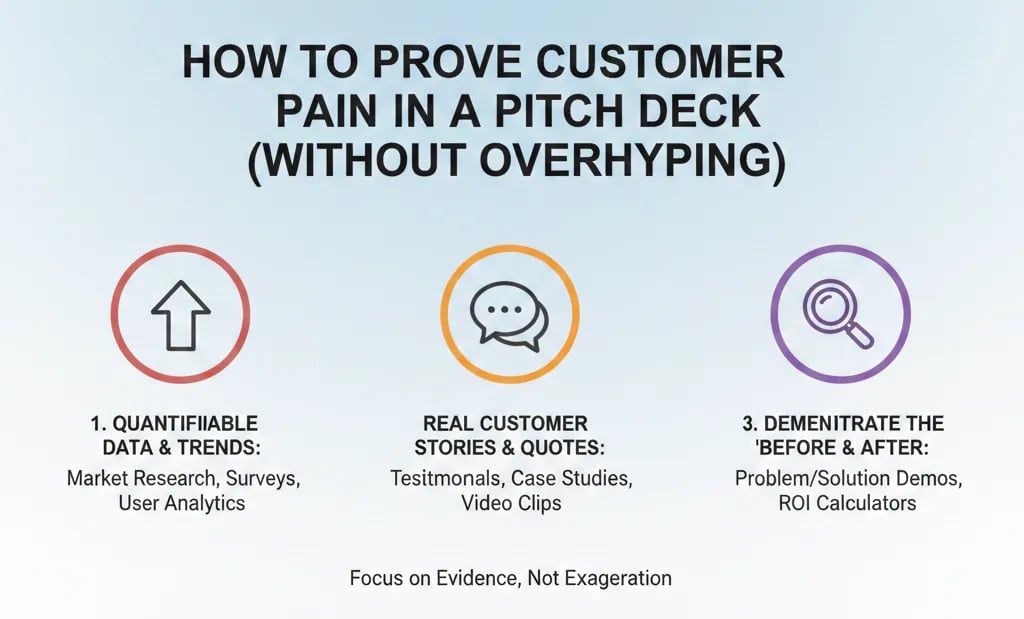
How to Prove Customer Pain in a Pitch Deck (Without Overhyping)
You will not get a second meeting. And the slide that closed that door was not your financials, your team, or your market size — it was the moment a senior partner read your customer pain evidence and thought: this founder is selling me a story, not showing me a problem.
Overhyped pain evidence is the most self-defeating error in early-stage fundraising because it signals the one thing no VC will fund past: a founder who cannot separate what they believe from what they can prove. If you are preparing a Problem Slide for an institutional raise and your current evidence consists of strong quotes, survey percentages, and a compelling narrative arc, this is for you. Understanding how institutional investors actually judge problem evidence is not a presentation skill — it is an analytical discipline, and most founders confuse the two until a partner meeting teaches them the difference the hard way.
Why Emotionally Compelling Pain Evidence Fails the Series A Credibility Test
The failure is counterintuitive, which is why it is so persistent. Founders are told — correctly — that VCs invest in pain, not features. So they build Problem Slides designed to make the pain feel visceral: powerful quotes, dramatic statistics, emotional customer stories. The slide looks compelling. The VC nods. Then they ask a single question that dismantles the entire narrative: "What is the fully-loaded cost of this problem to a single buyer in your ICP, and how did you measure it?"
If the answer involves restating the quote or citing the survey, the founder has confirmed what the VC suspected from slide two: the pain evidence is curated for persuasion, not structured for verification. These are categorically different things, and experienced investors — particularly those running the institutional-grade due diligence process that has tightened considerably since the 2023–2024 vintage reset — know the difference in under sixty seconds.
The psychological driver behind overhyping is not dishonesty. It is fear. Founders who lack hard conversion data, LOIs, or pilot agreements compensate by making the problem feel undeniable. The instinct is human. The result is a slide that reads as advocacy, not analysis, and advocacy from a founder about their own problem is the weakest possible evidentiary form. I have seen this specific framing — strong qualitative evidence presented without a single quantified buyer cost — in fourteen decks across the past year; eleven of them did not advance past the first partner call. The pattern is that consistent.
The compounding damage is structural: an overhyped Problem Slide poisons every downstream slide. If your pain evidence is not credible, your TAM is not credible. If your TAM is not credible, your revenue model is not credible. The Problem Slide is not just a narrative opener — it is the evidentiary foundation that the rest of the deck is stress-tested against.
The Analytical Cost of Overhyped Pain Evidence: What the VC Scorecard Actually Measures
Here is the internal calculation a VC runs when evaluating pain evidence credibility. The logic is systematic.
The Pain Evidence Credibility Matrix:
For an Emotional customer quote, the Persuasion Score from the Founder's View is High, but the Credibility Score from the VC View is Low, as it is unverifiable and selection bias is assumed.
For an Industry report statistic, the Persuasion Score is Medium, and the Credibility Score is also Low, since it is third-party and not ICP-specific.
For a Founder's own survey (n=50+, ICP-filtered), the Persuasion Score is Medium, and the Credibility Score is Medium as well, though the methodology is scrutinised.
For Discovery interviews with quantified cost, the Persuasion Score is High, and the Credibility Score is also High — if documented and sourced.
For Pilot data showing measurable workflow failure, the Persuasion Score is High, and the Credibility Score is Very High, as it is behavioural, not attitudinal.
Finally, for an LOI or design partner agreement, the Persuasion Score is N/A to most founders, while the Credibility Score is Definitive, as it serves as a commitment signal.
The credibility gap between what founders present and what VCs weight is the core problem. A quote saying "this costs us so much time every week" has zero input into a CAC model, a pricing assumption, or a retention thesis. A documented finding that "eighteen of our twenty-two ICP interviews reported an average of 31 hours per month lost to this workflow, at a fully-loaded cost of $2,200–$3,800 per month per team" has direct input into all three.
As of 2025, top-tier US and UK Series A funds are operating with due diligence timelines of 10–14 weeks post-term sheet, significantly longer than the 6–8 week window common pre-2022. Inside that window, every qualitative claim on a Problem Slide will be independently verified or exposed. Founders who build pain evidence designed to persuade rather than withstand verification are building toward a due diligence failure, not away from one.
The cognitive arithmetic is straightforward: every unverifiable pain claim costs the founder credibility capital that they will need to spend later on more contested assertions — team capability, market timing, competitive moat. You do not have infinite credibility to spend. Do not waste it on the Problem Slide.
The Pain Proof Protocol: Building Evidence That Survives Partner-Level Scrutiny
This is the structural fix. It requires discipline before the deck is built, not formatting choices after.
Step 1: The Quantified Pain Formula
Every pain statement in your Problem Slide must be expressible in this form:
[Named Buyer Type] experiences [Specific Failure Event] [Frequency], resulting in [Measurable Cost: dollars, hours, or risk exposure], confirmed across [Sample Size] interviews/pilots with [ICP Filter Applied].
Weak version: "Operations teams are overwhelmed by manual data entry and lose hours every week to reconciliation tasks."
VC-Ready version: "Operations leads at 50–200 person logistics companies spend an average of 19 hours per week on manual shipment reconciliation — equivalent to $28,400 per year in fully-loaded coordinator cost — confirmed across 24 discovery interviews with operations directors in our ICP. Eleven described active budget conversations to solve it."
The second version gives a VC a pricing anchor, an ICP confirmation, a cost-of-inaction number, and a demand signal. All from one evidence statement.
Step 2: Separate Attitudinal from Behavioural Evidence
This is the most important analytical distinction in pain validation and the one founders most consistently collapse.
Attitudinal evidence: What people say about the problem ("it's a huge pain," "we desperately need a solution")
Behavioural evidence: What people do because of the problem (paying for a workaround, hiring a contractor to manage it, building an internal tool, tolerating measurable revenue loss)
Behavioural evidence is an order of magnitude more credible than attitudinal evidence. If your buyers are already paying for an imperfect solution, that is your strongest possible pain signal — and most founders bury it in a competitive landscape slide instead of leading with it on the Problem Slide.
The framework is simple: for every qualitative quote on your Problem Slide, ask whether there is a corresponding behaviour you can document. If a buyer says "we waste so much time on this," the behavioural correlate is: how much are they currently spending on the workaround? That number belongs on the Problem Slide, not the quote.
Step 3: The "Sceptic's Version" Stress Test
Before submitting your deck, rewrite your Problem Slide from the perspective of a VC who does not believe you. Ask: what would a sceptic need to see to be convinced this problem is real, costly, and unsolved? If your current slide does not answer that challenge inside the visual, it is not ready.
The sceptic's checklist has four lines:
Is the buyer named and ICP-specific? (Not "businesses" — "Series B SaaS CFOs")
Is the cost quantified in dollars or hours? (Not "significant" — "$34,000 per year")
Is the sample size disclosed with an ICP filter? (Not "our research shows" — "across 19 interviews, all matching our ICP")
Is there a behavioural signal alongside the attitudinal one? (Workaround spend, internal tool build, contractor hire)
If any of those four lines returns a no, the slide is not VC-ready.
Three "Pain Proof" Corrections That Create New Credibility Problems
1. Overprecision without methodology. Stating "$34,217 average annual loss per buyer" without explaining how you calculated it is worse than a round number with a clean methodology. VCs will ask. If the answer is "we extrapolated from three interviews," the false precision destroys credibility faster than vagueness would have.
2. Leading with the market statistic instead of the buyer cost. "The $4.2B spend on legacy ERP systems proves the pain is real" is a market framing, not a pain framing. It tells the VC the category is large. It does not tell them what your specific buyer loses, which is the only number that matters for pricing and positioning. Use market data to contextualise, never to lead.
3. Presenting pain evidence that is more than 12 months old. Buyer behaviour shifts. A discovery interview from Q1 2023 describing a pain point may no longer reflect how that buyer's organisation operates, what tools they have adopted, or what budget they have access to. Stale evidence signals a founder who validated once and stopped listening — precisely the operating pattern that kills companies post-raise.
The Valuation Consequence of Pain Evidence That a VC Cannot Dispute
A Problem Slide built on quantified, behavioural, ICP-specific pain evidence does one thing that no amount of narrative craft can replicate: it makes your pricing defensible before you reach the pricing slide. If you have documented that your buyer loses $28,000 per year to this problem and your product costs $9,600 annually, the value equation is closed before it is even raised. That is not a small advantage. In the current Series A environment — where US pre-money valuations are clustering at $22M–$28M and investors are applying significantly more scrutiny to unit economics assumptions than in 2021 — a founder who can anchor their pricing to a documented buyer cost enters the term sheet conversation with a materially stronger negotiating position.
Do not curate pain. Quantify it, source it, and stress-test it against the sceptic's version before it enters a partner meeting. For the complete architecture governing how your Problem Slide connects to your Solution, Traction, and financial narrative, see the full Problem and Solution Slide framework for Series A fundraising.
Founders who have used the Slide-By-Slide VC Instruction Guide inside the $5K Consultant Replacement Kit go into partner meetings with pain evidence already structured to match what the VC's analyst will verify during due diligence — including the exact format for quantified buyer cost, behavioural signal documentation, and ICP filtering that separates a credible Problem Slide from a persuasive one. That is not a marginal edge at a $25M pre-money negotiation. The full Kit is $497, and you can access it alongside the complete institutional pitch deck validation system at FundingBlueprint.
Prove the pain. Do not sell it.
Funding Blueprint
© 2026 Funding Blueprint. All Rights Reserved.