
Why Pitch Decks Exist: The Real Purpose Behind Them
Your Pitch Deck is not a brochure; it is a "Financial Option Contract." A forensic audit on why "Education" spikes Cognitive Load and kills Series A fundraises in 6 seconds.
1.1: WHAT A VC PITCH DECK ACTUALLY IS?
1/14/20265 min read
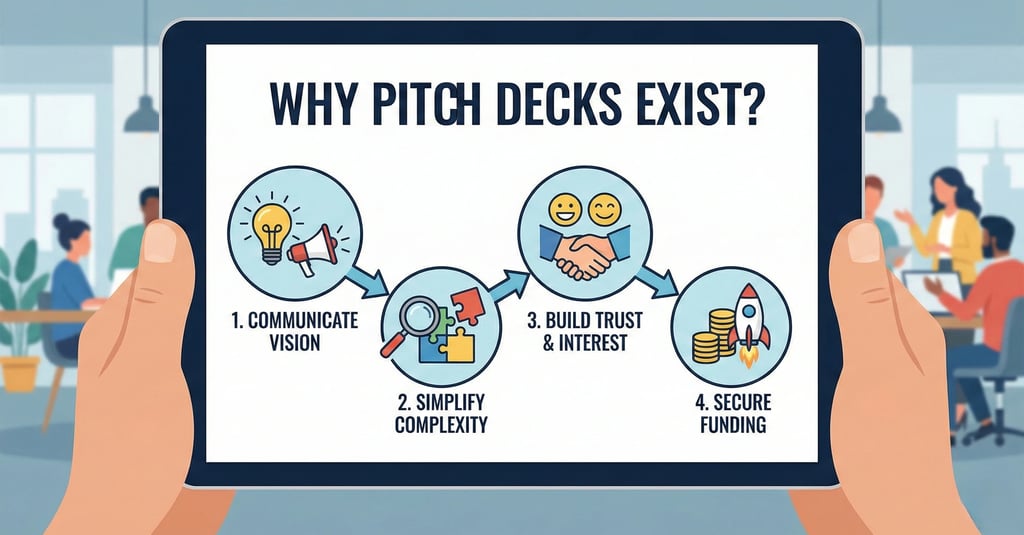
The Asset Allocation Filter: Why Your Pitch Deck Is Not a Brochure
If you are a Seed or Series A founder treating your pitch deck as a "comprehensive business plan" or an "educational document," you have already failed the first audit. In the high-velocity capital markets of 2026, nobody reads. They scan, they judge, and they disqualify. The counter-intuitive truth is that the purpose of a pitch deck is not to secure funding. That is a hallucination of the uninitiated. The sole, mechanical function of a deck is to buy you twenty minutes of attention on a Zoom call. That is it.
You are not selling a vision; you are selling a metric that fits a specific risk profile. If you fail to understand this distinction, you are simply creating noise in an inbox that receives 400 separate solicitations a week. This fundamental misunderstanding is why 98% of cold outreach is deleted within six seconds. To survive the initial cull, you must understand the architectural difference between a marketing brochure and What a VC Pitch Deck Actually Is (and What Investors Mean When They Ask for One). If you cannot separate "explaining your product" from "selling your equity," you are uninvestable.
The Forensic Diagnosis
Why does the "Brochure Mindset" destroy fundraises with 100% lethality? Because it signals a lack of operational focus.
When a General Partner (GP) opens a deck and sees a "Problem Slide" that spans three pages with dense paragraphs explaining the history of the Fintech industry, they do not think, "Wow, this founder is thorough." They think, "This founder cannot prioritize."
The "Red Flag" Scenario
Let’s look at the forensic evidence found in a failed Series A deck.
The Slide: A "Market Opportunity" slide containing four different CAGRs, quotes from Gartner, and a history of the internet.
The VC Internal Monologue: "I know the market size. I have three analysts who do nothing but size markets. I don't need a history lesson; I need to know why you are the only entity capable of capturing 1% of it within 18 months. Next."
The Psychological Audit
Why do intelligent founders commit this error? It usually stems from Imposter Syndrome masquerading as "Context." Founders fear that if they don't explain every nuance of the problem, the investor won't "get it." This is a fatal ego error. You assume the investor is a student waiting to be taught. In reality, the investor is a capital allocator looking for a pattern match. By over-explaining, you trigger the "Consultant Frame"—you look like an advisor, not an executor. Investors back assassins, not professors.
The Cost of Cognitive Load
We can prove the failure of the "Brochure Deck" using simple time-value logic and the mechanics of VC fund economics.
A standard VC associate reviews 50 to 100 decks per day. If they spend 5 minutes on each, that is 8 hours of reading. This is physically impossible. The actual average review time for a pre-meeting deck is 2 minutes and 42 seconds.
If your deck requires 10 minutes of cognitive load to understand the core value proposition, you are asking for a 370% "attention premium" over the market average. You are technically insolvent on an attention basis.
The "Time-to-Insight" Equation:
Score = Capital Efficiency
Time to Understand
If the denominator (Time to Understand) increases, the Score approaches zero, regardless of how good the numerator (Capital Efficiency/Metrics) is.
The Logic Chain:
Step 1: VCs operate on a Power Law distribution. Only 1 in 100 investments returns the fund.
Step 2: To find that 1, they must reject the 99 "false positives" as fast as possible.
Step 3: A deck that requires deep reading prevents rapid rejection.
Step 4: Paradoxically, this does not make them read it more; it makes them reject it immediately to preserve bandwidth.
Step 5: Therefore, ambiguity is treated as incompetence. If I have to hunt for your ARR, I assume it is low. If I have to hunt for your Burn Multiple, I assume it is high.
Every extra second of cognitive load essentially dilutes your perceived valuation. You are taxing the investor's time before you have generated a single dollar of return for them.
The "Insider" Solution Protocol: The Trailer, Not the Movie
To fix this, you must pivot your strategy from "Education" to "Verification." Your deck is a movie trailer. The movie is the Partner Meeting. If the trailer shows the entire plot, the twist ending, and the credits, nobody buys a ticket.
The Protocol
You need to construct a narrative that answers three binary questions in under 90 seconds. If the answer to any of these is "maybe," you are dead.
Is this a Venture Scale market? (Yes/No)
Is this team capable of executing? (Yes/No)
Is the math working right now? (Yes/No)
Before vs. After Comparison
The Weak Version (The "Educator"):
Slide Header: "Understanding the Inefficiencies in Global Supply Chain Logistics."
Content: Two paragraphs of text describing how shipping containers get stuck in ports. A stock photo of a ship.
Metric: None.
VC Reaction: "Boring. I already invested in Flexport. Pass."
The VC-Ready Version (The "Assasin"):
Slide Header: "We Reduce Port Wait Times by 40% for Enterprise Clients."
Content: A split screen. Left side: "Standard Process (14 Days)." Right side: "Our Algorithm (8 Days)."
Metric: "Unit Economics: $400 saved per container. CAC: $50. Payback: Immediate."
VC Reaction: "The math works. How did they do that? I need to ask them."
The "Signal-to-Noise" Ratio
Use the Rule of 10/20/30 modified for 2026 Forensic Audits:
10 Slides: If you can't explain your business in 10 slides, you don't understand your business model.
20 Minutes: The deck should support a 20-minute verbal defense, but stand alone in a 2-minute read.
30 Point Font: Force brevity. If you have to use font size 12 to fit your text, you are writing a novel, not a pitch.
The Golden Formula for Slide Density:
Value = Key Metric + Insight
Word Count
Maximize the metric, minimize the word count. If a sentence does not directly support the claim that you will return 10x capital, delete it.
The "Death Traps"
In attempting to optimize for brevity and impact, founders often swing too far in the opposite direction. Avoid these specific lethal errors:
The "Teaser" Delusion: Do not hide your metrics to "create mystery." This is not a dating app. If you hide your Revenue or Burn Rate hoping to "reveal it in the meeting," the VC assumes the numbers are catastrophic. Transparency is the only currency that matters.
The Design Overkill: A beautiful deck with zero substance is arguably worse than an ugly deck with good numbers. Do not let your designer turn your Pitch Deck into an abstract art piece. If the design obscures the data, fire the designer. Legibility beats aesthetics every time.
The "2021 Valuation" Trap: Do not paste valuation comps from 2021 (e.g., "Competitor X raised at 100x ARR"). We are in 2026. Capital is expensive. Interest rates are real. If you anchor your deck to a bubble-era valuation, you signal that you are financially illiterate.
The "High-Ticket" Conclusion
Understanding the true purpose of a deck shifts the power dynamic. You stop begging for validation and start offering an asset allocation opportunity. By stripping away the fluff and focusing on the mechanical transfer of information, you respect the investor's time and demonstrate executive maturity. This shift alone can be the difference between a flat rejection and a term sheet. It protects your equity by ensuring you are valued on your metrics, not your ability to write prose.
For a comprehensive breakdown of the entire capital raising ecosystem, review How VC Pitch Decks Really Work in 2026 — And Why Most Founders Get Them Wrong.
The Filter: You can spend the next six weeks A/B testing your slides against a wall, or you can use the Slide-By-Slide VC Instruction Guide included in our $5k Consultant Replacement Kit. It contains the exact structural templates that pass the 2-minute analyst screen, stripping out the guesswork. At $497, it costs less than one hour of a bad consultant's time and solves the "Cognitive Load" problem instantly. You can build this manually, or use the Slide-By-Slide VC Instruction Guide included in our $5k Consultant Replacement Kit ($497) available on the home page.
Funding Blueprint
© 2026 Funding Blueprint. All Rights Reserved.