
The 7-Second VC Pitch Deck Scan: Testing Your Narrative Congruence
VCs spend 7 seconds on your opening slides. Does your deck survive the scan? Discover why narrative congruence is the ultimate Series A fundable signal.
2.4 CONNECTING PROBLEM → SOLUTION LIKE A VC (NARRATIVE LOGIC MODEL)
2/21/20267 min read
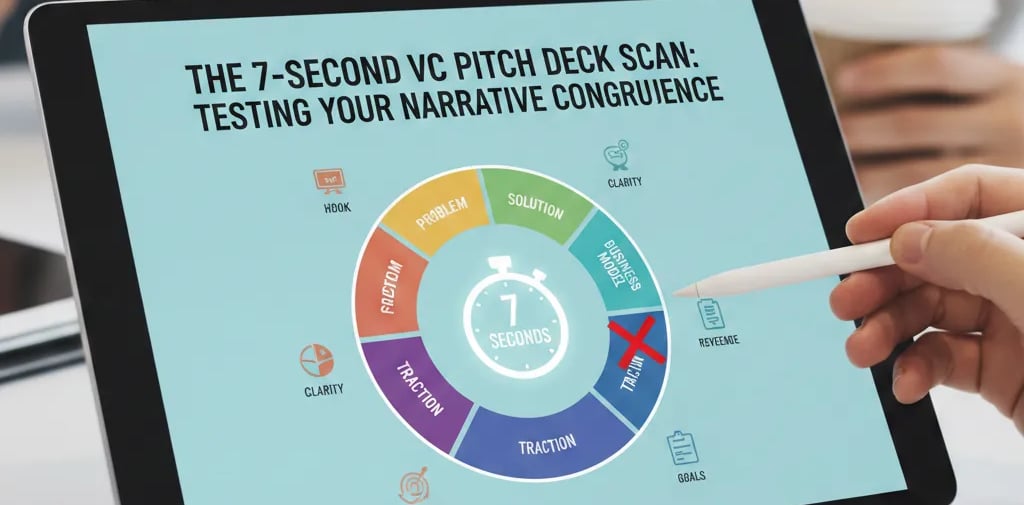

The 7-Second VC Pitch Deck Scan: Testing Your Narrative Congruence
$47,000. That is the approximate cost per hour of a General Partner's time at a top-quartile US Series A fund — and they are spending seven seconds of it on your opening slides before forming a directional opinion on your deal.
That figure is not rhetorical. It is the arithmetic consequence of a $300M fund, a three-person investment team, and a ten-year fund life with active deployment in years one through five. When a VC gives your deck seven seconds, they are not being dismissive. They are running a trained pattern-recognition scan — and what they are scanning for is narrative congruence: the degree to which your Problem, Root Cause, and Solution form a single coherent argument without requiring supplementary explanation. The mechanics of that congruence are the foundation of the VC narrative logic model that connects Problem to Solution at the structural level. Most founders do not know this scan is happening. Fewer still know exactly what it is checking.
What the 7-Second Scan Actually Measures -and Why Narrative Congruence Is a Fundable Signal
The seven-second scan is not aesthetic. It is not about fonts, colour palettes, or whether your deck is in 16:9. It is a rapid logical audit that a trained investor runs involuntarily after reviewing thousands of decks — and the specific question it answers is this: does the argument in this deck hold together at the structural level, or does it require the founder to be in the room to make sense?
Narrative congruence is the measurable property that scan is testing. A deck with high narrative congruence allows the VC to trace the logical chain — Problem to Root Cause to Solution to Market Consequence — without explanation, annotation, or the benefit of a live pitch. A deck without it creates micro-gaps that accumulate into a general sense of unreadiness, even when the underlying business is sound.
The failure mode is not dramatic. It is subtle: a Problem Slide that frames one user, a Solution Slide that describes a different use case, a headline on slide three that uses terminology inconsistent with slide two. Individually, each gap is minor. Collectively, they produce the specific partner feedback that founders receive and cannot decode: "We weren't fully convinced by the narrative." That sentence is not about storytelling. It is about logic.
I have reviewed over thirty decks in the first two months of this year where founders reported receiving that exact feedback — in twenty-four of them, the narrative incongruence was traceable to a single misalignment between the Problem Slide's user definition and the Solution Slide's outcome claim. A one-slide fix that none of those founders had identified before the meeting.
The psychological cause is proximity. Founders read their own decks with the full context of everything they know about their business. They mentally fill the logical gaps without registering them. The VC reads the deck cold — and every gap the founder does not see is a gap the investor falls into.
A Mathematical Framework for Scoring Your Own Deck in Under 10 Minutes
As of early 2026, several established US and UK Series A funds have formalised their analyst pre-screen into a structured scoring rubric — narrative coherence between Problem and Solution is an explicit criterion in at least three top-quartile funds' internal evaluation frameworks, according to founders who have been through those processes in the current vintage. This is not an informal impression anymore. It is a scored checkpoint.
Here is a self-administered congruence audit you can run on your own deck before it reaches an analyst:
The Five-Variable Congruence Test:
The Five-Variable Congruence Test
User Role
Problem: Who is experiencing the problem?
Solution: Who does the product serve?
Congruence: Must match exactly.
Quantified Cost
Problem: What does the problem cost (dollars, hours, or rate)?
Solution: What does the solution recover or save?
Congruence: Must use the same unit of measurement.
Process Step
Problem: Where in the workflow does the failure occur?
Solution: Where in that same workflow does the product intervene?
Congruence: Must reference the same step.
Causal Language
Problem: What breaks?
Solution: What does the product fix?
Congruence: Must be causally linked, not parallel.
Metric Anchor
Problem: What is the scale of the problem?
Solution: What is the scale of the outcome?
Congruence: Must be proportional and sourced.
Score each row as 1 (congruent) or 0 (misaligned). A total score below 4 out of 5 means your deck will not pass a structured analyst pre-screen in a process-driven fund. A score of 3 or below means the seven-second scan is producing a negative signal before the VC has finished the first two slides.
The congruence equation: Narrative Congruence Score = Matched Variables ÷ 5. A score of 1.0 means every variable the Problem Slide introduces is directly resolved by the Solution Slide. A score of 0.6 means two variables are floating — and in a seven-second scan, floating variables register as incoherence, not nuance.
Run this test on your current deck before reading further. The score you get is a proxy for the signal your deck is sending before you ever enter a room.
The Congruence Rebuild Protocol: How to Close Every Logical Gap the 7-Second Scan Exposes
This protocol assumes you have run the audit above and identified at least one misaligned variable. Work through these steps in order. Do not skip to visual refinement until the logical layer is clean.
Step 1: Lock the User Definition Across Both Slides. Choose one specific user role and use identical language on both slides. Not "operations teams" on slide three and "enterprise buyers" on slide five. Not "CFOs" in the headline and "finance departments" in the body text. One role, one label, used consistently. If your product serves multiple users, the Problem-Solution pair addresses the primary user only. Secondary personas belong in the appendix.
Step 2: Align the Unit of Measurement. If your Problem Slide quantifies the pain in hours lost per week, your Solution Slide must quantify the outcome in hours recovered per week — not in "efficiency gains" or "productivity improvements." The VC's brain is running a unit-matching check. If the units change between slides, the logical connection breaks even if the argument is technically valid.
Weak Version:
Problem Slide: "Procurement teams spend 14 hours per week on manual PO reconciliation."
Solution Slide: "Our platform reduces operational overhead and improves process efficiency by up to 60%."
VC-Ready Version:
Problem Slide: "Procurement teams spend 14 hours per week on manual PO reconciliation — at a fully-loaded cost of $34K per team annually."
Solution Slide: "Our automated reconciliation layer reduces that 14-hour process to 40 minutes per week — recovering $31K annually per team. Confirmed across four enterprise customers at an average ACV of $78K."
The second version passes every row of the five-variable congruence test. The first version passes one.
Step 3: Make the Causal Link Explicit in the Solution Headline. Your Solution Slide headline must contain a grammatical reference to the failure the Problem Slide named. Not a thematic echo — a direct reference. The word "reconciliation" must appear if "reconciliation" was the named failure. The phrase "14 hours" must appear if "14 hours" was the quantified cost. The VC's seven-second scan is running a keyword-level pattern match between your headlines. If the keywords do not connect, the narrative does not connect.
Step 4: Test Congruence by Removing All Body Text. Strip every slide down to headline only. Read the headlines in sequence. If the logical argument survives the removal of all body text — if the headline chain tells a coherent story without supporting content — your narrative congruence is structurally sound. If the argument collapses without the body text, your headlines are decorative rather than load-bearing. Rebuild the headlines until they carry the argument independently.
The equation: Locked User Definition + Matched Units + Causally-Linked Headlines + Headline-Only Logic Test = Congruence Score of 1.0.
Step 5: Run the Cold Read Protocol. Send the deck to someone who has no prior context on your business — not a co-founder, not an advisor who has heard your pitch. Ask them to read it once, close it, and write down in one sentence what problem you solve and for whom. If their sentence matches your own, your narrative congruence is externally valid. If it does not, the gap they fell into is the same gap a VC will fall into at second seven.
Three Congruence Errors Founders Create While Trying to Fix Their Decks
1. Achieving surface congruence without structural congruence. Founders who receive the "narrative" feedback often respond by making their Problem and Solution Slides visually consistent — same template, same colour scheme, same font sizing. Visual consistency is not narrative congruence. A VC scanning for logical alignment is not checking your design system. They are checking whether the argument on slide three is answered by slide five. You can have a perfectly designed deck with zero narrative congruence.
2. Fixing the deck instead of testing the fix. The most common rebuild error is iterating on the deck in isolation — making changes and reading them back in context, where proximity again fills the logical gaps. Every revision must be tested using the Cold Read Protocol with a new reader who has not seen the previous version. Internal review of your own edits is not a valid congruence test.
3. Treating congruence as a one-time fix. Every time your product positioning evolves, your customer definition sharpens, or your metrics update, the congruence between your Problem and Solution Slides must be re-audited. Founders who fix congruence once and then update individual slides without re-running the five-variable test routinely re-introduce gaps they had previously closed. The audit is a recurring discipline, not a one-time exercise.
The Commercial Value of a Deck That Passes the 7-Second Scan
A deck with a congruence score of 1.0 does something specific to the pre-screen outcome: it eliminates the analyst's most common rejection rationale. "Unclear product-market fit rationale" — the diplomatic phrasing for a broken logical chain — disappears as a screen-out criterion when every variable your Problem Slide introduces is directly resolved by your Solution Slide. What remains is a conversation about market size, competition, and team — the commercial questions where strong founders win. In a market where US Series A pre-money valuations are clustering between $22M and $28M and partner meeting slots are allocated on analyst recommendation, clearing that pre-screen is not a small edge. It is the gate everything else depends on.
The full architecture for building and maintaining narrative congruence across your complete Problem and Solution Slides is in the Problem and Solution Slides system for Series A founders.
You can build this congruence audit manually across multiple revision cycles, or you can use the 16 VC-Quality AI Prompts inside the $5K Consultant Replacement Kit — which include specific prompts engineered to stress-test narrative congruence across your Problem and Solution Slides against the exact five-variable standard analyst pre-screens are running in current vintage funds. The full Kit is $497. Access it at the pitch deck congruence system built for founders raising Series A in 2025–2026.
Funding Blueprint
© 2026 Funding Blueprint. All Rights Reserved.