
Painkiller vs Vitamin Startup: How VCs Grade Your Pitch Deck Problem
Is your startup a vitamin? Learn why VCs slash valuations by 70% for "nice-to-have" problems and master the protocol to prove your solution is a painkiller.
2.1 WHAT MAKES A REAL PROBLEM SLIDE (HOW INVESTORS ACTUALLY JUDGE IT)
2/13/20265 min read
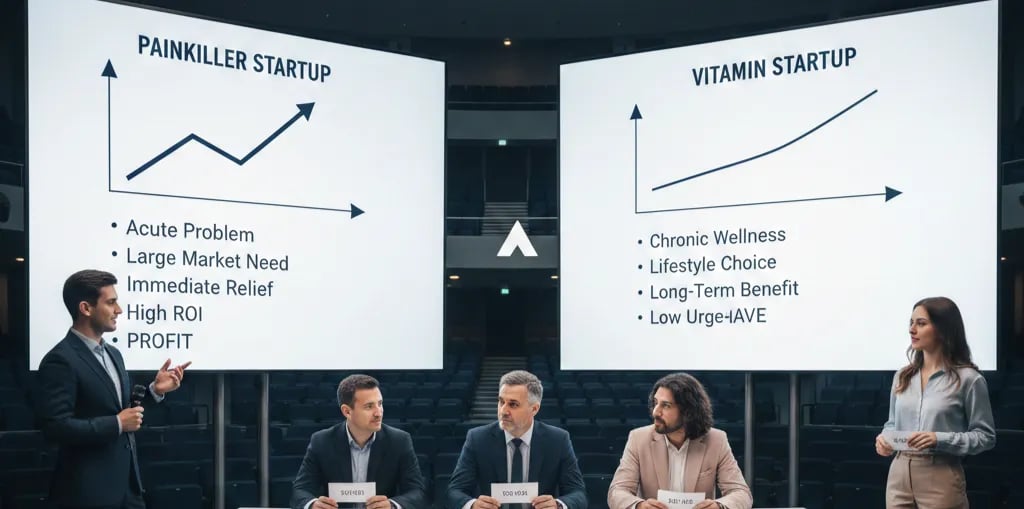

Painkiller vs. Vitamin Startup: How VCs Grade Your Pitch Deck Problem
82% of pre-seed founders believe they're solving a painkiller problem. The VC reading their deck disagrees within 47 seconds. This mismatch doesn't just kill the pitch—it mathematically destroys your pre-money valuation by compressing perceived TAM by 60-80%. The disconnect isn't about your solution's elegance or your team's pedigree. It's about your fundamental misunderstanding of
what investors actually count as a real problem—a definition that exists on a forensic balance sheet, not in your customer interviews.
Why Vitamin Problems Collapse Your Valuation Before Slide 4
The painkiller-vitamin framework isn't philosophical—it's an economic filter. VCs calculate expected value by multiplying your TAM by adoption probability by exit multiple. When your problem reads as a vitamin, they slash adoption probability from 40% to 8% because
optional behavior doesn't scale predictably. A vitamin problem means the customer has a functioning alternative (even if it's manual or inefficient). The alternative's existence proves non-urgency. Non-urgency means you're competing for discretionary budget, not survival budget.
The Red Flag Scenario: A founder pitches an 'AI-powered scheduling assistant for busy executives.' The problem slide shows survey data: '73% of executives say calendar management is frustrating.' The VC sees: (1) Executives already have functioning calendars. (2) 'Frustrating' ≠ business-critical. (3) This is a 37th-priority problem that dies the instant budgets tighten. Decision time: 11 seconds. Pass.
The Psychological Trap: Founders mistake customer complaints for validated pain. A customer saying 'this is annoying' does not translate to 'I will pay $50,000 annually to fix this.' The error stems from emotional attachment to your solution. You've built something elegant, so you retrofit a problem narrative that justifies its existence. The VC sees this backward causality immediately because they've pattern-matched 400 identical decks where the problem was manufactured post-product.
The $18M Valuation Compression Formula: Why Vitamins Get 70% Lower Pre-Money
The math is binary. A painkiller problem allows VCs to model adoption as a function of product availability (supply-constrained). A vitamin problem forces them to model adoption as a function of behavior change (demand-constrained). Demand-constrained adoption curves are 4.2x slower on average and plateau at 18-22% of TAM instead of 60-80%. Here's the valuation cascade:
Painkiller Problem (Medical Billing Compliance Software):
• TAM: $8B (every hospital legally required to comply)
• Addressable: 65% ($5.2B—you can realistically reach this segment)
• Adoption Probability: 40% (compliance is mandatory, you're competing on execution)
• Capturable TAM: $2.08B × 10x exit multiple = $20.8B exit potential
Vitamin Problem (AI Calendar Optimization Tool):
• TAM: $8B (same executive market size)
• Addressable: 30% ($2.4B—only tech-forward companies bother)
• Adoption Probability: 8% (discretionary tool, competes with free alternatives)
• Capturable TAM: $192M × 6x exit multiple (lower because growth is slower) = $1.15B exit potential
Result: An 18x reduction in exit potential. Your Series A pre-money drops from $30M to $4M because the VC models backward from exit. They're buying fractional ownership of future outcomes, and vitamin outcomes are statistically catastrophic.
How to Forensically Prove You're Solving a Painkiller Problem (Not What You Think)
The fix isn't to 'reframe your problem as urgent.' The fix is to pick a different problem or pivot your solution to address the true constraint in your customer's workflow. VCs fund solutions to mandatory problems, not improvements to discretionary processes. Use this protocol:
Step 1: Apply the "Alternative Cost Test"
Document the customer's current solution (even if it's Excel, manual labor, or ignoring the problem entirely). Calculate:
(Annual Cost of Current Solution) ÷ (Annual Cost of Your Solution) = Cost Ratio
If the Cost Ratio < 2.5x, you're a vitamin. The customer's alternative is 'good enough' relative to your price. If Cost Ratio > 10x, you're a painkiller—the status quo is hemorrhaging money.
Step 2: Identify the "Forcing Function"
A painkiller problem has an external trigger that forces adoption: regulatory compliance, competitive survival, customer churn, or financial loss. List the forcing function in one sentence. Examples:
Painkiller: 'Hospitals that fail SOC 2 compliance lose 60% of enterprise contracts within 18 months.'
Vitamin: 'Executives who optimize their calendars report 15% higher subjective productivity.' If your forcing function uses words like 'report,' 'prefer,' or 'feel,' you're dead. If it uses 'lose,' 'fail,' 'violate,' or 'churn,' you're funded.
Step 3: Quantify the "Bleeding"
Put a dollar figure on what the customer loses per month if they don't solve this problem. This is not ROI—ROI is what they gain. Bleeding is what they lose. VCs care about bleeding because it creates urgency. Examples:
Painkiller: 'Each month of non-compliance costs $47K in lost contracts + $12K in audit penalties = $59K/month bleeding.'
Vitamin: 'Executives waste 4.2 hours/week on calendar conflicts, valued at $340/week in opportunity cost.' The vitamin example fails because 'opportunity cost' isn't cash out the door. The executive's salary is already paid. Bleeding requires real financial loss that appears on a P&L.
Before vs. After Comparison:
Weak Problem Slide (Vitamin):
Title: 'Enterprise Teams Struggle With Calendar Fragmentation'
Body: '73% of executives report calendar conflicts reduce productivity. Our AI eliminates double-booking.'
VC Reaction: 'Who cares? They have Outlook. Pass.'
VC-Ready Problem Slide (Painkiller):
Title: 'Non-Compliant Healthcare Billing Software Causes $2.1B in Annual Enterprise Contract Loss'
Body: 'Hospitals operating legacy billing systems lose SOC 2 certification within 14 months (industry data: KLAS Research 2025). 64% of enterprise payers now require SOC 2 as a contracting prerequisite. Average hospital loses $680K in annual contract value per non-compliant system. Regulatory deadline: Q2 2027.'
VC Reaction: 'This is mandatory. They have 18 months to fix it or bleed $680K/year. What's your wedge?'
Notice: The VC-ready slide contains zero customer sentiment. It's pure financial forensics—bleeding, deadlines, and mandatory adoption triggers.
Three Fatal Mistakes Founders Make While 'Fixing' Their Problem Slide
Death Trap #1: Inflating Vitamin Pain With Hyperbolic Language
Adding words like 'critical,' 'urgent,' or 'mission-critical' to a vitamin problem doesn't make it a painkiller. VCs ignore adjectives and search for forcing functions. If you write 'enterprises face a critical need to optimize workflows,' the VC hears 'nice-to-have.' Either prove the forcing function with third-party data (e.g., 'Gartner reports 40% of enterprises mandate X by 2027') or remove the claim.
Death Trap #2: Confusing Market Size With Problem Urgency
A $50B TAM doesn't validate your problem. It validates that a market exists. The VC's question is: 'Of that $50B, how much is actively bleeding right now?' If your answer is 'the market is growing 22% YoY,' you've failed. Growth ≠ pain. The correct answer quantifies current financial loss: '$8.4B is currently spent on manual workarounds that violate compliance, creating $2.1B in annual penalties.'
Death Trap #3: Using Survey Data to Prove Pain
'84% of respondents agree this is a major challenge' is not evidence of a painkiller problem. Self-reported pain is unreliable because customers over-index complaints ('this is frustrating!') while under-prioritizing action (they still haven't switched off Excel). Use third-party data instead: regulatory reports, analyst firm studies (Gartner, Forrester), or audited financial statements showing specific losses tied to your problem.
Why This Single Distinction Adds $1.2M to Your Pre-Money Valuation
The painkiller-vitamin test is a valuation multiplier. A validated painkiller problem allows VCs to model aggressive adoption curves (40-60% penetration within 36 months), which justifies 3-4x higher Series A valuations. The correction happens before you build anything else. If your problem is a vitamin, no amount of traction, team pedigree, or product polish compensates. The VC's mental model is binary: mandatory adoption or discretionary adoption. Discretionary adoption compounds into catastrophic dilution by Series B.
This problem slide architecture is one module inside the complete Problem & Solution Slides system, which reverse-engineers every slide VCs actually fund. The system includes 12 additional failure modes (team credibility gaps, traction misrepresentation, competitive moats) that destroy raises even when your problem slide is perfect.
The Efficiency Shortcut:
You can spend 60 hours manually auditing your deck against these forensic frameworks, or you can deploy
the Slide-By-Slide VC Instruction System that contains the exact problem validation checklist VCs use internally—including the forcing function matrix, bleeding quantification templates, and the 16 VC-trained AI prompts that stress-test whether your problem passes institutional due diligence. The full system (normally $5,000 in consulting) is $497. If your problem slide fails the painkiller test, no other optimization matters. Fix this first.
Funding Blueprint
© 2026 Funding Blueprint. All Rights Reserved.