
One-Page Summary vs Full Pitch Deck: When to Send What
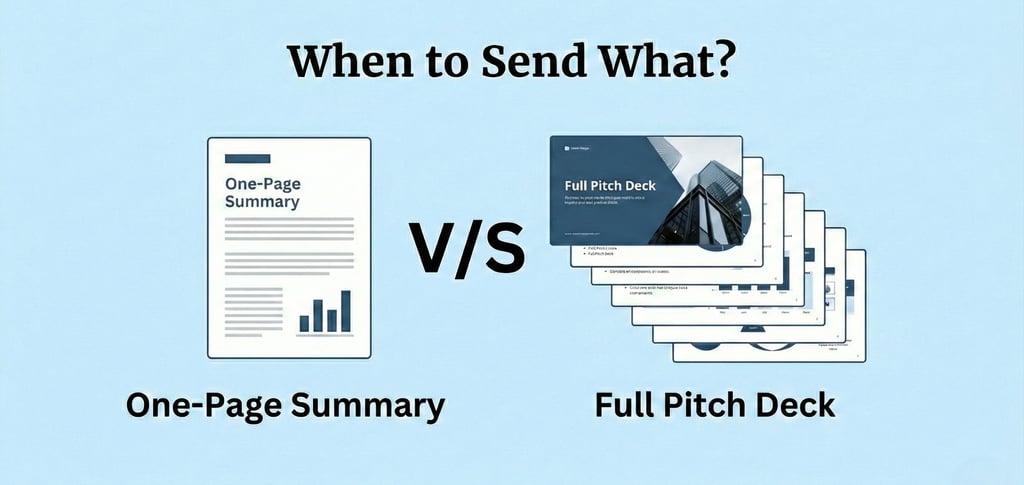
Stop attaching full decks to cold emails. It signals "Desperation" and gets you archived in 5 seconds. The forensic audit on why One-Pagers create leverage while PDFs destroy it.
1.1: WHAT A VC PITCH DECK ACTUALLY IS?
1/15/20265 min read
Stop Bleeding Leverage Before You Even Reply
If you are attaching a 15-slide PDF to a cold email or a first-touch LinkedIn DM, you have already signaled you are a "Tier 3" opportunity. Series A founders who close rounds do not beg for attention with unsolicited attachments; they create information gaps that investors are compelled to close.
The amateur move is believing that "more information" equals "more interest." It is the opposite. In the current liquidity environment, access to your full deck is a privilege, not a flyer. Before you construct the narrative, you must understand the asset class you are actually selling. This is a critical distinction covered in What a VC Pitch Deck Actually Is (and What Investors Mean When They Ask for One), but for now, understand this: The One-Pager and the Pitch Deck are not interchangeable formats. They are different weapons for different kills.
The Forensic Diagnosis: Why The "Attachment First" Strategy Torches Deal Flow
The single fastest way to get archived in a VC's inbox is to force a "cognitive tax" on them before they have agreed to pay it.
The "Red Flag" Scenario
You send a cold email to a Partner at a Tier 1 fund. The subject line is decent. But attached is Company_Name_Deck_v4.pdf (18MB).
The VC's Immediate Internal Monologue:
"This founder doesn't respect my time workflow. They are asking me to download, open, and parse 15 slides before I even know if they are in my sector. They are spraying and praying. This is spam."
When you send the full deck immediately, you remove the "opt-in" friction that validates interest. You are showing your hand before the betting has started. A full deck is a closing instrument; a One-Pager is an opening instrument.
The Psychological Audit: The "Desperation Ratio"
Founders make this mistake due to Insecurity of Value. You fear that if you don't show the graph on Slide 9 proving your CAC reduction, the investor won't care.
This is a fundamental misunderstanding of the VC funnel. The investor’s goal at the "top of the funnel" (email receipt) is not to invest; it is to disqualify. By sending a full deck, you provide 15 pages of surface area to find a reason to say "no." By sending a precise One-Pager, you provide only enough surface area to generate a meeting. You are over-indexing on "transparency" and under-indexing on "leverage."
The Mathematical Proof: The Cost of Cognitive Load
Let’s look at the "Time-to-Reject" calculus. This isn't art; it's efficiency math.
A Partner reviews 50-100 inbound leads per week. They allocate roughly 2 minutes per lead for initial screening.
Scenario A (Full Deck):
File Download/Load Time: 5 seconds.
Slide Navigation (12 slides @ 5s/slide): 60 seconds.
Context Switching Cost: 10 seconds.
Total Investment: 75 seconds.
Outcome: If the narrative isn't perfect by Slide 2, they skim. If they find one flaw in your financial projections on Slide 11, you are rejected. You gave them 12 opportunities to find a flaw.
Scenario B (The Executive Summary/One-Pager):
Inline Reading Time (No attachment/Single page PDF): 30 seconds.
Key Metrics Scan (ARR, YoY Growth, Burn): 10 seconds.
Total Investment: 40 seconds.
Outcome: The investor has not seen the flaw in your Year 3 projections yet. They only see the high-level traction. Their curiosity is piqued. They reply: "Interesting numbers. Send the deck."
The Efficiency Delta:
By using a One-Pager, you reduce the Cognitive Load by ~47% while retaining control of the process.
Furthermore, consider the Conversion Probability (Pc):
Pc = Perceived Upside
Time Invested
If you demand high Time Invested (Full Deck) early, Pc drops unless the Perceived Upside is immediately obvious (e.g., you are a repeat founder with a unicorn exit). For everyone else, you must lower the Time Invested denominator to maximize the Conversion Probability.
The "Insider" Solution Protocol: The "Tease-Verify-Close" Sequence
You need a strict protocol for information release. Do not deviate.
Phase 1: The Tease (The One-Pager / Teaser Email)
Trigger: Cold outreach or Introduction.
Objective: Get the "opt-in."
Format: A text-based email or a single-page PDF (Teaser).
The "VC-Ready" One-Pager Structure:
The Header: Company Name + One-Sentence "High Concept" Pitch (e.g., "Stripe for Construction in SEA").
The Traction Box (The Kill Shot): 3-4 bullet points of hard data.
Weak: "We have great traction and happy customers."
VC-Ready: "€1.2M ARR, growing 14% MoM. 115% NRR. Break-even projected Q3 2026."
The Problem/Solution: Two paragraphs max.
The Ask: "Raising $2M Seed to scale GTM."
If they don't reply to this, they weren't going to read your deck anyway.
Phase 2: The Verification (The Core Deck)
Trigger: Investor replies, "Send the deck" or "Let's chat."
Objective: Secure the Partner Meeting.
Format: The 12-15 slide DocSend link (Trackable).
Protocol:
Send the deck immediately (within 2 hours of the request).
Use DocSend. If you attach a PDF now, you lose analytics. You need to know which slides they camped on.
The "Weak Version": A 40-slide "Read Deck" with dense text.
The "VC-Ready Version": A 12-slide "Show Deck." Visuals, large font, narrative flow. It supports the meeting; it doesn't replace it.
Phase 3: The Close (The Data Room)
Trigger: Second meeting / Due Diligence.
Objective: Pass the Investment Committee (IC).
Format: Notion/Google Drive/Data Room Software.
This is where your spreadsheets, legal docs, and the "Long Form" deck live. Never send this before Phase 2.
The Framework: The "Request-Response" Rule
Rule: Never provide a layer of depth until the investor has explicitly requested it or implicitly agreed to it by moving to the next stage.
Cold Contact -One-Pager.
Response - Deck.
Meeting - Financial Model/Data Room.
The "Death Traps": How Founders Ruin The One-Pager
Even when founders adopt this strategy, they often botch the execution.
1. The "Novel" on One Page
Do not cheat margins or use 8pt font to cram your entire 15-slide deck onto one page.
The Error: "I need to explain the technology architecture."
The Audit: No, you don't. You need to explain the value of the architecture. If the font is unreadable on an iPhone, you are deleted.
2. The "Blind" Tease
Founders sometimes withhold too much information, thinking it creates mystery.
The Error: Hiding revenue numbers or pricing to "discuss it on the call."
The Audit: VCs optimize for "Pattern Matching." If you hide your ARR or market size, they assume the numbers are terrible. Transparency on metrics is mandatory; transparency on strategy comes later.
3. The "Static" PDF
Sending a One-Pager as an image pasted into the email body that doesn't load for Outlook users.
The Audit: Always attach as a clean, lightweight PDF (<2MB) and include the highlights as text in the email body. Assume the attachment won't be opened.
The "High-Ticket" Conclusion
The difference between a "pass" and a "term sheet" often comes down to sequencing. By withholding the full deck until requested, you signal scarcity and competence. You force the investor to ask for the meeting, shifting the power dynamic slightly in your favor. This discipline prevents "deck fatigue" and ensures your narrative is consumed in the correct order.
This protocol protects your valuation. Fix this sequencing, and you stop bidding against yourself.
For a complete breakdown of the narrative structure required once they do open the file, you must understand the mechanics detailed in How VC Pitch Decks Really Work in 2026 — And Why Most Founders Get Them Wrong.
The Filter
You can build this hierarchy manually, struggling to format a One-Pager that hits the right psychological triggers. Or, you can use "The Slide-By-Slide VC Instruction Guide"—specifically the Executive Summary Module—included in our $5k Consultant Replacement Kit.
It contains the exact One-Pager templates and DocSend setups used to close Series A rounds this quarter. Price: $497. (Available on the home page). Stop guessing. Execute.
Funding Blueprint
© 2026 Funding Blueprint. All Rights Reserved.