Negotiation, Follow-Up & Closing Rounds: The Art of the Dismount

Negotiation & Closing: The term sheet is just the start. Master the Leverage Coefficient and "Dismount" protocols elite London and NYC founders use to avoid deal collapse in 2026.

PILLAR 9 - FUNDRAISING STRATEGY

1/4/20267 min read

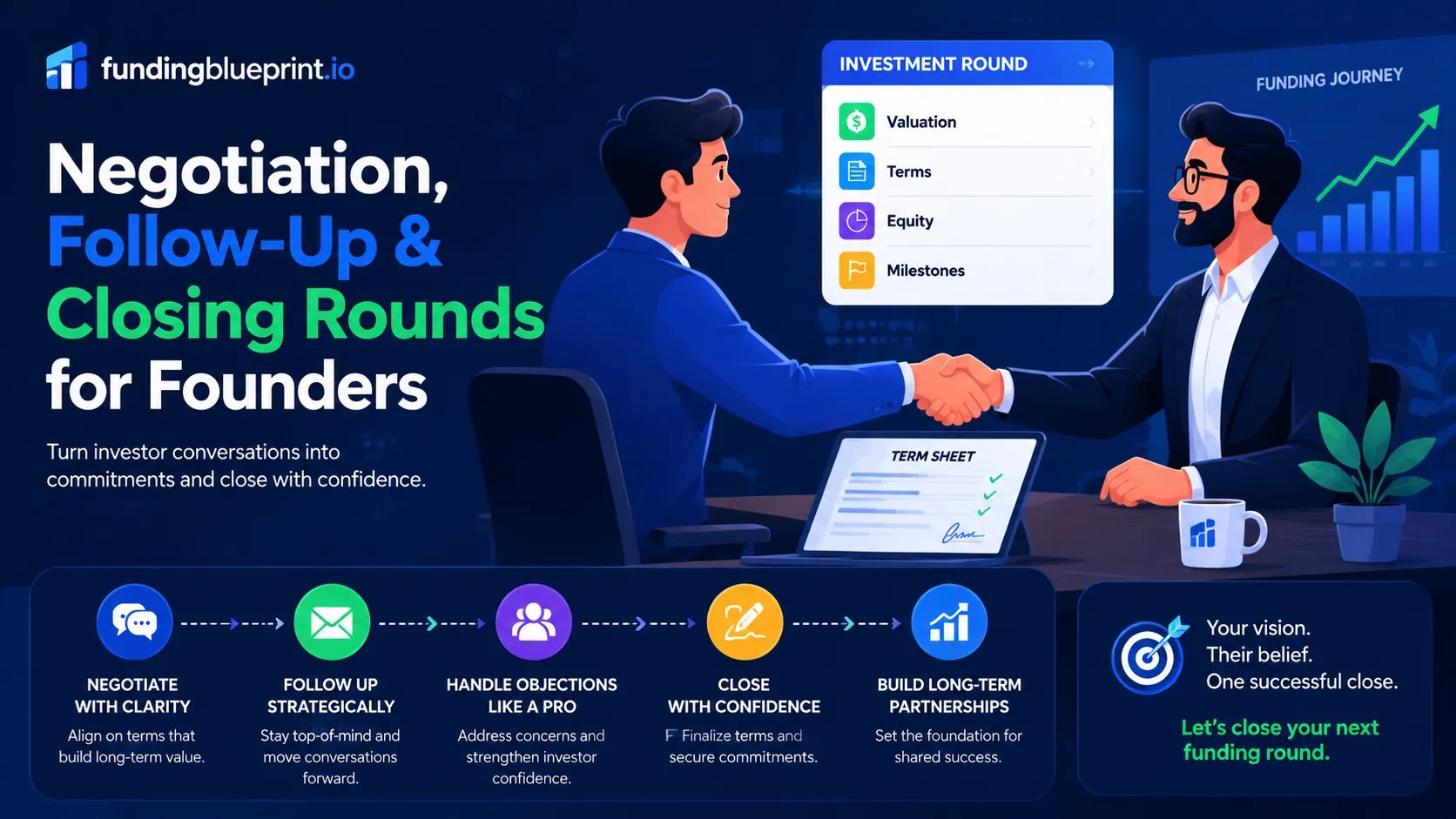
The stages of successful business negotiation and closing rounds.

Negotiation, Follow-Up & Closing Rounds: The Art of the Dismount

The deal is not done when you shake hands. The deal is done when the wire hits the bank.

The most lethal phase of the fundraising cycle is the "Trough of Diligence." This is the period between the verbal "Yes" and the actual funding. In this gap, time kills all deals. Founders often relax after receiving a Term Sheet, believing the hard work is over. In a forensic reality, this is when the leverage shifts from the Founder (who has the asset) to the Investor (who has the cash).

If you mismanage the closing process, a "Hot Deal" turns into a "Stale Deal" in roughly 14 days. If you negotiate the wrong terms, you might keep your CEO title but lose your economic ownership.

When we audit failed closings in London or New York, the cause is rarely the business model. It is usually "Process Entropy"—the failure to drive legal momentum—or "term sheet illiteracy," where a founder optimizes for the highest Valuation but accepts toxic Liquidation Preferences that wash them out in the exit.

This analysis is a surgical guide to the final mile. We will strip away the legal jargon and focus on the Economic Mechanics of the Term Sheet, the psychology of the Follow-Up, and the operational rigor required to force a Close.

This sub pillar is part of our main PILLAR 9 — FUNDRAISING STRATEGY

The Trench Report: The "High Valuation" Trap (A $30M Exit with $0 Return)

In Q1 2025, I was brought in to advise a Series B founder who was selling his company for $30M. He owned 20% of the cap table. He expected a $6M payout.

The Structural Error:

Three years prior, during his Series A negotiation, he had optimized purely for "Headline Valuation." He wanted to be a "$20M company." To get that high valuation, the investors demanded a "2x Participating Liquidation Preference."

  • The Math: The investors had put in $10M.

  • The Clause: "2x Preference" meant they got $20M back first. "Participating" meant after they took their $20M, they also got their pro-rata share of the remaining $10M.

The Forensic Result:

  • Exit Price: $30M.

  • Investor Payout: $20M (Preference) + roughly $4M (Participation) = $24M.

  • Remaining Pot: $6M.

  • Debt/Fees: $6M.

  • Founder Payout: $0.

The Verdict:

The founder had negotiated for Ego (Valuation) instead of Economics (Structure). He built the company for 5 years and walked away with nothing because he didn't read the fine print.

The Technical Pivot:

We now enforce the "Clean Term Protocol." We advise founders to accept a 20% lower valuation in exchange for a "1x Non-Participating Preference."

  • The Logic: A lower valuation is temporary dilution. A bad structure is permanent destruction.

The Forensic Formula: The Founder Efficiency Score Efo

When negotiating, plug the offer into this formula to see if the deal is actually good.

Efo = Exit Value - (Liquidation Pref X Investment)

Fully Diluted Shares

  • Rule: If increasing the Valuation requires increasing the Liquidation Preference multiplier (>1x), Efo almost always decreases. Never trade Structure for Price.

The Four Levers of the Term Sheet

A Term Sheet is not a single document; it is a complex system of four interlocking levers. If you pull one, the others move.

Lever 1: Economics (Price & Pool)

  • The Valuation: Pre-money vs. Post-money.

  • The Trap: "The Option Pool Shuffle." Investors will ask for a 15% Option Pool (shares reserved for future employees).

    • Forensic Nuance: If the Pool comes out of the Pre-Money, the dilution falls 100% on the Founder. If it comes out of the Post-Money, the dilution is shared.

    • The Move: Negotiate the Pool size down to what you actually need (e.g., 10%) based on a hiring plan, not an arbitrary 20%.

Lever 2: Control (Board & Votes)

  • The Board: Who fires the CEO?

  • The Standard: 2 Founders, 1 Investor, 2 Independents (2-1-2).

  • The Trap: Giving investors "Board Control" (3-2 split) at Series A.

  • The Move: Protect the "Independent" seats. Ensure they are mutually agreed upon, not investor-appointed.

Lever 3: Protection (Anti-Dilution)

  • The Mechanism: What happens if you raise money later at a lower price (Down Round)?

  • The Standard: "Broad-Based Weighted Average." (Fair).

  • The Trap: "Full Ratchet." (Toxic). If you sell one share at a lower price later, the investor gets to re-price all their old shares to that new low price. This can own 90% of your company overnight.

  • The Move: Never sign a Full Ratchet. Walk away.

Lever 4: Exclusivity (No Shop)

  • The Mechanism: You agree not to talk to other investors for X days.

  • The Standard: 30 Days.

  • The Trap: 60+ Days. This locks you up while the investor drags their feet. If they walk away after 60 days, your deal is "market stale."

  • The Move: Cap it at 30 days. "Diligence is a sprint, not a marathon."

Regional Calibration (SF vs. London)

Term Sheet "Market Standards" differ wildly across the Atlantic.

San Francisco (The "Founder Friendly" Standard)

  • The Instrument: SAFE (Simple Agreement for Future Equity) or NVCA Standard Terms.

  • The Vibe: Speed. "High Resolution Fundraising."

  • The Norms:

    • 1x Non-Participating Preference (Standard).

    • No Board Seat for Seed Investors (Information Rights only).

    • Founder Vesting: "Double Trigger" acceleration (if company is sold AND founder is fired, shares vest instantly).

London / New York (The "Investor Protection" Standard)

  • The Instrument: Priced Equity Round (Shareholders Agreement).

  • The Vibe: Structure & Control.

  • The Norms:

    • Tranche Investing: This is a uniquely European poison. "We will give you £2M, but only £1M now. You get the other £1M if you hit $1M ARR."

    • Forensic Warning: Kill the Tranches. It turns the investor into a boss who audits you every month. It destroys agility.

    • Board Control: European investors often demand a Board Observer seat even for small checks.

The Psychology of Follow-Up & Closing

The period between "First Meeting" and "Term Sheet" is defined by Momentum Management.

The "Soft Circle" Protocol

You cannot herd cats (Angels) one by one. You must use "Batch Processing."

  • The Situation: You have $500k in "soft interest" (verbal yes) from 10 angels, but no Lead.

  • The Error: Waiting for a Lead before finalizing the angels.

  • The Fix: "The Rolling Close."

    • Script: "We are closing the first $500k tranche on a SAFE next Friday. The valuation cap is $10M. We are doing this to clear legal capacity for the institutional lead coming in later. I have $100k left in this tranche. Are you in or out?"

    • Result: You convert "Soft Interest" into "Hard Cash" by creating artificial scarcity and a timeline.

The "Exploding Term Sheet" Defense

  • The Situation: An investor gives you a Term Sheet but says, "This offer expires in 24 hours."

  • The Forensic Reality: This is bullying. They are trying to prevent you from shopping the deal to competitors.

  • The Fix: "The Governance Defense."

    • Script: "We are incredibly excited about this offer. However, as a fiduciary, I am required to review this with my Board/Advisors and existing counsel. We cannot sign in 24 hours. We can commit to a decision by [Day + 3]."

    • Result: No reputable investor will walk away because you wanted to read the contract. Call their bluff.

The "Wednesday Wire" Protocol

  • The Metric: Bank settlement times.

  • The Rule: Never schedule a close for a Friday.

  • The Why: Wires sent on Friday afternoon often get stuck in "Correspondent Bank Limbo" over the weekend. You spend Saturday and Sunday terrified the money is lost.

  • The Fix: Schedule signing for Tuesday. Schedule wires for Wednesday Morning.

Earned Secrets

Hidden levers of the closing process.

Secret 1: The "Lawyer" Signal

Who you hire as legal counsel signals your sophistication.

  • The Secret: If you hire your family lawyer or a "General Corporate" lawyer, the VC knows they can bully you on terms.

  • The Hack: Hire a "Deal Lawyer" (e.g., from Gunderson, Cooley, Goodwin).

    • Why: They know what is "Market." If a VC tries to insert a "Full Ratchet," a Deal Lawyer simply says, "That’s not market standard," and the clause disappears. They pay for themselves in equity saved.

Secret 2: The "Side Letter"

Sometimes you can't change the main Term Sheet because of the Lead Investor, but you need a specific concession.

  • The Secret: Use a "Side Letter."

  • The Hack: This is a private agreement between the Company and one investor.

    • Example: An investor wants a Board Seat, but you don't want to give it. Compromise: Give them a Side Letter granting "Board Observer Rights" that expire after 12 months. It solves the ego problem without permanently damaging the governance.

Secret 3: The "Signaling Risk" of a Dragged Close

If diligence takes longer than 30 days, "Deal Rot" sets in.

  • The Secret: Other investors in the syndicate will start calling you: "Is the Lead still in?" Doubt spreads like a virus.

  • The Hack: Send a "Weekly Deal Update" email to the committed syndicate during diligence.

    • Content: "Legal is 80% done. Data Room review complete. Target signing date: Nov 14th."

    • Effect: You control the narrative. Silence is interpreted as failure; communication is interpreted as progress.

Expert FAQ: The Unasked Questions

Q: Should I negotiate the Valuation?

A: Forensic Answer: Yes, but prioritize Terms.

  • Strategy: If an investor offers $10M Pre-Money, and you want $12M, ask for $12M. But if they say "We can do $12M, but we need a 2x Liquidation Preference," revert to $10M immediately.

  • Rule: Clean terms > High Valuation. Always.

Q: What is a "Pay-to-Play" provision?

A: Forensic Answer: A clause that forces investors to participate in future rounds to keep their pro-rata rights or preferred status.

  • Is it good? Yes, for the Founder. It prevents "Dead Weight" on the cap table. If things get tough and you need a bridge round, a Pay-to-Play forces your existing investors to step up or get washed out.

Q: Can I fire an investor after closing?

A: Forensic Answer: No.

  • Reality: Equity is permanent. You are married. You cannot divorce them (unless you buy them out, which is expensive).

  • Action: This is why "Diligence on the Investor" (Reference checks with their other founders) is critical before you sign.

Forensic Audit Checklist

Before you sign the Term Sheet, run this 5-point diagnostic:

  1. The Preference Check: Is it 1x Non-Participating? (If "Participating" or ">1x", Stop).

  2. The Pool Check: Is the Option Pool calculated on the Post-Money (Ideal) or Pre-Money (Standard)? If Pre-Money, have you verified the hiring plan actually requires that size?

  3. The Board Check: Do you maintain control? (Avoid 2-2 splits or losing the Independent seat).

  4. The "Bad Actor" Check: Does the term sheet include "Full Ratchet" anti-dilution or "Super Pro-Rata" rights?

  5. The Lawyer Check: Has a specialized VC lawyer reviewed it? (Not just your cousin who does real estate law).

Narrative Breadcrumb

You have navigated the negotiation. You avoided the "Participating Preferred" trap. You kept the Board balanced. The wires have landed. The bank account balance has jumped from $4,000 to $2,000,000.

But the moment the money hits, the clock restarts. You are no longer a "Fundraising Founder"; you are an "Operating CEO." The investors expect you to execute the plan you promised. If you fail to communicate progress, the relationship will sour within 90 days.

(Note: The Funding Blueprint Kit includes the VC-Ready Pitch Deck (Elite Canva Template) and the Slide-By-Slide VC Instruction Guide. These tools ensure that when you finally get the "Yes," you send a deck engineered with the exact Sequoia/a16z logic required to convert that click into a partner meeting. Access the full forensic suite at the home page.)