
Messaging That Builds Trust: The "Integrity" Infrastructure of the Pitch
Stop the silent 'No.' Build a high-authority 'Integrity Infrastructure' in your pitch deck to prove founder-market fit and operational maturity in 2025.
PILLAR 5: STORYTELLING AND NARRATIVE ENGINEERING
12/22/20256 min read
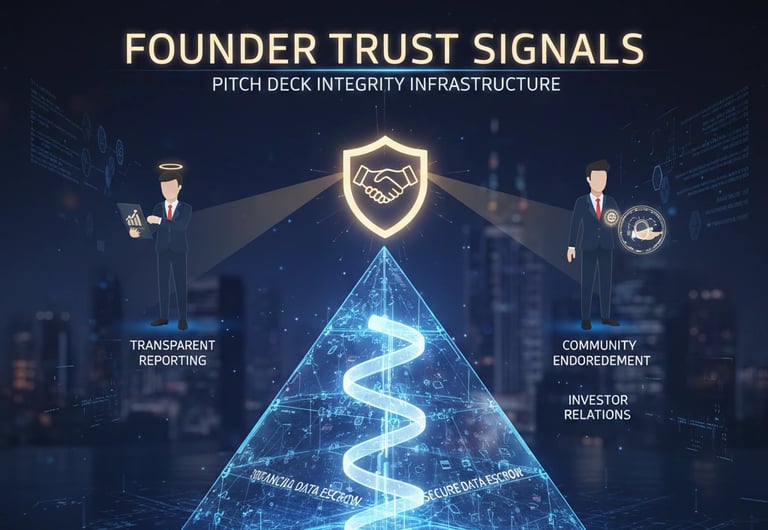
Messaging That Builds Trust: The "Integrity" Infrastructure of the Pitch
In the venture capital arenas of London, New York, and San Francisco, trust is the only currency that doesn't deflate. Every day, VCs are pitched "revolutionary" technologies and "billion-dollar" ideas. Most of these claims are met with immediate, calculated skepticism. Behind closed doors, investors aren't just evaluating your market size; they are performing a psychological audit of your character and the reliability of your word.
The brutal truth? Messaging that feels like "selling" kills trust. If your pitch deck sounds like a marketing brochure, we assume you are hiding the "bodies." Trust is built when a founder demonstrates Intellectual Honesty, Operational Grip, and Consistency. To win a term sheet in the 2025 market, your messaging must move from "Persuasion" to "Proof."
This sub pillar is part of our main Pillar 5: Storytelling and Narrative Engineering
Key Takeaways: The Trust Blueprint
Precision Over Superlatives: Delete words like "world-class," "revolutionary," and "unique." Use specific data points to let the investor draw those conclusions for themselves.
The "Blemish" Effect: Admitting a specific failure and explaining the systemic fix builds more credibility than a perfect, "straight-line" growth chart.
Metric Integrity: Ensure every number in your deck matches your raw CRM data. A 2% discrepancy is enough to kill a deal in due diligence.
The "Earned Secret" Narrative: Trust is established when you show you've spent more time in the "trenches" of your problem than anyone else in the room.
Localized Authority: Calibrate your tone for the region—SF values "Aggressive Transparency," while London and Toronto value "Pragmatic Understatement."
The VC Lens: Screening for "Signal vs. Noise"
Investors use a mental filter to separate founders who "know" from founders who "guess." Trust is lost the moment a founder uses a "Vanity Metric" (like total downloads) to hide a "Real Metric" (like daily active usage).
1. The "Transparency" Signal
In a high-trust pitch, the founder doesn't wait for the investor to find the "red flag." They point to it first. This is a technical maneuver known as Stealing Thunder. By disclosing a weakness (e.g., "Our churn spiked in Q2 because of a buggy update"), you take the sting out of the discovery and prove you are an honest operator.
2. The "Competence" Signal
Trust is built through Deep Domain Authority. If an investor asks a technical question and you answer with a "visionary" platitude, you’ve lost. High-trust messaging is granular. It shows you understand the unit economics, the regulatory nuances, and the competitive landscape better than the person writing the check.
1. The Language of Precision: Killing the "Hype"
Nothing kills trust faster in a New York or London boardroom than Superlative Inflation. When you call your product "the best," you are making a subjective claim. When you show your "Net Promoter Score (NPS) is 75," you are presenting a fact.
The Trap: "We have a world-class team from top universities." (Vague/Arrogant)
The Trust-Builder: "Our founding team has spent a combined 15 years scaling infrastructure at Stripe and Palantir." (Verifiable/Specific)
The Trap: "Our market opportunity is infinite." (Lazy)
The Trust-Builder: "We are targeting the $4.2B UK logistics niche, specifically the 15,000 firms currently reliant on manual reconciliation." (Grounded/Strategic)
2. The "Blemish" Effect: Why Perfection is a Red Flag
Psychologists have long documented the Pratfall Effect: people who are perceived as highly competent become more likable and trustworthy when they commit a small blunder or admit a flaw. In a pitch deck, this translates to the "Ugly" slide.
The "Hard Truths" Slide
Include a slide that outlines your biggest challenges or past failures.
The Messaging: "We failed to land [Customer X] in Q1 because our enterprise security wasn't up to code. We spent Q2 hiring a CISO and achieving SOC2 compliance. Today, that 'weakness' is our strongest competitive moat."
The VC Reaction: "This founder has the ego-strength to admit mistakes and the operational speed to fix them. I can trust them with $10M."
3. Metric Integrity: The "Forensic" Handshake
In the UK and Canada, where due diligence is often more "Forensic" than in the US, your messaging around data must be bulletproof.
Avoid the "Chart Crime"
Don't use cumulative growth charts to hide a plateau. Don't "massage" your LTV (Lifetime Value) by ignoring the cost of customer support.
The Trust-Builder: Use a Cohort Analysis table. It shows the raw truth of how customers behave over time. Even if the numbers aren't perfect, the transparency tells the investor that you are an honest partner.
The Signal: Messaging that says, "Here is exactly how we calculate this, and here is where we are still improving," creates a partnership dynamic rather than a buyer/seller dynamic.
4. The "Earned Secret" as an Authority Hook
Trust is not just about honesty; it’s about Believability. Why should I believe you can solve this problem? You build this through the "Earned Secret"—an insight discovered through trial and error that isn't obvious to outsiders.
Narrative Messaging for Authority:
The Hook: "The industry believes the problem is [X]. But after running 1,000 A/B tests with our pilot customers, we discovered the real friction is actually [Y]."
The VC Thought: "They’ve done the work. They aren't just reading Gartner reports; they are building from first principles."
Fundraising in SF vs. London: Regional Trust Patterns
Messaging that builds trust in San Francisco might trigger "Hype Alarms" in London or Toronto.
San Francisco (The "Bold" Tone): Trust is built through Conviction. If you sound too "cautious," SF investors think you don't believe in the vision. Trust here is: "I have seen the future, and I am the one to build it."
London & Toronto (The "Measured" Tone): Trust is built through Understatement. If you over-promise, you are viewed as "flighty." Trust here is: "Here is the data, here are the risks, and here is our methodical plan to mitigate them."
5. Consistency: The "Follow-Up" Trust Loop
Trust isn't built in a single 60-minute meeting; it's built in the spaces between meetings. Your messaging must remain consistent across your deck, your data room, and your casual emails.
The "Say/Do" Ratio
If you tell an investor on Monday that you are "closing a major partnership by Friday," and you don't send an update on Friday, the trust score drops.
The Tactical Fix: Use your follow-up emails to demonstrate Velocity. "As mentioned on Monday, we closed that partnership today. See the signed LOI in the data room."
The Signal: This proves your "Say/Do" ratio is 1:1. High-trust founders are predictable in their execution.
6. Semantic Depth: The Mechanics of "Social Proof"
While you shouldn't rely on "Logo Bait" (Sub-pillar 11), the way you message your existing support can build massive trust.
The "Validation" Messaging
Instead of just listing an advisor, quote them.
Messaging: "Our lead angel, the former CTO of [Big Tech], spent 4 days auditing our codebase before investing. His report is available in the data room."
The Result: You are leveraging the trust the VC has in other experts to build trust in you.
The "Trench" Report: The $20M "Integrity" Save
I once saw a founder in New York lose a lead investor during due diligence because a single metric—Gross Margin—was off by 4% compared to the pitch deck. It wasn't intentional fraud; it was a spreadsheet error.
The consequence? The investor pulled the term sheet, saying, "If I can't trust the basic math in your deck, how can I trust the strategic vision you've built on top of it?" The Lesson: Trust is fragile. The founder eventually raised, but only after they added an "Internal Audit" slide to their deck and personally walked every new investor through the raw data. Messaging that builds trust must be "Defense-First." Assume the investor will find the error, and fix it before they do.
Expert FAQ: The Psychology of Reliable Messaging
Is it better to hide a "Down Month" in my traction?
Absolutely not. Investors look for Slope, not just the last point. A down month is a "Blemish" that allows you to explain your resilience. Hiding it is a "Red Flag" that signals a lack of integrity.
How do I handle a question I don't know the answer to?
Build trust by saying: "I don't have the exact cohort breakdown for that specific region in my head, and I don't want to give you a 'ballpark' that might be wrong. Let me send you the raw data from the CRM tonight." This signals that you value Accuracy over "Looking Smart."
What is the most "Trust-Killing" phrase in a pitch?
"We have no competition." It signals either arrogance or a lack of market research. Both are terminal for trust. Instead, say: "The incumbents are [X and Y], but here is why their legacy architecture makes them unable to solve the specific pain point we've identified."
Does the "Design" of my deck affect trust?
Yes. In 2025, a sloppy, disorganized deck signals a sloppy, disorganized founder. High-quality design is a proxy for Professionalism and Attention to Detail. It shows you take the investor's time seriously.
Summary Checklist: The Trust Audit
No Superlatives: Have you removed words like "best," "first," and "revolutionary"?
Stealing Thunder: Have you identified your biggest risk before the investor does?
Metric Accuracy: Do your slides match your data room perfectly?
Earned Secrets: Does your narrative prove you’ve done the "work"?
Say/Do Ratio: Are you following up exactly when you said you would?
Funding Blueprint
© 2025 Funding Blueprint. All Rights Reserved.