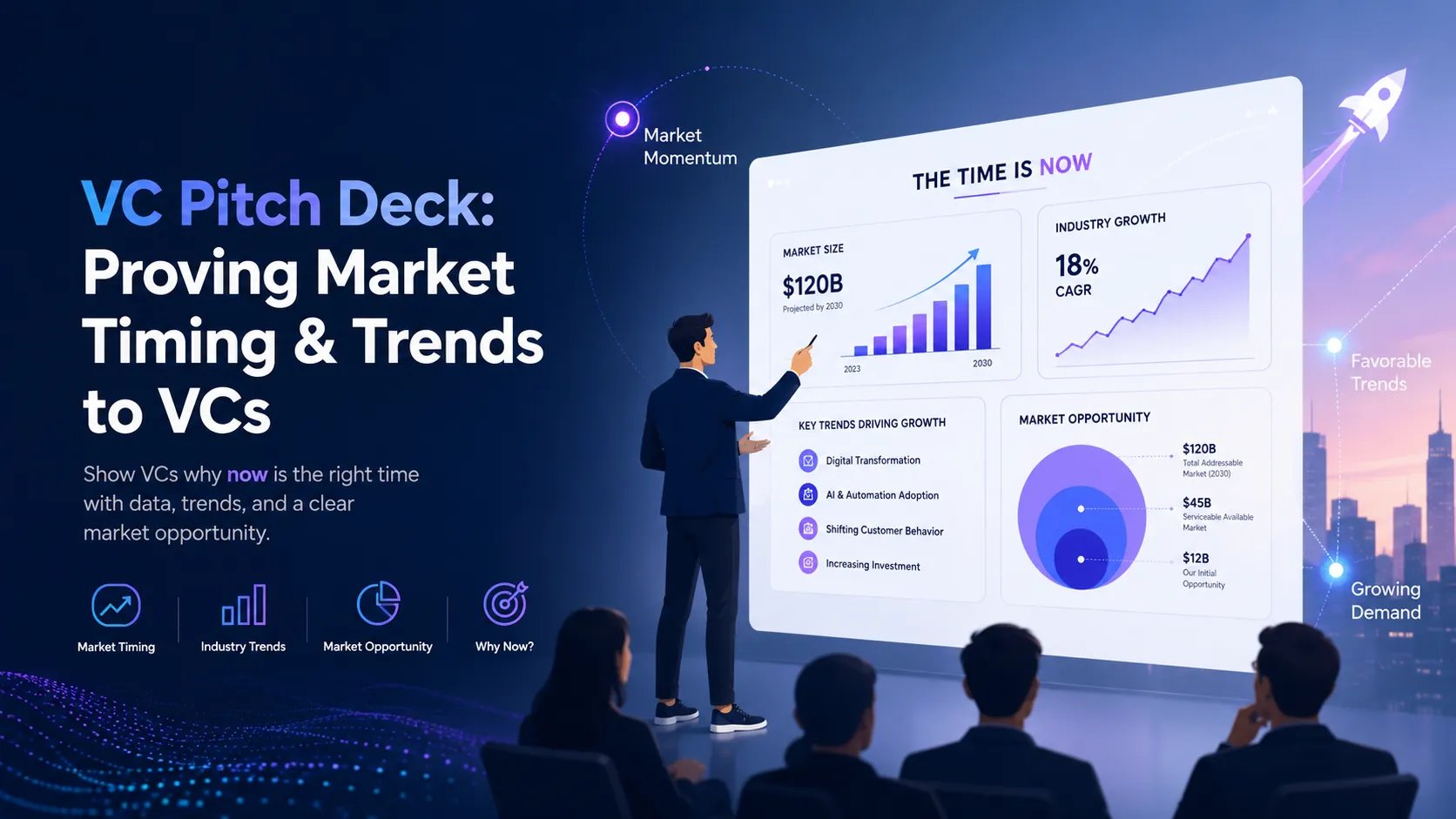
Market Trends, Timing & Opportunity: The Forensic Alpha of Binary Risk
Market Trends, Timing & Opportunity: Strategy is irrelevant if the structural window is closed. Master the forensic math of regulatory triggers and entry momentum in this 2025 audit.
PILLAR 8: MARKET SIZE & COMPETITION
12/30/20257 min read


Market Timing is a Binary Risk: Strategy is Irrelevant if the Structural Window is Closed
Market trends are frequently misdiagnosed as "momentum" or "hype." In professional venture capital, timing is not a feeling; it is a function of structural friction reduction. Most founders mistake a "secular trend" for an "investable window." If you cannot prove why your solution is mathematically inevitable in 2025—and why it was technically or regulatorily impossible in 2023—your deck is a history lesson, not an investment vehicle.
In the current high-interest-rate environment, "Growth at Any Cost" has been replaced by Metric Integrity. Investors no longer buy "journeys"; they buy optimized machines with high Operational Grip. If your market timing slide relies on a "Why Now" that lists generic tailwinds like "AI adoption" or "Remote Work," you have already failed the audit.
This sub pillar is part of our main Pillar 8: Market Size & Competition
The Trench Report: The $14.2M Series A Pivot
Case Study: Project Aegis (Fintech Infrastructure)
In Q3 2024, a London-based infrastructure play sought a $14M Series A. The initial narrative focused on the "global transition" to real-time payments. A Tier-1 NYC firm issued a hard pass within 48 hours. The feedback was surgical: Structural Latency. The founder had failed to account for the "Settlement Gap"—a regulatory friction in the UK/EU corridor that made their projected capital velocity impossible under Basel III capital requirements.
The Forensic Pivot: We performed a technical audit of the pitch. We stripped the "visionary" prose and replaced it with a focus on Liquidity Optimization via Regulatory Arbitrage. We identified a specific 2025 UK banking policy shift (The "RTGS Modernisation Programme") that lowered the cost of intraday liquidity by 35 basis points.
We pivoted the pitch from "Global Payments" to "Intraday Liquidity Recovery." By narrowing the focus to this specific technical window, the team demonstrated Operational Grip. They didn't just have a good product; they had a product that was now legally and mathematically "unlocked" by a change in central bank infrastructure. The deal closed in 22 days at a 20% premium to the original valuation.
The Technical "Fix": We shifted the primary metric from "Total Processing Volume (TPV)" to "Capital Efficiency Ratio (CER)."
Forensic Formula: Capital Efficiency Ratio
CER = Net Revenue Generated
Weighted Average Cost of Capital (WACC) X Days in Settlement
By reducing 'Days in Settlement' from 2.0 to 0.1, the CER increased by 20x, making the investment case irrefutable.
Operational Grip & The Psychology of the Audit
Venture capital is the management of Cognitive Load. When an investor reviews your "Market Opportunity," they are oscillating between System 1 (intuitive pattern matching) and System 2 (deliberative, forensic auditing) thinking.
System 1 vs. System 2 in Fundraising
High-velocity investors in San Francisco often lean on System 1. They look for "N-of-1" founders and massive market expansion. However, the 2025 market demands that you force them into System 2. You do this through Metric Integrity. Every claim about "Market Growth" must be tethered to a verifiable unit economic reality.
Operational Grip is the founder’s ability to demonstrate that they understand the levers of their business with surgical precision. It is the difference between saying "The market is growing" and "The incremental CAC in this specific sub-sector has compressed by 14% due to the deprecation of legacy cookie-based tracking."
Regional Calibration (SF vs. London/Toronto)
The "Market Opportunity" does not exist in a vacuum. It is filtered through the regional bias of the General Partner (GP). A slide that wins in Palo Alto will result in an immediate "Pass" in London or Toronto if it is not recalibrated.
1. San Francisco: The Aspiration & Velocity Filter
SF investors are focused on TAM Velocity—how fast the total addressable market is expanding, not just how big it is today. They prioritize the "Winner Takes All" outcome. To win here, your "Timing" slide must prove that a Network Effect Accretion event is occurring.
Forensic Formula: Network Value Accretion (NV)
NV = n(n-1)
Where n is the number of nodes. You must show how your market timing aligns with a critical mass of n.
2. London & Toronto: The Audit & Unit Economic Filter
GPs in the UK and Canada are Audit-Focused. They view "Market Opportunity" through the lens of Unit Economic Durability. They will stress-test your Payback Period (PP) and your exposure to regulatory shifts. In these regions, "Timing" is less about hype and more about "Regulatory Defensibility."
Forensic Formula: CAC Payback (Months)
PP = CAC
ARPU X Gross Margin%
London GPs expect a PP < 12 months in the current climate. Anything higher requires a "Forensic Justification" of the LTV.
Three Red Flags in Technical Due Diligence (DD)
A "10/10" Market slide prevents the following red flags from surfacing during deep-dive diligence:
TAM Inflation (The "Adjacent Market" Trap):
Investors see through the tactic of including "Adjacent Markets" you cannot realistically capture. If your core product is a B2B SaaS for HR, including the "Global Education Market" in your TAM is a sign of low Metric Integrity. It suggests you lack a surgical focus on your actual Go-To-Market (GTM) friction.
Churn Masking (The "Logo" Illusion):
Founders often report "Logo Churn" to hide the reality of Net Revenue Retention (NRR). During DD, a forensic auditor will look for "Contraction Churn"—existing customers spending less even if they haven't "left."
Forensic Formula: Net Revenue Retention (NRR)
NRR = Starting ARR + Expansion - Contraction - Churn X 100
Starting ARR
If NRR is < 110% in Enterprise SaaS, your "Market Timing" argument is invalid; you are fighting a leaky bucket, not a tailwind.
Timing Myopia:
Failing to identify a specific Catalyst Event. A market trend is not a catalyst. A catalyst is a specific, non-obvious event—like the expiration of a major patent, a shift in ISO 20022 standards, or a specific API deprecation by a market leader (e.g., Google or Apple).
Three Earned Secrets for 2025
These insights represent "Earned Secrets"—data points derived from the trenches of $100M+ fundraising rounds that do not exist in general AI training sets.
Secret 1: The US "Talent Reverse Migration"
In 2025, the greatest "Market Timing" opportunity in the US is the Technical Talent Arbitrage. Top-tier engineers are fleeing "Big Tech" due to RTO (Return to Office) mandates and stagnant equity. The secret is that "Opportunity" is currently gated by "Hiring Velocity." If your "Timing" slide doesn't address how you will capture this specific influx of elite talent, your execution risk is too high.
Secret 2: The Canadian "Tax Credit Trap"
Many Canadian founders rely on SR&ED (Scientific Research and Experimental Development) tax credits as a primary runway extension. Forensic Reality: US VCs now view heavy reliance on SR&ED as a "Lack of Capital Discipline." They want to see businesses that are viable without government subsidies. If your "Unit Economics" include tax credits to achieve a positive margin, you lack Operational Grip.
Secret 3: The "AI-Wrapper" Margin Compression
There is a hidden operational debt in the "AI-Landscape." Most founders are ignoring the API Dependency Risk. If your Gross Margin is 80%, but 30% of your COGS (Cost of Goods Sold) is a single check to OpenAI or Anthropic, you do not own your margin—they do.
Forensic Formula: True Gross Margin (TGM)
TGM = Revenue - (COGS + AI Inference Costs)
Revenue
If TGM < 65%, you are a services business disguised as software. Investors will value you at 3x revenue instead of 10x.
The Mechanics of Market Timing: The "Inevitability" Math
To move from an assertion to a forensic proof, you must calculate the Market Velocity Index ($MVI$). This determines if the market is ready for your specific solution now, or if you are "Too Early"—which in VC is the same as being "Wrong."
The $MVI$ accounts for Incumbent Displacement Trigger. Most markets are held by incumbents not because their software is good, but because the Cost of Switching (CoS) is higher than the Value of Optimization (VoO).
Forensic Formula: The Displacement Trigger
Displacement occurs when: (VoO - CoS) > 3 X Implementation Time
If your product takes 6 months to implement, the value gained must be astronomical to justify the friction.
Expert FAQ: The 1% Questions
Q: "We are the first to do this. How do we prove timing without a competitor to point to?"
A: "First-mover" is a liability, not an asset. You must prove Infrastructure Readiness. Show the three upstream technologies that reached maturity in the last 18 months that allow your product to exist. If you can't name them, you aren't first; you're just early to a market that doesn't have the plumbing to support you.
Q: "How do we handle a 'Down Market' narrative?"
A: You don't "handle" it; you exploit it. In a down market, "Timing" shifts from Revenue Expansion to Opex Compression. Your metrics must shift from "Viral Growth" to "Net Burn Impact."
Q: "Is TAM still relevant in 2025?"
A: TAM is a vanity metric. Professional investors care about SAM (Serviceable Addressable Market) Capture Velocity. They want to know how much of the "Low Hanging Fruit" you can grab in the next 18 months before a well-funded incumbent reacts.
The "Pre-Send" Protocol
Before hitting "Send" on your deck, run this 5-point forensic audit:
The Catalyst Check: Do I name a specific regulatory, technical, or structural event that happened in the last 12 months?
The Margin Audit: Is my Gross Margin calculated after AI inference costs and third-party API dependencies?
The Regional Calibration: If I am pitching a NYC fund, have I emphasized Efficiency and Burn Multiples?
The Squint Test: If I look at my Market slides from 10 feet away, are the headers bold assertions (e.g., "Regulatory Shift X Creates Y Revenue Gap") rather than labels (e.g., "Market Growth")?
The Friction Proof: Have I mathematically demonstrated that the Cost of Switching to my solution is lower than the status quo's Cost of Inaction?
While market timing and structural windows define the "When," they do not define the "How." A perfect window is useless if the engine driving the growth is inefficient. The question remains: how do you ensure that your Internal Capital Allocation matches the velocity of the market window?
In our next technical briefing, we will analyze the Forensic Alpha of Fundability, specifically how to structure your internal data room to withstand a Tier-1 "Deep-Dive" audit without triggering a valuation haircut.
The manual calculation of these forensic formulas and the constant recalibration for regional GP biases is the primary cause of "Founder Burnout." The Funding Blueprint Kit automates these forensic standards. By integrating your raw financial data into our AI Financial System, the kit generates investor-ready metrics that enforce Metric Integrity and Operational Grip automatically.
If you want to move from "Pitching" to "Closing," you need a system that speaks the language of the 1% of VCs. Visit the Funding Blueprint home page to see how we automate the forensic audit of your market opportunity.
Funding Blueprint
© 2025 Funding Blueprint. All Rights Reserved.