Market Positioning, Differentiation & Category Design: The Architecture of Monopoly

A forensic audit of Market Positioning. Learn to engineer 'Category King' valuation multiples using the Magic Triangle and Distinctiveness Index (DI). Stop competing.

PILLAR 8: MARKET SIZE & COMPETITION

1/1/20267 min read

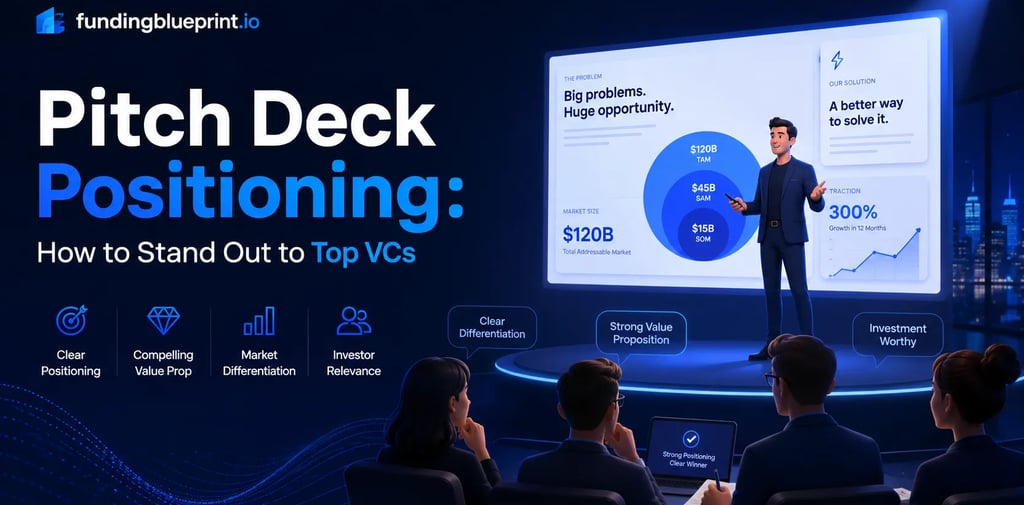
A diagram titled "The Architecture of Monopoly" on a boardroom screen illustrating the relationship

Market Positioning, Differentiation & Category Design: The Architecture of Monopoly

Positioning is not a marketing tagline. It is the business strategy of defining the rules of the game so that you are the only one who can win.

In the forensic analysis of venture capital, the greatest failure mode is not a lack of product capability, but a failure of Cognitive Framing. If you position yourself as "Better Email," you are competing with Gmail, and you will lose. If you position yourself as "Async Workplace Collaboration," you are competing with Slack, and you might win.

When a Tier-1 investor in London or New York reads your deck, they are subconsciously running a "Comparative Valuation Algorithm." They are trying to place you in a mental bucket.

  • If they bucket you as a "Tool," you are valued at 5x revenue.

  • If they bucket you as a "Platform," you are valued at 10x revenue.

  • If they bucket you as a "Category King," you are valued at 20x revenue.

Your job is not to fit into their existing buckets. Your job is to break their buckets and force them to build a new one just for you. This is the art of Category Design. It is the difference between competing for market share and creating a market where you are the only option.

This analysis is a surgical guide to engineering your market position, stripping away the creative fluff to focus on the psychological and economic levers that dictate valuation.

This sub pillar is part of our main Pillar 8: Market Size & Competition

The Trench Report: The "Better Widget" Trap (A $30M Pivot)

In Q3 2024, I advised a Cyber Security startup in Tel Aviv. They were raising a Series B. Their initial pitch was: "We are an AI-powered Antivirus that is 20% faster than Norton."

The Structural Error:

This is "Comparison Positioning." By defining themselves against Norton, they accepted Norton’s rules. They were fighting a feature war on a battlefield Norton owned.

  • The Valuation Ceiling: Antivirus is a commodity market. Investors viewed them as a "slightly better mouse trap" with a cap on pricing power.

  • The Risk: Norton could simply buy a smaller competitor, add "AI" to their marketing, and kill the startup’s differentiator.

The Technical Pivot:

We executed a "Category Reset." We analyzed why customers were buying. They weren't buying "virus protection"; they were buying "insurance against ransomware shutdowns."

We renamed the category from "Antivirus" to "Enterprise Resilience Infrastructure."

  • The Shift: We stopped selling "protection" (a cost center) and started selling "resiliency" (a strategic asset).

  • The Enemy: We stopped fighting Norton. We started fighting "Downtime."

The Result:

The pitch changed from "We are cheaper/faster" to "We are the only solution for Zero-Day Resilience." The Average Contract Value (ACV) tripled because "Infrastructure" commands a higher budget than "Tools." The round closed at a $120M valuation, double the initial offer, because they were no longer a "Better Widget"—they were a "Category King."

The "Magic Triangle" of Category Design

Category Design is not about making up a buzzword. It is about aligning three specific vectors to create a self-reinforcing loop. This is known as the "Magic Triangle" (credit to Play Bigger).

1. Product Design (The Solution):

You must build a product that solves the problem in a way that the old category cannot.

  • Forensic Note: It’s not enough to be different; you must be structurally different. (e.g., Tesla didn't build a better gas car; they built a computer on wheels).

2. Company Design (The Business Model):

Your business model must fit the new category.

  • Forensic Note: If you are creating the "On-Demand" category, you cannot have a subscription model with a 12-month lock-in. The model must match the promise.

3. Category Design (The Market Container):

You must name and frame the market itself.

  • Forensic Note: This requires "Languaging." You must give a name to the customer's pain (e.g., "Zoom Fatigue" or "Data Silos") and a name to the new future (e.g., "Video First" or "Unified Intelligence").

Forensic Formula: The Distinctiveness Index (DI)

To measure if your differentiation is sticking, we use a proxy for "Share of Mind."

DI = Direct Brand Search Volume

Generic Category Search Volume

  • Logic: If people search for "Kleenex" instead of "Tissue," Kleenex has a $DI$ approaching 1.0. They own the category. If people search for "CRM" instead of your name, your DI is near 0.

  • Goal: You want to see the $DI$ trend upward over time, indicating you are becoming synonymous with the solution.

Regional Calibration (SF vs. London)

Positioning is highly sensitive to the cultural context of the investor.

San Francisco (The "Blue Ocean" Architect)

  • The Mindset: SF investors want to fund Category Creators. They are looking for the "Uber of X" or the "Airbnb of Y."

  • The Strategy: Radical Differentiation.

  • The Pitch: "The old world is broken. We are burning the ships. We are creating a new behavior."

  • The Risk: You must prove that the market wants a new behavior. (e.g., Google Glass failed because it tried to create a category no one wanted).

  • Forensic Trigger: Use words like "paradigm shift," "movement," and "evangelism."

London / New York (The "Niche Dominator")

  • The Mindset: London/NY investors are more skeptical of "made-up" categories. They prefer Category Refiners. They want you to take an existing, proven market and dominate a lucrative vertical within it.

  • The Strategy: Specialized Differentiation.

  • The Pitch: "The general CRM market is crowded. But the CRM market for Private Equity is underserved and high-value. We are the definitive operating system for PE firms."

  • The Risk: The market might be too small (niche). You must prove the Total Addressable Market (TAM) of the niche is still >$1B.

  • Forensic Trigger: Use words like "purpose-built," "compliant," "vertical-specific," and "workflow integration."

Metric Logic & Red Flags

Founders often confuse "Positioning" with "Puffery." We look for specific red flags that indicate you are hallucinating your market position.

Red Flag 1: The "We Have No Competitors" Fallacy

  • The Error: "We are unique. No one does what we do."

  • The Forensic Reality: If you have no competitors, you have no market. Your competitor is the status quo (Excel, Pen & Paper, Apathy).

  • The Fix: Position against the "Old Way." "Our competitor is not Startup X; our competitor is the manual spreadsheet process that wastes 20 hours a week."

Red Flag 2: The "Feature Soup" Positioning

  • The Error: "We are a cloud-based, AI-enabled, blockchain-secured, mobile-first analytics tool."

  • The Forensic Reality: This is word salad. It forces the investor to do the mental work of figuring out what you actually do.

  • The Fix: The "XY" Positioning. "We are [X] for [Y]." (e.g., "We are the Operating System for Dental Practices"). Clear, concise, bucketable.

Red Flag 3: The "Better/Faster/Cheaper" Trap

  • The Error: Defining yourself solely by comparison. "We are 10% cheaper than Salesforce."

  • The Forensic Reality: This is a race to the bottom. It implies Salesforce is the standard, and you are the discount option.

  • The Fix: Different, Not Better. "Salesforce is a database; we are an intelligence layer."

Earned Secrets

These are the psychological levers of positioning that elite marketers use but rarely share.

Secret 1: "Dam the Demand"

Most startups try to create demand. This is expensive. The secret is to redirect existing demand.

  • The Mechanism: Find a huge wave of demand (e.g., "Remote Work") and position your product as the only barrier to riding that wave successfully.

  • The Secret: Don't sell the boat; sell the fear of missing the tide. "You are moving to remote work, but your security stack is stuck in the office. We bridge that gap."

Secret 2: Name the "Villain"

Every great story needs a villain. In business, the villain is not a person; it is a problem.

  • The Mechanism: Give the problem a nasty, sticky name.

    • Salesforce called it "Software" (and used the "No Software" logo).

    • Drift called it "The Lead Form" (and launched "Conversational Marketing").

  • The Secret: If you name the problem, customers assume you have the solution. If you call it "Data Silos," you own the concept of "Unified Data."

Secret 3: The "Cognitive Referent" Hack

Human brains understand new things by anchoring them to old things.

  • The Mechanism: You can control your valuation by choosing your anchor.

  • The Secret:

    • If you say "We are like Uber for Dog Walking," you anchor to a high-volume, low-margin transactional model.

    • If you say "We are like Salesforce for Pet Services," you anchor to a high-margin, recurring revenue SaaS model.

    • Forensic Advice: Choose a "Cognitive Referent" that has the valuation multiple you want.

Expert FAQ: The Unasked Questions

Q: Should I niche down or go broad?

A: Forensic Answer: Niche down to win, broaden out to scale.

  • The "Bowling Pin" Strategy: You cannot knock down all pins at once. Aim at the lead pin (a specific vertical or use case). Once you knock it down (dominate that niche), the momentum knocks down the rest.

  • Mistake: Aiming for the whole market on Day 1 leads to "diluted messaging" where you appeal to no one.

Q: How do I know if my Category Design is working?

A: Forensic Answer: Listen to your customers' language.

  • Stage 1: They describe you using your competitor's name. ("It's like a cheaper Zoom"). -> Failed.

  • Stage 2: They describe you using features. ("It's a video tool"). -> Weak.

  • Stage 3: They use your language. ("It's a 'Video-First' workspace"). -> Winning.

  • Stage 4: They use your brand as a verb. ("Just Zoom me"). -> Monopoly.

Q: Can I re-position later?

A: Yes, but it is expensive. It's like changing the foundation of a house while living in it.

  • Pivot Cost: You will lose customers who bought the "old" vision.

  • Advice: It is better to spend an extra month nailing positioning before the roadshow than to pivot in the middle of Due Diligence.

Forensic Audit Checklist

Before you hit "Send" on your deck, run your Positioning Slide through this 5-point diagnostic:

  1. The "Bar Test": If you described your product to a stranger in a loud bar, would they understand it in one sentence? (If you have to explain it twice, your positioning is too complex).

  2. The "Who Cares?" Test: Does your positioning focus on a "Migraine Problem" (urgent, painful) or a "Vitamin Problem" (nice to have)? Investors fund painkillers, not vitamins.

  3. The "Villain" Check: Have you clearly identified the "Old Way" of doing things and why it is failing? (e.g., "Spreadsheets are breaking your supply chain").

  4. The Differentiation Logic: Is your differentiator defensible? (e.g., "We have a patent" vs. "We are cheaper").

  5. The Visual Grip:

Do you use a 2x2 matrix or a "Old World vs. New World" table? (Visuals process 60,000x faster than text. Show, don't just tell).

Narrative Breadcrumb

You have now engineered your Market Position. You are not just another startup; you are a Category Designer. You have framed the problem, named the villain, and anchored your value.

But even the best positioning cannot save you if the team slide looks weak. Investors bet on the jockey, not just the horse. The next failure mode is "Team Composition & Founder-Market Fit." This is where we analyze not just who you are, but why you are the only team in the world capable of executing this vision...

(Note: The Funding Blueprint Kit includes the "Category Design Canvas" and "Positioning Auditor." These tools force you to answer the hard questions about your villain, your cognitive referents, and your differentiation math before you get in front of an investor. Access the forensic suite at the home page.)

A marketplace positioning map diagram showing a company's competitive