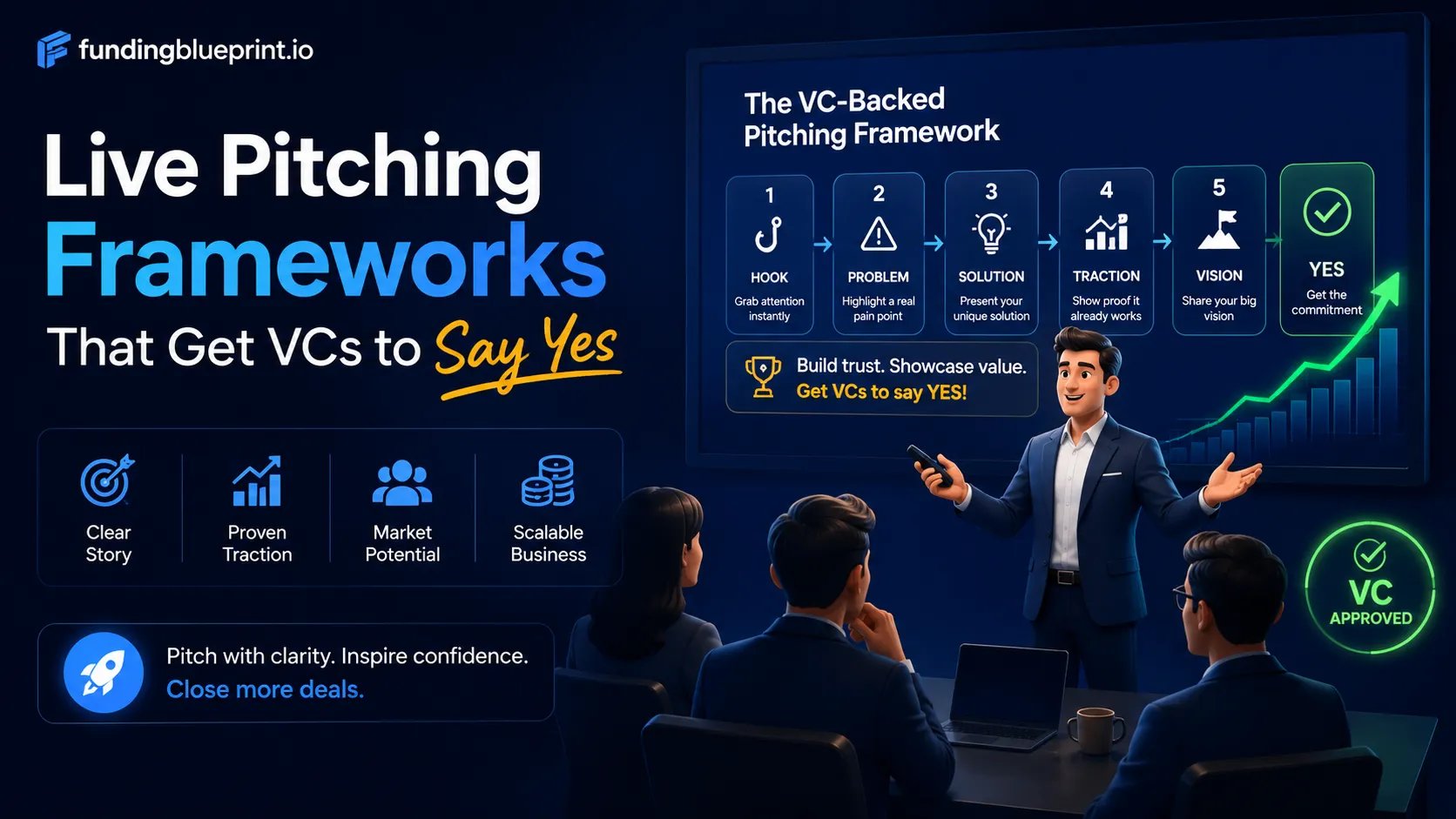
Investor Meetings & Live Pitching: The Theatre of High-Stakes Audit

Investor Meetings & Live Pitching: Your pitch is not a speech; it is a forensic interrogation. Master the Question Velocity and Frame Control protocols elite London and NYC VCs respect.

PILLAR 9 - FUNDRAISING STRATEGY

1/3/20269 min read

Investor meetings and live pitching presentation strategy.

Investor Meetings & Live Pitching: The Theatre of High-Stakes Audit

The pitch meeting is not a presentation. It is a status negotiation disguised as a conversation.

The most catastrophic error founders make is treating an investor meeting like a "Demo Day" or a university lecture. They believe their job is to get through the slides, educate the audience, and wait for applause. In a forensic reality, the slides are merely the background scenery for a psychological audit of your competence.

When you walk into a partner meeting (or log onto Zoom) with a Tier-1 fund in London, New York, or San Francisco, you are entering an asymmetric warfare zone. The investor has seen 5,000 pitches. You have likely done fewer than 50. They know the script; you are guessing it. They are looking for reasons to say "No," while you are desperately looking for a "Yes."

If you "present," you are subservient. You are the vendor asking for money. If you "consult," you are a peer offering an opportunity. The goal of the meeting is not to educate the investor; it is to Frame Control. You must shift the dynamic from "Applicant vs. Judge" to "Peer vs. Problem."

This analysis is a surgical dissection of the Live Pitch. We will strip away the "soft skills" and focus on the Cognitive Mechanics and Power Dynamics that actually determine whether you get a second meeting or a polite "We'll pass." We will analyze the physics of the boardroom, the math of the dialogue, and the specific verbal levers that establish authority.

This sub pillar is part of our main PILLAR 9 — FUNDRAISING STRATEGY

The Trench Report: The "Filibuster" Failure (A $10M Disaster)

In Q2 2025, I was retained to coach a Series A DeepTech founder in Boston. He was brilliant—a literal rocket scientist with patents in propulsion technology. He had secured a Partner meeting with a top-tier firm known for hard-tech bets.

The Structural Error:

The meeting was booked for 45 minutes. The founder, terrified of silence and eager to prove his technical depth, spent the first 35 minutes talking non-stop. He walked through every technical nuance of the propulsion system, the physics of the fuel efficiency, and the history of the prototype. He filibustered the meeting.

The Forensic Result:

I sat in the corner of the room and watched the Partner.

  • Minute 12: The Partner stopped taking notes.

  • Minute 20: The Partner checked his email on his watch.

  • Minute 36: The Partner interrupted, cutting off the founder mid-sentence: "This is great tech, but we're out of time. Send me the deck, and we'll take a look."

The Verdict:

The deal died in that room. The founder walked out thinking he crushed it because he "explained everything." The investor passed because he "couldn't get a word in to test the commercial logic." The founder treated the meeting as a lecture; the investor wanted an audit.

The Technical Pivot:

For the next meeting, we instituted the "10-Minute Rule."

  • The Constraint: The founder was forbidden from speaking for more than 10 minutes without asking a "Verification Question."

  • The Mechanism: He had to pause and ask, "Does this align with what you're seeing in the broader logistics market?" or "Is this consistent with your other hardware portfolio companies?"

  • The Effect: This forced the meeting into a dialogue. It forced the investor to engage their System 2 (analytical) brain rather than passively drifting into System 1 (autopilot).

The Result:

In the very next meeting, the founder spoke for 8 minutes, then asked a question. The Partner engaged. They spent the remaining 35 minutes debating market size and customer adoption, not propulsion physics. He got the term sheet because he proved he could listen, not just lecture.

The Forensic Formula: The Dialogue Ratio D(r)

You can mathematically predict the success of a meeting based on who is holding the floor.

D(r )= Investor Speaking Time

Total Meeting Time

  • Forensic Benchmarks:

    • D(r)< 0.1: Failure. You are lecturing. The investor is bored.

    • D(r) > 0.5: Weakness. You are being interrogated. You have lost narrative control.

    • D(r) approx 0.3: Optimal. You lead the narrative (70%), but they are actively engaged (30%). This ratio signals a "Peer-to-Peer" discussion.

The Three Acts of the Live Pitch

A forensic pitch is structured like a screenplay. It has three distinct acts, each with a specific "Exit Criteria" that must be met before moving to the next.

Act 1: The Frame Set (Minutes 0-5)

  • The Goal: Establish Status.

  • The Trap: Waiting for the investor to say, "Go ahead." This makes you the subordinate.

  • The Forensic Move: The "CEO Opening."

  • The Script: "I know we have 45 minutes on the calendar. I’d love to spend the first 15 giving you the high-level narrative and the market shift we are seeing, and then spend the bulk of the time deep-diving into the metrics and discussion. Does that work for you?"

  • The Psychology: You have just set the agenda. You are managing the time. You are the CEO of the meeting.

Act 2: The Narrative Arc (Minutes 5-20)

  • The Goal: Trigger Greed (FOMO).

  • The Trap: Starting with "Team, Problem, Solution." This is the standard accelerator format. Investors zone out because they know the pattern.

  • The Forensic Move: "The Pattern Interrupt."

  • The Technique: Start with a "Contrarian Truth" or a "Market Insight" that violates their expectations.

    • Example: "Everyone thinks the problem in logistics is speed. We have proprietary data proving the problem is actually 'Warehouse Anxiety'—the fear of stockouts. Here is the graph showing that customers pay 20% more for certainty than for speed."

  • The Result: They lean in. You have violated their prediction of a boring pitch. You have taught them something new before you even sold them your product.

Act 3: The Diligence Trap (Minutes 20-45)

  • The Goal: Survive the "Q&A Audit."

  • The Trap: Answering difficult questions defensively or with "Yes/No."

  • The Forensic Move: "Judo Answers."

  • The Technique: Never answer a difficult question immediately. Pivot the energy of the question to your strength.

    • The Attack: "Why is your Customer Acquisition Cost (CAC) so high compared to the industry average?"

    • The Amateur Answer: "Well, ads are expensive right now, but we are working on SEO..." (Defensive).

    • The Judo Answer: "Great observation. Our CAC is high intentionally. We made a strategic decision to aggressively capture the Enterprise segment, where the CAC is $5k but the LTV is $500k. We are trading short-term efficiency for long-term monopoly. If you look at our LTV:CAC ratio, it is actually 4x higher than the industry average. Let me show you that slide."

Regional Calibration (SF vs. London)

The "vibe" of the room changes drastically depending on the GPS coordinates of the fund. A pitch that wins in San Francisco will often fail in London, and vice versa.

San Francisco (The "Dreaming" Room)

  • The Atmosphere: Optimistic, casual, fast-paced.

  • The Behavior: They will interrupt you with "What if?" questions. They are looking for the 100x outcome.

  • The Strategy: Feed the Fire. If they get excited about a massive, crazy vision, throw out your script and brainstorm with them. Do not try to reign them in with "realistic projections."

  • Forensic Signal: If they stop looking at their phone and start drawing on the whiteboard, you are winning.

  • The Pitch: Focus on Upside Maximization. "If this works, we replace the entire internet infrastructure."

London / New York (The "Auditing" Room)

  • The Atmosphere: Skeptical, formal, reserved.

  • The Behavior: They will interrupt you with "How?" questions. They are looking for the downside risk. They are protecting their LP's capital.

  • The Strategy: Defend the Castle. Stick to the logic. Do not get swept up in hyperbole. Prove you know your unit economics cold.

  • Forensic Signal: If they nod slowly and write down a number, you are winning. If they cross their arms and lean back, you are losing.

  • The Pitch: Focus on Downside Protection. "Even in a recession, our retention is 98% because we are a compliance necessity."

Metric Logic & Red Flags

During the Q&A, investors are not just asking for numbers; they are testing your "Founder-Market Fit." They want to know if you understand the levers of your own business better than they do.

Red Flag 1: The "I'll Get Back to You" on Core Metrics

  • The Error: Not knowing your Burn Rate, CAC, Gross Margin, or Churn off the top of your head.

  • The Forensic Reality: If you have to look up your Churn Rate, you don't care about it. If you don't care about it, you are losing customers.

  • The Fix: Memorize the "Holy Trinity" of metrics (Growth Rate, Margins, Retention) before walking in. These numbers must be instant.

Red Flag 2: The "Defensive Crouch"

  • The Error: Getting angry, annoyed, or defensive when challenged on a weakness.

  • The Forensic Reality: Investors test for "Coachability." They will deliberately poke holes in your logic just to see how you react. If you argue or get defensive, they assume you will be a nightmare to work with in the Boardroom.

  • The Fix: Use the "Yes, And..." technique. "You're right, that is a significant risk. That is exactly why we hired a VP of Engineering from Google to mitigate it. Here is her plan..."

Red Flag 3: The "Tech Failure"

  • The Error: "Can you see my screen?" ... "Wait, the audio isn't working." ... "The video is buffering."

  • The Forensic Reality: If you cannot run a Zoom meeting effectively, the investor assumes you cannot run a technology company.

  • The Fix: Always have the deck loaded locally. Have a PDF backup ready to email instantly if screenshare fails. Never rely on the venue's wifi; have a hotspot ready.

Forensic Formula: The Confidence Conversion C(c)

You can quantify how well you handled the Q&A.

C(c) =Questions Answered Directly

Total Questions Asked

  • Rule: If you dodge questions, pivot without answering, or give long, winding non-answers, your C(c) drops. High C(c) creates trust. Answer the question in the first sentence with a number or a "Yes/No," then explain.

    • Bad: "Well, the market is interesting..."

    • Good: "Our market share is 2%. Here is how we get to 10%."

Earned Secrets

These are the hidden dynamics of the boardroom that only insiders know.

Secret 1: The "Associate" is the Scribe

  • The Secret: In a meeting with a Partner and an Associate, the Partner is listening for "Vibe" and "Vision," but the Associate is physically writing the "Investment Memo."

  • The Hack: Do not ignore the Associate. Make eye contact with them when quoting numbers. They are the ones who have to write them down. If you win the Associate, you win the data entry into the deal system. If the Associate thinks you are arrogant, the memo will be lukewarm.

Secret 2: The "Trap Question" (Seed Stage)

  • The Secret: Investors often ask: "What is your Exit Strategy?"

  • The Hack: This is a trap. If you answer "We plan to sell to Google in 3 years," you fail. VCs need IPO-sized returns (100x). Selling early limits their upside.

  • The Correct Answer: "We aren't building this to sell. We are building this to go public. We believe this is a standalone generational company. However, obviously, the strategic value to a player like Google would be immense at scale."

Secret 3: The "Hard Stop" Power Move

  • The Secret: Meetings that drag on lose momentum. If you run over time, you look disorganized.

  • The Hack: End the meeting exactly on time, or 2 minutes early.

  • The Script: "I want to be respectful of your time, and I know we are at the hour. I have a hard stop for another partner meeting. Is there one final critical question I can answer?"

  • The Effect: This signals Scarcity. It shows you are in demand. It shows you run a tight ship.

Expert FAQ: The Unasked Questions

Q: Should I send the deck before the meeting?

A: Forensic Answer: Yes, but not the full deck.

  • Strategy: Send a "Teaser Deck" (10 slides, high level) 24 hours before. This allows the investor to prepare and ask better questions.

  • In Meeting: Present the "Full Deck" (15-20 slides) with the detailed graphs.

  • After Meeting: Send the "Data Deck" (Deep dive metrics, appendix slides).

  • Why: Control the flow of information. Never send your full financial model before the first meeting; they will find a reason to say "No" without ever talking to you.

Q: Remote (Zoom) vs. In-Person?

A: Forensic Answer: In-Person wins every time.

  • Data: Conversion rates for In-Person meetings are ~30% higher. You can read body language, build rapport, and there is no "Mute" button for them to hide behind while checking email.

  • Rule: If you can fly to SF/NY/London for "Partner Week," do it. Batch your meetings geographically.

Q: What if they ask for Valuation in the first meeting?

A: Forensic Answer: Do not give a number.

  • The Trap: If you say "$10M," and they were thinking "$15M," you lost money. If they were thinking "$8M," you lost the deal (priced yourself out).

  • The Pivot: "We are letting the market set the price. We are currently seeing interest that aligns with standard Series A ranges for this sector. We are looking for the right partner first, price second."

Forensic Audit Checklist

Before you log in or walk in, run this 5-point diagnostic:

  1. The Tech Check: Is your camera at eye level? Is your lighting good? (No "Witness Protection" silhouettes).

  2. The Role Assignment: If pitching with a co-founder, do you know who answers what? (CEO handles Vision/Sales; CTO handles Product/Tech. Never interrupt each other. It looks dysfunctional).

  3. The "Ask" Prep: Do you know exactly how much you are raising and what it buys? (e.g., "$2M to reach $1.5M ARR in 18 months").

  4. The Research: Have you read the Partner's last 3 tweets or blog posts? (Know their current obsession so you can reference it).

  5. The "Close" Script: Do you have a line to end the meeting? ("What is your process from here?" is the standard closing move to extract a timeline).

Narrative Breadcrumb

You have survived the meeting. The Partner leaned in. The Associate took furious notes. You ended on time, creating a sense of scarcity.

But the deal is not done. You are now entering the "Diligence Zone." This is where momentum goes to die. The investor will say: "Send over your deck and your model." If your visual assets do not match the verbal confidence you just displayed, the trust will evaporate.

(Note: The Funding Blueprint Kit includes the VC-Ready Pitch Deck (Elite Canva Template) and the 16 VC-Quality AI Prompts. These tools ensure that your visual aids match the forensic precision of your spoken pitch, preventing 'Cognitive Dissonance' during the meeting. Access the full forensic suite at the home page.)