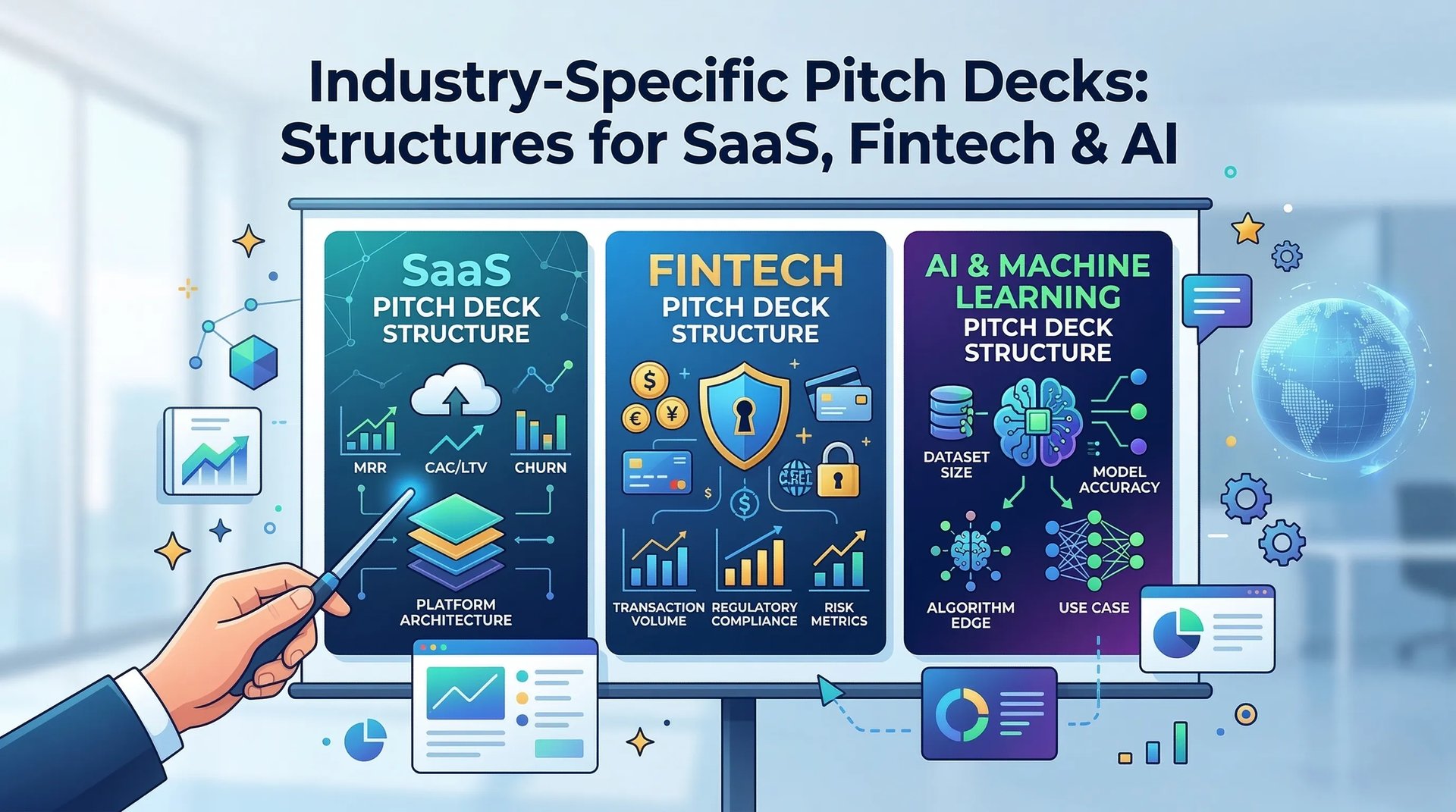
Industry-Specific Pitch Decks: Structures for SaaS, Fintech & AI
Why a one-size-fits-all pitch deck is an "IQ test" you’re failing. Learn the killer metrics and structures for B2B SaaS, Fintech, DeepTech, and Consumer apps.
PILLAR 3: SLIDE STRUCTURE & FRAMEWORKS
12/16/20254 min read


Industry-Specific Deck Structures: Why "One Size Fits All" Is a Lie
If you’re pitching a high-margin B2B SaaS platform using the same deck structure as a capital-intensive DeepTech hardware play, you’ve already failed the IQ test. In the IC room, we don't just look for "good" businesses; we look for "fit."
The brutal truth? A "standard" pitch deck is a generalist’s tool, and generalists don't get outsized returns. When I’m reviewing a deck in London’s fintech hub or an AI-first fund in San Francisco, I am looking for the specific industry "shorthand" that proves you aren't just a founder—you're an insider. If you don't use the right structure for your sector, I assume you don't understand your own unit economics.
This sub pillar is part of our main PILLAR 3 — SLIDE STRUCTURE & FRAMEWORKS.
The VC Lens: The Sector-Specific "Killer" Metric
Every industry has a "one slide to rule them all." In an Investment Committee meeting, we often flip straight to that slide to see if the deal is even worth discussing.
The hidden risk we hunt for is Operational Naivety. For a Biotech founder, that risk is "Regulatory Blindness." For a Consumer App founder, it’s "Retention Decay." In New York, the lens is often on Market Dominance; in Toronto or London, the lens is frequently on Sustainability and Burn. If your structure doesn't prioritize the specific risk-profile of your industry, you aren't being concise—you're being dangerous.
The "Trench" Report: The Hardware Startup That Acted Like SaaS
I once saw a Canadian hardware company pitching a "SaaS-lite" deck. They focused on their beautiful UI and their $50/month subscription model. They used a standard 10-slide "Sequoia-style" framework.
The consequence? They were laughed out of the room. Why? Because they ignored the COGS (Cost of Goods Sold) and the Supply Chain Risk. They hadn't included a slide on "Manufacturing Scalability" or "Inventory Financing." By trying to look like a "clean" software company, they looked like they were hiding a "messy" hardware reality. They eventually raised, but only after they rebuilt their deck to lead with Gross Margin expansion and Patented Moats. Industry-specific structure isn't about vanity; it's about addressing the specific way your business could die.
The Tactical Framework: The Sector-Structure Matrix
Don't follow a generic template. Use the Sector-Structure Matrix to prioritize your slides based on where the "Signal" actually lives in your industry.
1. B2B SaaS: The "Efficiency" Build
Focus: Predictable growth.
The "Killer" Slide: Cohort Retention. If your retention "smiles" (users return over time), you win.
Key Metrics: NRR (Net Revenue Retention), LTV/CAC, and Magic Number.
2. Fintech: The "Trust & Regulatory" Build
Focus: Compliance and Cost of Capital.
The "Killer" Slide: The Regulatory Roadmap. Show me your EMI license or your banking partnership.
Key Metrics: Take Rate, Default Rate (if lending), and Customer Acquisition Cost vs. Lifetime Value (LTV).
3. DeepTech / Biotech: The "De-Risking" Build
Focus: Technical milestones.
The "Killer" Slide: The IP/R&D Roadmap. Forget revenue; show me that the science works and is protected.
Key Metrics: TRL (Technology Readiness Level), Patent Portfolio, and Time-to-Market.
4. Consumer (B2C): The "Virality" Build
Focus: Emotional resonance and scale.
The "Killer" Slide: Organic Growth / K-Factor. Show me that your users are your sales team.
Key Metrics: DAU/MAU (Stickiness), CAC Payback (must be fast), and Viral Coefficient.
Semantic Depth: The Mechanics of Sector Signaling
When you build an industry-specific deck, your Semantic Depth (the technical language you use) acts as a filter for "Smart Money."
The SaaS Signal
In a SaaS deck, don't just say "we have customers." Mention your ACV (Annual Contract Value) and your Logo Churn vs. Revenue Churn. In London, if your Gross Margin is below 80%, you better have a damn good explanation for the high service component.
The Marketplaces Signal (The "Liquidity" Metric)
If you’re building a marketplace (like Uber or Airbnb), I don't care about your TAM. I care about Liquidity. Show me your GMV (Gross Merchandise Volume) and your Take Rate. More importantly, show me your "Density" metrics—how you dominate a single city or niche before moving to the next.
The AI/ML Signal (The "Compute" Cost)
In 2025, every SF investor is looking at your Compute Efficiency. If your "Gross Margin" is being eaten by OpenAI API costs, you aren't a tech company; you're a reseller. Your deck structure must include a "Technical Defensibility" slide that explains your proprietary data moat or your fine-tuning strategy.
The Pillar Connection: Contextualizing the Masterclass
This sub-pillar is the "Customization Engine" of the Pitch Deck Masterclass. You can understand "Famous Frameworks" and "Logical Flow," but without industry-specific calibration, your deck will feel "uncanny"—it will look like a pitch deck but won't feel like a deal. Industry-specific structures ensure that your "Signal" is tuned to the exact frequency of the investors who specialize in your space.
Expert FAQ: The No-BS Sector Check
Q: I'm a "Climate Tech" founder. Should I focus on the "Mission" or the "Math"?
A: Lead with the Mission, but win with the Math. In London and the US, Climate Tech is moving from "Impact" to "Infrastructure." Your deck should focus on Unit Economics—can you produce your green solution cheaper than the brown alternative? If the answer is "only with subsidies," you’ll struggle with Tier-1 VCs.
Q: Should I have a "Regulatory" slide if I’m in a gray area (like Crypto or AI)?
A: Yes. Ignoring regulation is the fastest way to get a "pass." Show that you have a "Regulatory Moat"—that you are building within the future legal framework. In Toronto and the UK, being "compliance-first" is a massive signal of maturity.
Q: How do I structure a "Hardware-as-a-Service" (HaaS) deck?
A: This is the hardest structure. You must bridge the gap between "Hardware Risk" and "SaaS Upside." Lead with the Physical Moat (the device), but move quickly to the Recurring Revenue and the Data Insights. Your "Ask" slide must clearly separate "R&D" from "Inventory Working Capital."
Q: Does the "Team Slide" change by industry?
A: Absolutely. In DeepTech, I want to see PhDs and "Principal Scientists." In B2C Consumer, I want to see "Growth Hackers" and "Product Designers" who have worked on apps with 10M+ users. Match your team’s pedigree to the industry’s primary challenge.
Funding Blueprint
© 2025 Funding Blueprint. All Rights Reserved.