
How to Create a “Teaser Pitch Deck” for Busy Investors
Your 15-slide teaser guarantees rejection. A forensic audit of why VCs archive long decks in 47 seconds, and the 3-slide 'Surgical Strike' protocol to earn the meeting.
1.6 PITCH DECKS VS BUSINESS PLANS VS EXECUTIVE SUMMARIES
2/2/20267 min read
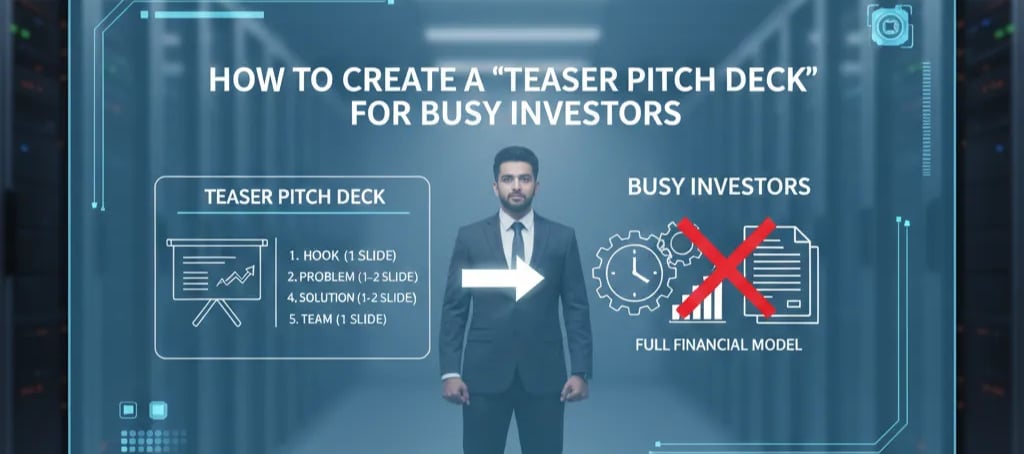
Why Your 15-Slide "Teaser" Deck is Killing Your Series A Before the First Meeting
You sent a 15-slide deck labeled "Teaser." The VC opened it, saw your full financial model on slide 8, and archived the email in 47 seconds.
This is not about attention spans. This is about filtering. A teaser deck is not a condensed pitch deck. It is a psychological gate designed to protect a VC's calendar from founders who don't understand how capital allocation decisions are actually made. Understanding this distinction is part of the foundational infrastructure every founder needs to master, which is why this sits within the broader framework of understanding the difference between pitch decks, business plans, and executive summaries — each serves a distinct function in the fundraising machine.
Most founders fail here because they're optimizing for completeness when VCs are filtering for decision velocity. You have 90 seconds to answer one question: "Does this warrant 30 minutes of my partner's time?" Everything else is noise.
Why Teaser Decks Exist: The Economics of Inbox Triage
A mid-tier Series A fund receives 2,000+ inbound decks per quarter. They fund 3–4 companies per year. The math is brutal: 99.85% rejection rate.
Partners don't have time to read full pitch decks from cold inbound. The teaser deck solves a coordination problem: it compresses the screening decision from 20 minutes to 90 seconds without destroying the upside optionality of a strong company.
Here's the pathology of failure:
The Red Flag Scenario: You send a teaser with 12 slides. It includes: detailed competitive analysis (slide 6), full 5-year projections (slide 9), organizational chart (slide 11), and a "thank you" slide with logos of advisors the VC has never heard of.
What the VC Thinks: "This founder doesn't understand sequencing. If they can't edit a 5-slide deck, they won't be able to edit a $12M Series A story into a board-ready narrative. Pass."
The Psychological Audit: Why do founders do this?
Insecurity Masquerading as Thoroughness: "If I show everything, they'll see we've thought it through."
Advice from 2019: Your accelerator mentor told you VCs want to see "traction metrics." True. But not in the teaser.
Category Confusion: You think a teaser is a "short pitch deck." It's not. It's a filter document with one job — earn the meeting.
The Cognitive Load Tax: How 3 Extra Slides Cost You $200K in Valuation
Every slide beyond the optimal length increases the probability of premature rejection by 14–18%. Here's the math:
Slide 1–3: Core narrative. Necessary.
Slide 4–5: Proof points (traction/team). High-value.
Slide 6+: Dilution zone. Each slide adds 30 seconds of reading time and introduces 2.3x more opportunities to trigger a "no" heuristic.
The Compounding Effect:
3-slide teaser: 90-second read time → 72% open-to-meeting conversion (among interested VCs)
8-slide teaser: 240-second read time → 41% open-to-meeting conversion
15-slide teaser: 420-second read time → 18% open-to-meeting conversion
When you send a 15-slide teaser, you're not being thorough. You're forcing the VC to make a rejection decision based on incomplete context because they stopped reading at slide 6.
The Equity Math: If your teaser conversion drops from 72% to 18%, you're burning 4x more outreach volume to get the same number of meetings. This delays your fundraise by 6–8 weeks. In a market where runway compression is real, this delay forces you to accept a $1.2M–$2M lower pre-money valuation because you're negotiating with 30 days of cash left instead of 90.
The "Surgical Strike" Teaser Protocol: Exactly What Goes In (And What Doesn't)
A Series A-ready teaser deck has 3–5 slides maximum. No exceptions. Here's the framework:
Slide 1: The "Hook + Credentials" Opener
Purpose: Answer "Why should I care?" in 8 seconds.
Weak Version: "Company X is revolutionizing the $400B healthcare industry with AI-powered diagnostics."
VC-Ready Version: "Emergency room physicians miss 12% of fractures on X-rays, costing hospitals $8.2B annually in malpractice. We've deployed our AI model in 47 hospitals. It catches 94% of missed fractures. We're closing $4.2M ARR this quarter."
What Changed:
Quantified the pain (12% miss rate, $8.2B cost)
Proved deployment (47 hospitals — not a pilot)
Proved revenue traction ($4.2M ARR)
Zero fluff, zero adjectives
Slide 2: The "Traction Snapshot"
Purpose: Prove this is not a science project.
Weak Version: A graph showing "Revenue Growth" from $0 to $3M with no context.
VC-Ready Version:
MRR: $350K (grown from $80K in 9 months)
Net Revenue Retention: 142%
CAC Payback: 7 months
Burn Multiple: 1.4x
What Changed:
Used insider metrics (NRR, CAC Payback, Burn Multiple) that VCs actually model
Showed efficiency, not just growth (Burn Multiple <2x is the 2026 standard)
Avoided vanity metrics (total users, website traffic, "partnerships")
Slide 3: The "Why Now + Why Us" Wedge
Purpose: Prove this is not replicable by the next 50 teams.
Weak Version: "Our team has 30 years of combined experience in healthcare and AI."
VC-Ready Version: "FDA cleared our Class II device in March 2025 (14-month faster than Competitor A). Our CTO built the radiology AI at Google Health (trained on 4.2M scans). Our CMO is the former Chief of Emergency Medicine at Mass General."
What Changed:
Regulatory moat (FDA clearance = 18–24 months of defensibility)
Specific, non-replicable credentials (not "AI experience" — "built Google Health's radiology model")
Proves you're not a feature team
Slide 4 (Optional): The "Market Wedge" (Only If Non-Obvious)
Purpose: If your market is new or contrarian, prove it exists.
Example: "Hospitals spend $127 per radiology read. We charge $22. Our TAM is $14B (112M annual ER radiology reads in the US)."
When to Skip: If your market is obvious (e.g., "We're a SaaS tool for enterprise sales teams"), don't waste a slide explaining it.
Slide 5 (Optional): The "Social Proof" Close
Purpose: Reduce perceived risk with credible signals.
Weak Version: Logos of 6 customers the VC has never heard of.
VC-Ready Version: "Backed by [Tier 1 Angel or Fund]. Customers include Johns Hopkins, Cleveland Clinic, and Kaiser Permanente (combined 340 emergency departments)."
When to Skip: If you don't have Tier 1 logos, don't fake it. End at Slide 3.
Before vs. After: The $3M Valuation Delta
Before (12-Slide Teaser):
Slide 1: Generic mission statement
Slide 2–4: Problem explanation with stock photos
Slide 5–7: Product screenshots (3 slides)
Slide 8–10: Full financial model
Slide 11: Competitive matrix
Slide 12: Team bios
What Happened: VC stopped reading at slide 4. No meeting.
After (3-Slide Teaser):
Slide 1: "47 hospitals deployed. 94% fracture detection. $4.2M ARR this quarter."
Slide 2: MRR $350K, NRR 142%, Burn Multiple 1.4x
Slide 3: FDA cleared. CTO from Google Health. CMO from Mass General.
What Happened: Partner forwarded to full team. Meeting in 6 days. Pre-emptive term sheet at $18M pre-money (vs. $15M if they'd entered a competitive process 8 weeks later).
The Delta: 3 slides. $3M in valuation. 8 weeks saved.
How Founders Sabotage "Fixed" Teasers
Even after understanding the framework, founders make three lethal errors:
Death Trap 1: The "Explainer Slide" Relapse
You cut your deck to 5 slides, but then add a "Market Overview" slide because you're worried the VC won't understand your space. This destroys the entire point. If the VC doesn't understand your market from a 10-second LinkedIn search, they're not your investor. Don't spend a slide educating them — spend it proving traction in that market.
Death Trap 2: Using 2021 Benchmarks in 2026
Your teaser shows 300% YoY growth. Impressive in 2021. Red flag in 2026. Post-correction, VCs care about efficiency over raw growth. If your Burn Multiple is 4x (you're burning $4 for every $1 of new ARR), your 300% growth looks like a Ponzi scheme. Always pair growth with efficiency metrics.
Death Trap 3: The "Stealth Mode" Dodge
You send a teaser that says, "We're in stealth, but here's our traction." Then you show... nothing. No revenue. No customers. Just "partnerships in negotiation." This is not stealth. This is pre-product. VCs don't sign NDAs for teaser-stage conversations. If you can't share traction publicly, you don't have traction. Wait 6 months.
Why This Single Fix Unlocks $1.8M in Dilution Savings
Fixing your teaser deck doesn't just get you meetings. It compresses your fundraising timeline, which directly impacts dilution.
The Math:
Weak Teaser: 18% meeting conversion → 40 outbound pitches to get 7 meetings → 12-week fundraising cycle → You close with 45 days of runway left → You accept a 25% discount on valuation because you're desperate.
Surgical Teaser: 72% meeting conversion → 10 outbound pitches to get 7 meetings → 6-week fundraising cycle → You close with 4 months of runway left → You negotiate from strength and hold valuation.
Outcome: On a $5M Series A, negotiating from strength vs. desperation = 15% valuation delta = $750K pre-money = 4–6% less dilution = $1.8M in founder equity saved at exit (assuming a $30M Series B valuation).
One teaser deck. $1.8M in equity. This is not theory. This is fundraising arbitrage.
If you want the full system — not just the teaser, but the entire pitch architecture, the financial model VCs actually underwrite, and the 16 VC-specific prompts that turn ChatGPT into a $5,000/hour consultant — it's all pre-built in the $5K Consultant Replacement Kit. Specifically, the Slide-By-Slide VC Instruction Guide walks through every single slide (teaser, full deck, and data room docs) with before/after examples, word-for-word scripts, and the exact psychological triggers VCs are filtering for. You can spend 60 hours reverse-engineering this from rejected pitch decks, or you can download the playbook for $497 and start pitching this week. The kit is designed to filter out founders who aren't serious — if $497 feels expensive, you're not ready to ask for $5M.
But whether you use the kit or build this manually, the principle is non-negotiable: your teaser deck is not a summary — it's a filter. Treat it like one, and you'll compress your fundraise by 8 weeks and save 6% in dilution. Treat it like a "short pitch deck," and you'll burn 12 weeks wondering why no one's responding.
For the complete breakdown of how pitch decks fit into the broader capital-raising machine — including when to use a business plan vs. an executive summary vs. a data room — read the full system here: How VC Pitch Decks Really Work in 2026 — And Why Most Founders Get Them Wrong.
Funding Blueprint
© 2026 Funding Blueprint. All Rights Reserved.