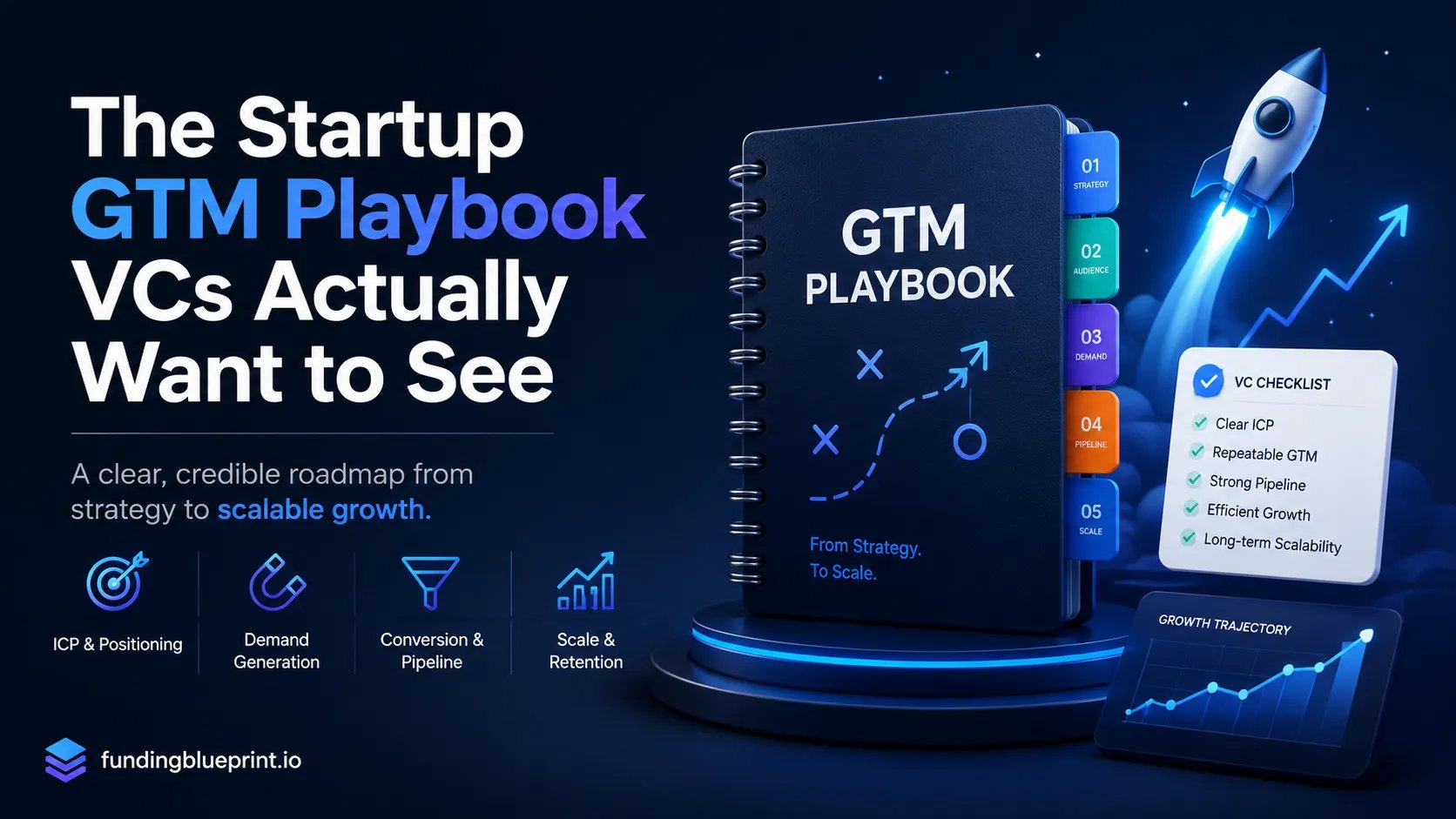
GTM Strategy & Distribution: The Forensic Science of Customer Acquisition
GTM Strategy & Distribution: Distribution wins, not products. Master the CAC Payback math and Channel-Model Fit that elite London and NYC VCs demand in 2026.
PILLAR 8: MARKET SIZE & COMPETITION
1/1/20269 min read


GTM (Go-To-Market) Strategy & Distribution: The Forensic Science of Customer Acquisition
Great products do not win. Great distribution wins.
The graveyard of venture capital is paved with superior products that failed to find an audience. In a forensic audit, we operate on a brutal truth: First-time founders obsess over product; second-time founders obsess over distribution.
Your Go-To-Market (GTM) strategy is not a marketing plan. It is not a list of conferences you plan to attend, a vague promise to "do SEO," or a hope that your product will "go viral." It is a mathematical equation that aligns your Average Contract Value (ACV) with your Customer Acquisition Cost (CAC). If this equation is unbalanced, you are not building a business; you are burning cash to subsidize customers who will never be profitable.
When a Partner at a Tier-1 fund in London or NYC reviews your GTM slide, they are looking for "Channel-Model Fit." They want to know if you understand the physics of your own sales motion. Are you trying to sell a $500/year product using a field sales team? (This leads to bankruptcy). Are you trying to sell a $500,000/year enterprise platform using Facebook Ads? (This leads to silence).
This analysis is a surgical dissection of GTM mechanics, removing the "brand awareness" fluff and focusing on the operational levers that actually drive revenue velocity. We will dismantle the common myths of "Growth Hacking" and replace them with the forensic realities of unit economics.
This sub pillar is part of our main Pillar 8: Market Size & Competition
The Trench Report: The "Field Sales" Suicide (A $12M Error)
In Q2 2024, I audited a Series A HR-Tech company in Toronto. They had raised a healthy Seed round and had a slick product priced at roughly $3,000 per year per client. To scale this revenue, the founders—following the advice of a generic sales advisor—hired 10 "Enterprise Account Executives" (AEs) with base salaries of $120k each.
The Structural Error:
The math was broken before the first phone call was made.
The Cost: A fully loaded Enterprise AE (salary + commission + software tools + travel + benefits) cost the company approximately $200,000 per year.
The Revenue Requirement: At a $3,000 price point, each AE had to close 67 deals per year just to cover their own cost (Break-even). That is more than one closed deal every single week, 52 weeks a year, without fail.
The Reality: In complex B2B sales, even a top-tier rep typically closes 2-4 deals a month. The reps were closing ~$40k/year in revenue while costing the company $200k/year. The company was bleeding $1.6M annually on the sales team alone, effectively subsidizing every client they signed.
The Technical Pivot:
We executed a "GTM Transplant." We recognized that a $3k ACV product sits in the "Dead Zone"—too expensive for a credit card swipe, but too cheap for a salesperson.
The Purge: We fired the field sales team.
The Shift: We replaced them with a Product-Led Growth (PLG) motion. We removed the "Request a Demo" gate and allowed users to onboard themselves via a free trial.
The Support Layer: We hired a low-cost "Customer Success" team (not sales) to answer chat tickets and upsell strictly after the user had already adopted the product.
The Inbound Engine: We reallocated the sales salaries into "Content Operations" to drive SEO traffic, ensuring leads came in organically rather than via cold calling.
The Result:
The CAC dropped from a crippling $4,500 to a manageable $300. The CAC Payback Period (the time it takes to earn back the marketing spend) went from 18 months (fatal) to 1.2 months (elite). The company became profitable on a unit basis within two quarters because the mechanism of sale finally matched the price of the product.
The "Channel Power Law" & The Physics of Sales
Amateur GTM slides list 10 channels: "We will do SEO, PPC, Email, Events, Influencers, Partnerships, and Cold Calling."
Forensic Reality: This is the "Spray and Pray" error. In reality, the Power Law applies to distribution: One channel will drive 80% of your growth. The other 9 are distractions that dilute your focus and capital.
We evaluate GTM maturity using specific forensic metrics that reveal the efficiency of your spend. The most critical concept to master is Channel-Model Fit.
The Forensic Spectrum of Sales Motions:
Self-Serve (PLG) | ACV < $1k:
The Physics: No humans can touch this deal. Margins are too thin. You must grow via SEO, Viral loops, or highly efficient paid ads. Support must be automated (documentation/AI).
The Trap: Hiring a salesperson for a $50/month product.
Transactional (Inside Sales) | ACV $1k - $10k:
The Physics: High velocity. A sales rep sits in an office (or Zoom) and closes 10-20 deals a month. The sales cycle is 14-30 days. One or two calls maximum.
The Trap: Treating these deals like Enterprise deals (flying to meet them, doing custom demos).
Enterprise (Field Sales) | ACV > $100k:
The Physics: "Elephant Hunting." Requires multiple stakeholders (CIO, CFO, User). Sales cycles are 6-12 months. Requires steaks, flights, and security questionnaires.
The Trap: Trying to close these deals with a "Buy Now" button on the website. No CIO swipes a corporate card for $100k without a contract.
The One Formula You Need: CAC Payback Period
While metrics like LTV:CAC are popular, they are often based on 5-year projections that are pure fiction. In a forensic audit, we care about Cash Flow Risk. How long is my money gone before it comes back?
CAC Payback (Months) = CAC
MRR times Gross Margin%
Forensic Benchmark:
< 6 Months: You are a cash-generating machine. You can reinvest profits into growth faster than competitors.
6-12 Months: Healthy. The industry standard for efficient SaaS.
> 12 Months: You are operating on a credit line. If funding dries up, you die.
> 18 Months: You are likely insolvent unless you have infinite runway (e.g., Uber in 2015).
Regional Calibration (SF vs. London)
Your GTM strategy must speak the language of your investor's risk appetite. A pitch that triggers a "Yes" in Silicon Valley might trigger a "red flag" in London.
San Francisco (The "Land Grab")
The Thesis: Velocity is the only moat. "If we don't take the market, someone else will."
The Strategy: Blitzscaling. SF investors want to see you pour gasoline on the fire. They are comfortable with "inefficient growth" (spending $3 to make $1) in the short term, provided you are capturing market share that locks out competitors.
The Pitch: "We are spending aggressively to acquire the entire market. Our CAC is high today, but our LTV is infinite because we will own the category. We are optimizing for Month-over-Month (MoM) Growth Rate."
The Expectation: 20-30% MoM growth.
London / New York (The "Burn Multiple")
The Thesis: Capital efficiency protects equity. "Don't run out of money before you find product-market fit."
The Strategy: Efficient Growth. These investors are often managing more conservative capital (pension funds/family offices). They fear dilution and down-rounds.
The Pitch: "We have a disciplined GTM. We do not scale spend until our Unit Economics are green. We are optimizing for the Burn Multiple."
The Expectation: A Burn Multiple < 1.5. (Burning $1.50 or less to generate $1.00 of Net New ARR). They want to see a clear path to cash flow breakeven.
Metric Logic & Red Flags
During Technical Due Diligence (DD), analysts look for specific "Red Flags" in the GTM strategy that indicate a lack of operational grip. These are the signals that get your deck tossed in the "Pass" pile.
Red Flag 1: The "Partnership" Delusion
The Error: "We will partner with Microsoft, Salesforce, and Accenture, and they will sell our product to their customers."
The Forensic Reality: Big companies do not sell small companies' products. They barely sell their own new products. Channel partnerships only work when you are already at scale ($10M+ ARR) and have massive demand that the partner can monetize.
The Verdict: Remove "Partnerships" from your early-stage GTM slide. It signals laziness and a lack of understanding of how incentives work.
Red Flag 2: The Viral Fallacy without the "K-Factor"
The Error: "We will grow via word-of-mouth."
The Forensic Reality: Unless you have a Viral Coefficient ($k$) > 1.0, viral growth is a bonus, not a strategy.
The Verdict: If you claim virality, you must show the mechanics: "Each user invites 2.5 people, and 50% of them convert." If you don't have this data, you don't have a viral strategy; you have a hope strategy.
Red Flag 3: The "All Things to All People" ICP
The Error: "Our Ideal Customer Profile (ICP) is Small Businesses, Enterprises, and Governments."
The Forensic Reality: You cannot sell to all three. SMBs need self-serve. Enterprise needs sales reps. Government needs RFP writers. Doing all three requires three separate companies.
The Verdict: Pick one ICP. "We sell to mid-market FinTech CFOs." Specificity breeds trust.
Earned Secrets
These are the non-obvious GTM realities that only operators know—the insights that don't appear in blog posts but dominate board meetings.
Secret 1: The Death of Outbound (The 2024 Deliverability Crisis)
For a decade, the playbook was "hire SDRs, buy lead lists, send 1,000 emails a day." Since Google and Yahoo's 2024 spam policy updates, cold email deliverability has collapsed. Open rates are down 40% across the industry.
The Earned Secret: The "Spray and Pray" outbound model is effectively dead. You can no longer rely on volume. You must pivot to "Nearbound" strategies—leveraging the networks of people your buyers already trust (advisors, investors, existing vendors). Warm intros are now the only scalable outbound motion.
Secret 2: Attribution Software is Lying (The Dark Social Reality)
HubSpot or Google Analytics 4 (GA4) will tell you that "Direct Traffic" or "Organic Search" is your top lead source. This is a lie.
The Earned Secret: Most B2B buying decisions happen in Dark Social—Slack communities, WhatsApp groups, Discord servers, and DM threads where tracking pixels cannot fire. By the time a prospect Googles your name, the decision has already been made based on a peer recommendation.
The Fix: Stop optimizing for "Last Click" attribution. Add a "How did you hear about us?" free-text field to your signup form. The answers ("My friend Steve told me in the CFO Slack group") will reveal your actual GTM source, which is usually peer influence, not ads.
Secret 3: The "Founder-Led Sales" Trap
Founders often try to hire a "VP of Sales" too early (e.g., at $500k ARR) to "offload" the sales work so they can focus on product.
The Earned Secret: A VP of Sales cannot fix a broken product pitch. Their job is to accelerate a working process, not invent it. If the Founder cannot sell the product, a hired gun cannot sell it.
The Rule: The Founder must close the first $1M-$2M in ARR personally. You cannot outsource the learning curve. You need to hear the "No"s yourself to fix the product.
Expert FAQ: The Unasked Questions
Q: Should I launch on Product Hunt?
A: Forensic Answer: Only if you treat it as a marketing stunt, not a GTM strategy. Product Hunt users are "Early Adopters" (tech enthusiasts), not necessarily your ideal B2B buyers. They have high churn and low willingness to pay. It is a vanity spike. Launch only if you have a pre-built email list of 500+ supporters ready to upvote in the first hour to game the algorithm. If you launch cold, you will be buried.
Q: Should I use an outsourced SDR (Sales Development Rep) agency?
A: Forensic Answer: generally, No. Agencies are incentivized on "Meetings Booked," not "Deals Closed." They will flood your calendar with low-quality leads to hit their metrics and get paid. You end up wasting your valuable Account Executives' time on bad calls. It is almost always better to build the SDR function in-house so you control the quality feedback loop.
Q: How do I calculate CAC when I have organic (free) leads?
A: You must calculate Blended CAC and Paid CAC separately.
Blended CAC: (Total Spend / Total Customers). This looks good on a slide.
Paid CAC: (Ad Spend / Customers from Ads). This tells the truth about scalability.
The Warning: Blended CAC hides inefficiency. If your Paid CAC is $5,000 but your Blended CAC is $500 because of one viral blog post, you might think you can scale ads. You can't. Always optimize for Paid CAC scalability.
Forensic Audit Checklist
Before you finalize your "GTM & Distribution" slide and export to PDF, run this 5-point diagnostic. If you fail any point, the slide is a liability.
The Math Check: Does your CAC Payback Period align with your runway? (If Payback is 12 months but you only have 9 months of cash, you will die before the money comes back).
The Focus Test: Do you list fewer than 3 primary channels? (If you list 5+, you are unfocused. Pick one major channel and one experimental one).
The Sales Motion Check: Is your sales motion appropriate for your price point? (No field sales for <$10k ACV. No credit card swipes for >$50k ACV).
The Pipeline Logic: Do you show a "Bottom-Up" build? Instead of just saying "$1M Revenue," do you say: "To hit $1M ARR, we need 5,000 visitors -> 500 leads -> 100 demos -> 20 closed deals"? Show the funnel conversion rates.
The Visual Grip: Does the slide clearly separate "Inbound" (Marketing) from "Outbound" (Sales)? Mixing them confuses the investor about your organizational structure and hiring needs.
You have engineered a product, built a moat, defined a revenue model, and now you have a GTM machine to sell it. The engine is running. But an engine is useless if the pilot is flying blind.
The final failure mode is Operational Blindness. This occurs when a founder measures the wrong things, confusing "Vanity Metrics" (Likes, Signups, Total Users) with "North Star Metrics" (Retention, Engagement, Net Dollar Retention). This leads us to the final, critical pillar of the fundraising narrative: "Key Metrics & Financial Projections."
(Note: The Funding Blueprint Kit includes the "GTM Simulator" module. It allows you to model different sales motions—PLG vs. Sales-Led—and automatically calculates the resulting CAC Payback, Magic Number, and Burn Multiple. It prevents you from choosing a GTM strategy that mathematically bankrupts your model. Access the forensic suite at the home page.)
Funding Blueprint
© 2025 Funding Blueprint. All Rights Reserved.