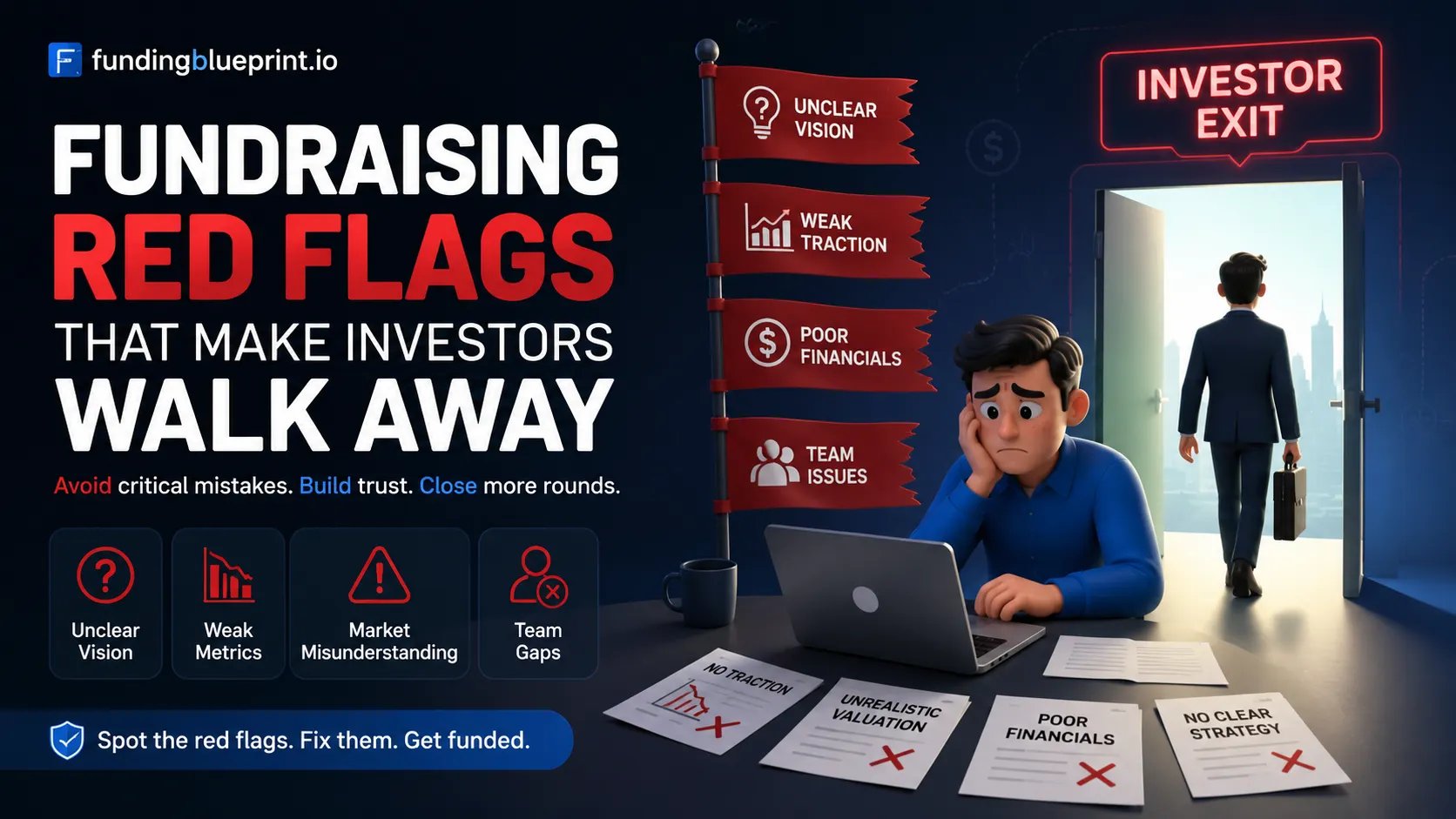
Fundraising Red Flags & Common Mistakes: The Forensic Audit of Failure
Fundraising Red Flags & Common Mistakes: Avoid the "Dead Equity" trap. Master the Failure Probability logic and Red Flag audit elite London and NYC VCs use to kill deals in 2026.
PILLAR 9 - FUNDRAISING STRATEGY
1/4/20268 min read


Fundraising Red Flags & Common Mistakes: The Forensic Audit of Failure
Fundraising is a game of pattern matching. Investors are not looking for reasons to say "Yes"; they are looking for reasons to say "No."
The most brutal truth in Venture Capital is that "No" is the default state. A General Partner (GP) at a Tier-1 fund sees 5,000 deals a year and makes 2 investments. That is a 0.04% acceptance rate. To survive this filter, you do not just need a great company; you need a "Clean Signal."
Most founders fail not because their business is unviable, but because they unknowingly trigger "Forensic Red Flags"—subtle signals of incompetence, dishonesty, or operational naivety that cause the investor to pass immediately. These are not obvious errors like "typos in the deck." These are structural flaws in the narrative, the cap table, or the founder's psychology.
In a forensic audit of failed rounds in London, New York, and San Francisco, we classify these mistakes into three categories: Structural (The Deal), Operational (The Business), and Behavioral (The Founder).
This analysis is a surgical dissection of the "Kill Signals" that destroy term sheets. We will strip away the polite feedback ("You're too early") and reveal the actual reasons investors passed, so you can sanitize your deal before you enter the market.
This sub pillar is part of our main PILLAR 9 — FUNDRAISING STRATEGY
The Trench Report: The "Advisor" Equity Trap (A Poisoned Cap Table)
In Q2 2025, I advised a HealthTech founder in Boston. She had a $5M term sheet on the table from a top-tier VC. During legal diligence, the deal suddenly stalled.
The Structural Error:
The VC’s legal team found a "Dead Equity" problem.
The Situation: Two years prior, the founder had given 5% equity to an "Advisor" who promised to make introductions. The Advisor made zero intros and did no work.
The Impact: The Cap Table showed that a non-operational person owned more equity than the CTO. To the VC, this signaled two things:
Poor Judgment: The founder gave away value for free.
Misaligned Incentives: There wasn't enough equity left to incentivize future hires.
The Forensic Result:
The VC demanded a "Recapitalization" (wiping out the advisor) as a closing condition. The Advisor refused to sign. The VC walked away. The deal died because of a mistake made on Day 1.
The Technical Pivot:
We now enforce the "FAST Agreement Protocol."
The Rule: Never give equity upfront.
The Mechanism: Use the Founder / Advisor Standard Template (FAST). Equity vests over 2 years. If the advisor delivers nothing in Q1, you fire them, and they get 0 shares.
The Lesson: "Dead Equity" is a parasite. If >10% of your cap table is owned by people who don't work there (excluding investors), you are unfundable.
The Forensic Formula: The Dead Weight Ratio ($R_{dw}$)
Calculate this before you pitch.
Rdw = Equity Owned by Non-Operational Founders/Advisors
Total Fully Diluted Equity
Benchmark: If Rdw > 15% (pre-Series A), you have a "Broken Cap Table." You must fix it via buybacks or dilution before raising.
The Three Categories of Kill Signals
We classify Red Flags based on where they appear in the diligence funnel.
Category 1: Structural Red Flags (The Deal Mechanics)
These are errors in how you are raising money.
1. The "Valuation Trap": Raising at a valuation you cannot grow into.
Scenario: You raised Seed at $20M Post-Money but only grew revenue 2x. Now you need to raise Series A.
The Kill Signal: To raise a "Flat Round" (same valuation) is a signal of failure. To raise a "Down Round" triggers anti-dilution clauses that wash you out.
Forensic Fix: Raise at the lowest valuation that minimizes dilution while allowing for a 3x markup in the next round. Don't optimize for ego.
2. The "Dirty Term Sheet": Having previous investors with "Super Pro-Rata" or "Blocking Rights."
Scenario: Your Angel Investor has a veto right on future financings.
The Kill Signal: No Series A VC will invest if a small angel can hold the round hostage.
Forensic Fix: Clean up your side letters. Convert all quirky angel rights to "Major Investor" standard rights (only for checks >$250k).
3. The "Bridge to Nowhere": Raising a small amount to "figure things out."
Scenario: "We are raising a $500k bridge to get to Series A."
The Kill Signal: Bridges are for timing, not survival. Unless you have a term sheet landing in 3 months, a bridge is just a longer runway to death.
Forensic Fix: Don't call it a bridge. Call it a "Seed Extension" and attach it to a specific milestone (e.g., "Unlock $2M Pipeline").
Category 2: Operational Red Flags (The Business Logic)
These are errors in your unit economics or metrics.
1. The "LTV:CAC" Hallucination: Calculating Lifetime Value (LTV) over 5 years.
Scenario: "Our LTV is $50k because customers pay $10k/year and stay for 5 years."
The Kill Signal: You have only existed for 1 year. You have no proof they stay for 5.
Forensic Fix: Cap LTV at 18-24 months. If the math doesn't work at 24 months, your business doesn't work.
2. The "Consulting Revenue" Mask: Hiding service revenue in ARR.
Scenario: You have $1M revenue, but $400k is "Onboarding Fees" or "Custom Dev."
The Kill Signal: Service revenue has 30% margins. SaaS revenue has 80% margins. Mixing them destroys your valuation multiple.
Forensic Fix: Separate "Recurring Revenue" and "Non-Recurring Revenue" clearly. Be proud of the former, minimize the latter.
3. The "CAC Payback" Lag: Payback periods > 18 months.
Scenario: It takes you 2 years of profit to pay off the ad spend to acquire a customer.
The Kill Signal: You are a bank, not a tech company. You are lending money to customers to buy your product.
Forensic Fix: If Payback is high, prove you have "Negative Churn" (Expansion revenue) that accelerates the payback curve.
Category 3: Behavioral Red Flags (The Founder Psychology)
These are errors in how you act.
1. The "Defensive Crouch": Arguing with investors.
Scenario: Investor says, "I worry about Google entering this space." Founder says, "You don't understand the tech."
The Kill Signal: Uncoachable. If you fight now, you will be a nightmare in board meetings.
Forensic Fix: "Judo Answer." "That is a valid risk. Here is why our data moat protects us..."
2. The "Dishonesty Gap": Small lies about traction.
Scenario: "We have signed Coca-Cola." (Reality: You are in a free pilot with one regional manager).
The Kill Signal: During diligence, they call Coke. Coke says "Who?" You are blacklisted instantly.
Forensic Fix: Be precise. "We are in a Paid Pilot with the North American division."
Regional Calibration (SF vs. London)
Red flags are culturally relative. What scares a London investor might excite a San Francisco investor.
San Francisco (The "Speed" Risk)
The Red Flag: Slowness.
The Signal: "We have been building this MVP for 18 months."
Why: SF investors value Velocity above all. If you ship slow, you learn slow.
Tolerance: They will tolerate high burn rates if growth is 300%. They will not tolerate slow execution.
London / New York (The "Efficiency" Risk)
The Red Flag: Unit Negative Growth.
The Signal: "We lose money on every unit, but we make it up in volume."
Why: European investors are "Solvency Focused." They remember 2008 and 2000. They hate negative gross margins.
Tolerance: They will tolerate slower growth (80% YoY) if the business is capital efficient (Burn Multiple < 1).
Metric Logic & The "Chart Crimes"
Nothing destroys trust faster than a misleading chart. We call these "Chart Crimes."
Crime 1: Cumulative Revenue Graphs
The Crime: Showing a chart that always goes up because it adds all historical revenue together.
The Forensic Reality: It hides churn. A company with $0 revenue today still looks good on a cumulative chart.
The Fix: Always show Monthly Recurring Revenue (MRR). If it’s flat, show it flat.
Crime 2: The "Y-Axis" Manipulation
The Crime: Starting the Y-Axis at $90k instead of $0 to make a small growth look like a vertical spike.
The Forensic Reality: Investors notice this instantly. It signals insecurity.
The Fix: Start at zero. If the growth looks small, focus on the percentage growth in the label.
Crime 3: The "Logos" Slide Dump
The Crime: Showing 50 logos where 45 are "Free Trial" users and 5 are paying.
The Forensic Reality: Diligence calls will reveal the truth.
The Fix: Segregate logos into "Customers" (Paying) and "Pilots" (Free). Transparency breeds trust.
Forensic Formula: The Churn Truth Creal
Founders often quote "Gross Churn" to hide the fact that they are losing customers
Creal = Logo Churn (Percentage of customers who left)
Warning: If Net Revenue Retention (NRR) is 110% (Good), but Logo Churn is 30% (Bad), you have a leaky bucket. You are masking the problem by upselling the few survivors. Investors will find this.
Earned Secrets
Hidden signals that kill deals in the backchannel.
Secret 1: The "Reference Check" Backfire
The Secret: Investors don't just call the references you list. They call the "Backchannel"—people you worked with who you didn't list.
The Red Flag: If a former co-founder or VP Sales says "He's hard to work with," the deal dies, and you will never know why.
The Fix: Audit your past. If you have a bad relationship, pre-empt it. "You might hear from X that we clashed. Here is the context." Own the narrative.
Secret 2: The "Spousal" Veto
The Secret: For Seed Stage founders, investors look for "Life Stability."
The Red Flag: If a founder says, "I'm going through a messy divorce," investors worry about focus and asset division.
The Fix: Keep personal drama off the table. Project stability.
Secret 3: The "Outsource" CTO
The Secret: A non-technical CEO with an outsourced dev shop in another country.
The Red Flag: You are not a tech company; you are a project manager. You cannot iterate fast enough.
The Fix: You must have a Technical Co-Founder or a Head of Engineering with significant equity on the cap table. Code must be owned in-house.
Expert FAQ: The Unasked Questions
Q: Can I raise money if I am a solo founder?
A: Forensic Answer: Yes, but it is 10x harder.
The Risk: "Bus Factor." If you get hit by a bus, the company dies.
The Mitigation: You must show a strong "Lieutenant Layer" (VP Product, VP Sales) with equity who can carry the torch.
Q: Is it a red flag if I have a side hustle?
A: Forensic Answer: Yes.
The Signal: "You are not all-in."
The Expectation: Investors expect obsession. If you are running an agency on the side to pay bills, you are distracted.
The Fix: "I am winding down my consulting work to go full-time upon closing this round." (Commitment Condition).
Q: What if my co-founder left?
A: Forensic Answer: This is a "Yellow Flag" (Caution).
The Fix: Be honest. "We had a vision misalignment. We executed a clean separation agreement. Their equity was repurchased/vested. Here is the legal doc."
The Kill: If the equity is messy (they still own 30% and are angry), the deal is dead. Fix the "Dead Equity" first.
Forensic Audit Checklist
Before you start your roadshow, run this 5-Point "Red Flag" Diagnostic:
The Cap Table Cleanse: Is >80% of equity held by active employees/investors? (Kill the dead weight).
The Metric Sanity Check: Are you calculating LTV, CAC, and MRR using standard GAAP definitions? (No creative accounting).
The Legal Audit: Do you have "Assignment of Inventions" agreements signed for every line of code? (If not, you don't own your IP).
The "Customer Concentration" Check: Does one customer account for >40% of revenue? (This is a risk. Be ready to explain mitigation).
The "Social Audit": Google yourself. Are there old tweets or blog posts that contradict your current pitch? Scrub the digital footprint.
Narrative Breadcrumb
You have sanitized your Cap Table. You have verified your metrics. You have identified and removed the "Kill Signals." You are now "Diligence Ready."
But avoiding mistakes is only half the battle. To win the round, you must actively Close. The final stage of fundraising is not about data; it is about "Leverage & Negotiation." This leads us to the final module: "Negotiation, Follow-Up & Closing Rounds."
(Note: The Funding Blueprint Kit includes the VC-Ready Pitch Deck (Elite Canva Template) and the Slide-By-Slide VC Instruction Guide. These tools help you structure your narrative to avoid common 'Chart Crimes' and present a 'Clean Signal' to investors. Access the full forensic suite at the home page.)
Funding Blueprint
© 2025 Funding Blueprint. All Rights Reserved.