Understanding the Fundraising Process: The Engineering of Capital Velocity

Understanding the Fundraising Process: Fundraising is engineering, not art. Master the Capital Velocity V(f) formula and Due Diligence timeline elite London and NYC VCs demand in 2026.

PILLAR 9 - FUNDRAISING STRATEGY

1/2/20268 min read

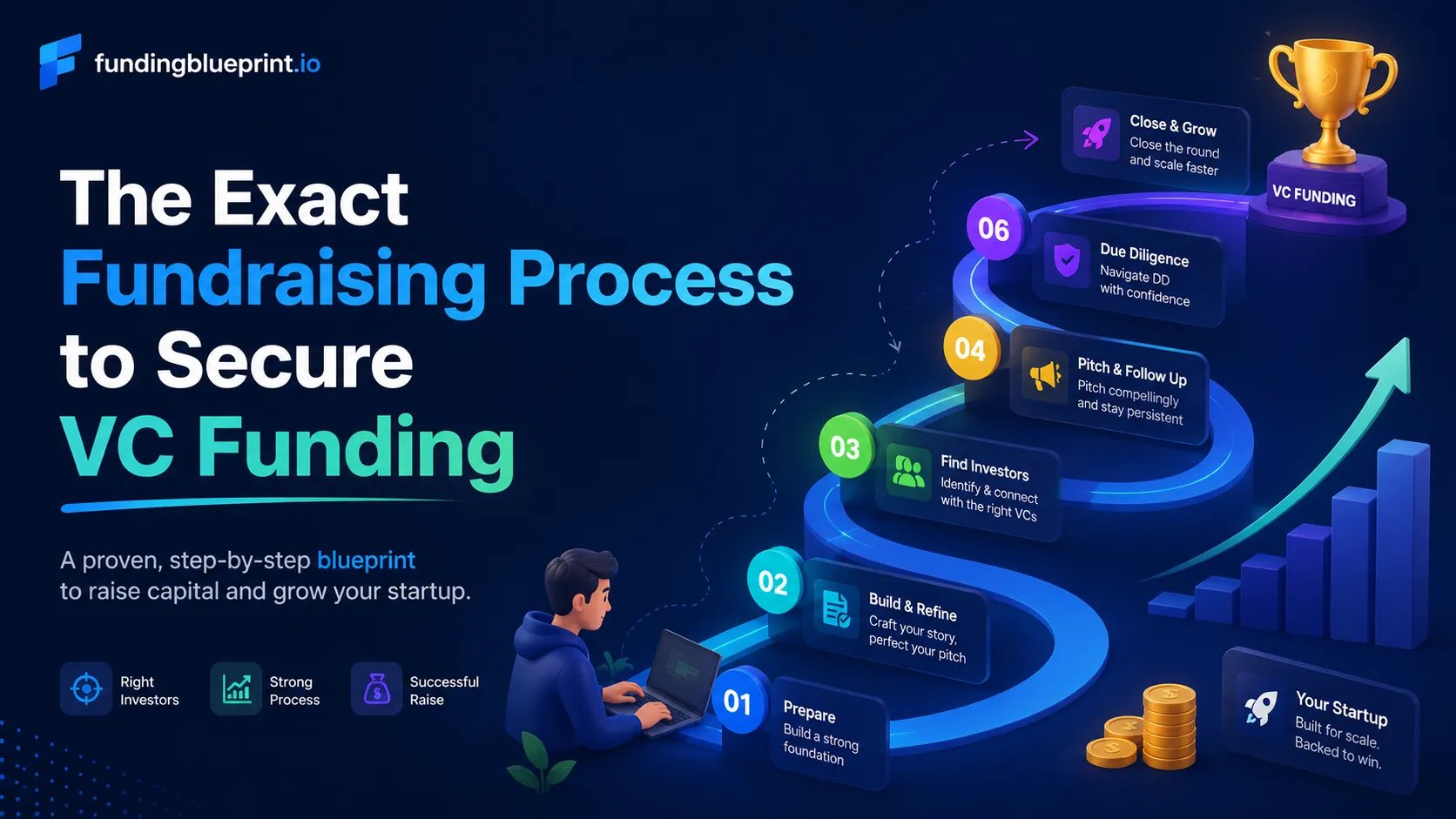
Fundraising process and capital velocity infographic.

Understanding the Fundraising Process: The Engineering of Capital Velocity

Fundraising is not an art, and it is not a "side hustle." It is a brutal, high-velocity B2B enterprise sales campaign where the product is your equity and the price is your valuation.

The single greatest failure mode for founders is treating fundraising as a series of casual coffee chats. They approach investors sequentially, hoping for a "connection." In the forensic reality of Venture Capital, this is known as a "Linear Process Failure."

Venture Capital is a momentum asset class. Deals do not close because the business is good; deals close because the investor fears that access to the business is disappearing. If you cannot engineer the psychological sensation of "scarcity," you will not raise capital, regardless of your EBITDA.

When we audit a fundraising strategy in London or New York, we do not look at the pitch deck first. We look at the CRM (Customer Relationship Management) system. We look at the "Top of Funnel" volume and the "conversion velocity" between stages. If you are not running your fundraise with the same rigor as your Sales Team runs their pipeline, you are already dead in the water.

This analysis is a surgical dissection of the fundraising process, stripping away the "networking" fluff to reveal the raw operational mechanics required to close a Round.

This sub pillar is part of our main PILLAR 9 — FUNDRAISING STRATEGY

The Trench Report: The "Linear Death" of a $5M Seed Round

In Q2 2024, I was retained to salvage a Seed Round for a Logistics AI company in Berlin. The founder was brilliant but was failing to raise $5M. He had been fundraising for 4 months.

The Structural Error:

He was running a "Linear Process."

  • The Behavior: He would meet with Investor A. If Investor A asked for data, he would pause everything to provide it. He would wait for their feedback before reaching out to Investor B.

  • The Result: He had 20 meetings over 4 months. Investors talk to each other. The word on the street was, "This deal has been shopping around for months with no lead." The deal had "Market Stench." Momentum was zero.

The Technical Pivot:

We paused the round for 3 weeks to "reset the clock." We built a list of 150 qualified funds. We prepared the Data Room before the first meeting.

  • The Pulse: We launched a "Parallel Process." We forced 40 first meetings into a single 10-day window.

  • The Psychology: When Investor A asked for a follow-up, the founder could honestly say, "I have 6 other partner meetings this week, so my next slot is Tuesday."

  • The Effect: Calendar density creates scarcity. Investors sensed the heat.

The Result:

By condensing 4 months of activity into 3 weeks, we generated 4 term sheets simultaneously. The competitive tension allowed us to negotiate the valuation up by 25%. The round closed in 5 weeks.

The Forensic Formula: Fundraising Velocity V(f)

You must track the speed of your funnel.

V(f) = Number of Partner Meetings

Weeks in Market

  • Benchmark: If V(f) < 3, you are moving too slow to generate FOMO (Fear Of Missing Out). You need V(f) > 5 to create a bidding war.

The Four Stages of the Capital Funnel

Amateurs think the process is "Pitch -> Money." Professionals understand the Capital Funnel. Each stage has a specific "Exit Criteria" that must be met to move the investor to the next stage.

Stage 1: The "Signal" Phase (Weeks 1-4)

  • Goal: Generate Leads.

  • Forensic Action: You do not just "email investors." You engineering "Inbound Signal."

  • The Mechanism: You coordinate your advisors, existing angels, and founders in your network to send intros in the same week. When a VC hears your name from three different trusted sources in 48 hours, it triggers a "Triangulation Alert." They must take the meeting.

Stage 2: The "Filter" Phase (Weeks 5-6)

  • Goal: Disqualify the "Tourists."

  • Forensic Action: Most investors will take a meeting just to learn about the market. They are "fishing for data," not "hunting for deals."

  • The Test: You must force a "Commitment Check." At the end of the first meeting, ask: "What is your specific process for getting to a Term Sheet, and does this deal fit your current thesis?" If the answer is vague, kill the lead. Protect your time.

Stage 3: The "Diligence" Phase (Weeks 7-8)

  • Goal: Survive the Audit.

  • Forensic Action: This is where momentum usually dies. The investor sends a 50-point checklist.

  • The Fix: Have a "Tiered Data Room."

    • Tier 1 (Teaser): Deck + High-level Model. (Send immediately).

    • Tier 2 (Deep): Cohort data, IP docs, Cap Table. (Send only after Partner Meeting).

    • Speed is Trust: If they ask for a metric and you send it in 15 minutes, you look competent. If it takes 3 days, you look disorganized.

Stage 4: The "Closing" Phase (Weeks 9-10)

  • Goal: Sign the Term Sheet.

  • Forensic Action: This is a negotiation. You never accept the first term sheet immediately.

  • The Lever: You use the "Soft Circle." "We have significant interest and are moving to close the round by [Date]. Please let us know if you want to be part of the syndicate."

Regional Calibration (SF vs. London)

The "Process" is culturally dependent. Using an SF process in London will make you look arrogant. Using a London process in SF will make you look slow.

San Francisco (The "Party Round" Velocity)

  • The Process: High Velocity / Low Diligence.

  • The Reality: Deals in SF can happen in days. Handshake agreements are common.

  • The Strategy: The "Rolling Close." You set a valuation cap (e.g., via SAFE note) and let investors wire money as they commit. You don't wait for a Lead Investor.

  • The Pitch: "We are closing this Friday. Are you in or out?"

  • Forensic Note: This works only in high-heat markets. Trying this in a cold market looks desperate.

London / New York (The "Lead Investor" Anchor)

  • The Process: Structured / Lead-Driven.

  • The Reality: European and East Coast investors rarely commit without a "Lead" (a large fund that sets the price and does the legal work).

  • The Strategy: Focus 100% of your energy on finding the Lead. Do not waste time collecting $25k checks from angels until you have the $2M anchor.

  • The Pitch: "We are in final diligence with a potential Lead. We are building the syndicate book now."

  • Forensic Note: You need a "Priced Round" (Equity), not just a SAFE note.

Metric Logic & Red Flags

During the process, investors are watching how you fundraise as a proxy for how you will run the company.

Red Flag 1: The "Maybe" Limbo

  • The Error: Keeping an investor on the list who hasn't replied in 2 weeks.

  • The Forensic Reality: "Maybe" is a polite "No."

  • The Fix: Force the "No." Send a "Break-up Email." "Hi [Name], I assume this isn't a fit right now so I'm crossing you off the list for this round to save your inbox. Best, [Founder]."

    • Psychology: 30% of investors will panic and reply, "Wait, I'm interested!" 70% will accept the out. Either way, you get clarity.

Red Flag 2: The "Open Calendar" Signal

  • The Error: Sending a Calendly link that is wide open with free slots.

  • The Forensic Reality: An empty calendar signals a cold deal.

  • The Fix: "Artificial Constriction." Block out 80% of your calendar. Offer only 3 slots. "I can do Tuesday at 2pm, Wednesday at 10am, or Thursday at 4pm." Make them fight for the time.

Red Flag 3: The "Data Room Dump"

  • The Error: Sending a Google Drive folder with 50 disorganized files.

  • The Forensic Reality: This triggers Cognitive Load. The investor assumes your company is messy.

  • The Fix: A curated Notion page or DocSend with a clear "Read Me" guide. Structure the data to tell a story.

    • Folder 1: The Vision (Deck)

    • Folder 2: The Proof (Metrics)

    • Folder 3: The Future (Model)

Forensic Formula: Conversion Efficiency ($CE$)

CE = Term Sheets

Partner Meetings

  • Benchmark: A healthy process is ~5-10%. If you have 20 Partner meetings and 0 Term Sheets, stop. There is a structural flaw in the pitch or the business.

Earned Secrets

These are the hidden mechanics of the fundraising backchannel.

Secret 1: The "Associate Filter" Bypass

Most emails go to Associates (junior staff). Their job is to say "No," not "Yes."

  • The Secret: Associates are incentivized to find "proprietary deals."

  • The Hack: Do not pitch the Associate. Ask the Associate for advice. "I'm not ready to pitch Partner X yet, but I'd value your feedback on my deck before I do."

    • Result: You turn the gatekeeper into a co-conspirator. If they like it, they will champion you to the Partner to look good.

Secret 2: The "Ghost Term Sheet"

Investors are herd animals. No one wants to be first; everyone wants to be second.

  • The Secret: You can manufacture a "Lead" sensation without lying.

  • The Hack: If you have high interest from Angels, bundle them. "We have $500k soft-circled from strategic angels, pending a Lead."

    • Result: This removes the risk of "zero." The VC sees that smart money is already waiting at the table.

Secret 3: The "Reference Check" Backchannel

Before a VC gives you a term sheet, they will call people you didn't list as references. They will call your former boss or a mutual connection.

  • The Secret: You can "seed" the backchannel.

  • The Hack: Identify the mutual connections on LinkedIn before the meeting. Reach out to those connections: "Hey, I'm meeting with Fund X. If they call you, I'd appreciate a good word."

    • Result: When the VC makes the "secret" call, your contact is ready with a glowing, specific review.

Expert FAQ: The Unasked Questions

Q: How much should I raise?

A: Forensic Answer: Raise for 18-24 months of runway.

  • The Math: Calculate your monthly burn to hit the next value inflection point (e.g., $1M ARR). Multiply by 18. Add 30% buffer for "The Unknown."

  • The Trap: Raising too much sets a valuation trap (you can't grow into the valuation). Raising too little means you are fundraising again in 9 months.

Q: Should I tell investors who else I'm talking to?

A: Forensic Answer: Never reveal names.

  • Why: If you say "I'm talking to Sequoia," the investor will call their friend at Sequoia. If Sequoia says "We passed," your deal dies instantly.

  • The Script: "We are in deep diligence with a few Tier-1 firms, but we've agreed to keep names confidential until the term sheet is signed."

Q: What is the best time of year to raise?

A:

  • Gold Zones: February-May and September-November.

  • Dead Zones: August (Europe is on holiday, US VCs are in the Hamptons) and December (Holidays).

  • Strategy: Launch your process in September or February. Do not launch in July.

Forensic Audit Checklist

Before you launch your process, run this 5-point diagnostic:

  1. The List Hygiene: Do you have a list of 100+ qualified funds? (Targeting fewer than 50 is suicide).

  2. The "Warm Intro" Map: Have you mapped a "connector" for at least top 20 funds? (Cold emails have a <1% conversion rate).

  3. The Calendar Block: Have you cleared your schedule for 2 weeks? (You cannot run a company and a fundraising process simultaneously without help. Delegate ops).

  4. The Data Room Check: Is your Data Room 100% ready? (If you have to "create" a file when asked, you are too slow).

  5. The "Narrative Arc": Does your pitch deck end with a clear "Ask"? (e.g., "Raising $2M to reach $1.5M ARR").

Narrative Breadcrumb

You have mastered the mechanics of the Fundraising Process. You know how to build a funnel, generate scarcity, and navigate the diligence audit. You are ready to engage.

But a flawless process is useless if the story doesn't land. The investor's brain is a pattern-matching machine. If your narrative doesn't trigger the "Unicorn Pattern" in the first 3 minutes, the best CRM in the world won't save you. This leads us to the art of "Storytelling & Pitch Deck Narrative."

(Note: The Funding Blueprint Kit includes the "Investor CRM Template" and the "Process Tracker." These tools automate the tracking of your funnel velocity and remind you when to send "Break-up Emails" to stalled leads. Access the full forensic suite at the home page.)