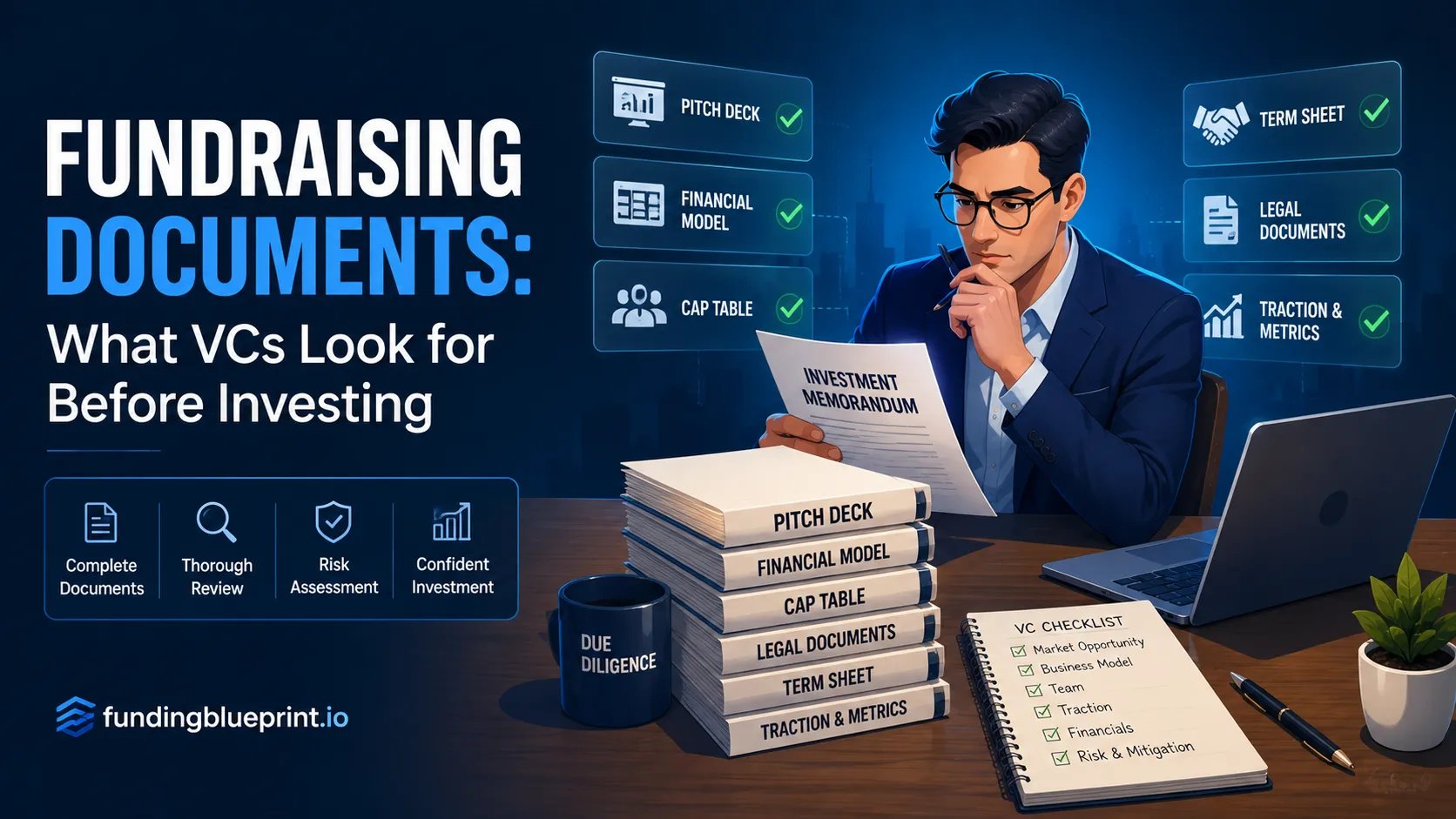
Fundraising Materials & Documentation: The Architecture of Trust
Fundraising Materials & Documentation: A messy data room kills deals. Master the Trust Density protocols and Information Hierarchy elite London and NYC VCs demand in 2026.
PILLAR 9 - FUNDRAISING STRATEGY
1/4/20267 min read


Fundraising Materials & Documentation: The Architecture of Trust
You are not raising money with a speech. You are raising money with a file.
The most dangerous misconception in early-stage fundraising is that the "Pitch" happens in the room. It does not. The "Pitch" happens asynchronously, at 11:30 PM, when a fatigued Partner opens your DocSend link on an iPad while waiting for a flight. In that silent moment, you are not there to explain the nuance, clarify the graph, or charm them with your vision. Your documentation must speak for itself.
In a forensic audit of failed rounds, we rarely find that the business was fundamentally uninvestable. We find that the interface to the business—the Pitch Deck, the Financial Model, and the Data Room—was structurally broken.
When a Tier-1 investor reviews your materials, they are conducting a "Competence Audit." If your deck is 40MB (too large to email), you look operationally sloppy. If your financial model is "hard-coded" (numbers typed in rather than calculated), you look financially illiterate. If your Data Room is disorganized, you look like a governance risk.
This analysis is a surgical guide to the Fundraising Asset Stack. We will strip away the graphic design fluff and focus entirely on the information architecture required to survive Technical Due Diligence.
This sub pillar is part of our main PILLAR 9 — FUNDRAISING STRATEGY
The Trench Report: The "Version Control" Suicide (A $7M Deal Lost)
In Q4 2024, I audited a Series A Fintech company in New York. They had high traction ($3M ARR) and a term sheet on the table from a lead investor. The diligence process began, and the Data Room was opened.
The Structural Error:
The founder had sent a PDF Pitch Deck to the Partner in Week 1 to get the meeting. In Week 4, the Finance Director uploaded the live Financial Model (Excel) to the Data Room.
The Discrepancy: The Pitch Deck claimed: "Gross Margins of 70%." The Financial Model showed: "Gross Margins of 55%."
The Cause: The founder had used "Pro Forma" (adjusted) numbers in the deck to make the business look better but used "GAAP" (actual) numbers in the model because he knew the accountants would check it. He failed to align the two narratives.
The Forensic Result:
The Associate spotted the discrepancy in 10 minutes. The email came back: "Can you explain the variance in margin logic between the deck and the model?" The founder’s explanation was clumsy and defensive.
The Verdict: The investor pulled the term sheet. They did not pull it because 55% margins were uninvestable; they pulled it because "Metric Integrity" was breached. If the numbers don't match, the CEO is either lying or incompetent. Neither is fundable.
The Technical Pivot:
We implemented a "Single Source of Truth" (SSOT) protocol.
The Fix: We built a "Master Data Sheet" in Excel. All charts in the Pitch Deck and all tables in the Data Room were linked dynamically to this one sheet. If we changed a number in the master, it updated everywhere instantly.
The Forensic Formula: The Diligence Velocity Ratio Vd
You can measure the quality of your documentation by how fast diligence moves.
Vd =Days from Data Room Access to Term Sheet
Number of Clarification Questions Asked
Benchmark: You want a high Vd. This means few questions and fast movement. If you get 50 questions about basic numbers, your documentation failed to explain the business.
The Asset Stack Architecture
You do not need "a deck." You need a Three-Tiered Asset Stack. Each asset serves a specific psychological phase of the funnel, and using the wrong one at the wrong time is fatal.
Tier 1: The Teaser Deck (The Hook)
Goal: Get the Meeting.
Format: 5-8 Slides. PDF. Under 5MB.
Psychology: Curiosity Gap.
Content:
The Hook: What is the contrarian truth?
The Problem: The "Hair on Fire" issue.
The Solution: High-level product shot.
The Traction: The "Up and to the Right" graph.
The Team: Logos and pedigree.
Forensic Rule: No Secrets. Do not hide the pricing or the basic mechanics. But do not include the full financial projections or the "Secret Sauce" architecture. Leave them hungry.
Tier 2: The Core Pitch Deck (The Narrative)
Goal: Get the Second Meeting / Partner Vote.
Format: 15-20 Slides. DocSend Link (Trackable).
Structure (The Sequoia Arc):
Company Purpose: Define the company in a single declarative sentence.
Problem: Pain validation.
Solution: The "Aha" moment.
Why Now: Timing (Regulatory change, tech shift).
Market Size: Bottom-Up TAM.
Competition: The "Value Chain Attack" (Why you win).
Product: Screenshots / Architecture.
Business Model: Unit Economics (LTV/CAC).
Traction: Cohort Analysis.
Financials: 3-year projection summary.
The Ask: Amount and milestones.
Tier 3: The Data Room (The Audit)
Goal: Pass Due Diligence and Sign.
Format: Notion Page or Box/Dropbox folder. Structured hierarchy.
Forensic Structure:
Folder 01: Corporate: Incorporation, Bylaws, Board Minutes, Cap Table.
Folder 02: Financials: The Excel Model (Open source), Bank Statements, P&L.
Folder 03: IP & Tech: Patent filings, Tech Stack diagram, Security Audit (SOC2).
Folder 04: Customers: Sample Contracts, Pipeline Export, Churn Data (Raw).
Folder 05: Team: Employee Agreements, Org Chart, IP Assignment deeds.
Regional Calibration (SF vs. London)
The "flavor" of your documentation must match the palate of the investor.
San Francisco (The "Dream" Deck)
Visual Style: Minimalist. Think Apple Keynote. Big font (30pt+). Less text.
The Narrative: Focus on "The Future State."
The Financials: SF investors often tolerate a "loose" financial model at the Seed stage. They care more about the "Growth Engine" (How you acquire users) than the "P&L" (How much you spend on office supplies).
Forensic Note: Include a "Vision Slide" that shows what the world looks like in 10 years when you win.
London / New York (The "Audit" Deck)
Visual Style: Dense. Think McKinsey/Consulting. It is acceptable to have data-heavy slides.
The Narrative: Focus on "The Execution Path."
The Financials: They will tear your Excel model apart.
Requirement: Your model must include a "Downside Case" (What happens if we grow 50% slower?). This proves you are a responsible steward of capital.
Forensic Note: Ensure your Data Room is GDPR Compliant. European investors will check for data privacy handling immediately.
Metric Logic & Red Flags
Your documentation is a test. Investors look for specific "Red Flags" that signal incompetence or deception.
Red Flag 1: The "Hard-Coded" Financial Model
The Error: Sending an Excel file where the revenue cells are just typed numbers (e.g., "100,000") rather than formulas (e.g., =Users * Price).
The Forensic Reality: This is an "Un-auditable Model." The investor cannot test assumptions. It suggests you made the numbers up.
The Fix: Build a "Driver-Based Model."
Input Tab: Listing all assumptions (Price, Churn, CAC, Headcount).
Output Tab: Calculated results.
Logic: If I change the "Price" in the Input Tab, the entire P&L must update instantly.
Red Flag 2: The Broken Cap Table
The Error: A Cap Table that doesn't sum to 100% or fails to account for the Option Pool (ESOP).
The Forensic Reality: This signals legal risk. If you don't know who owns your company, neither do they.
The Fix: Use software (Carta/Pulley) or a verified template. Ensure the "Fully Diluted" share count is accurate.
Red Flag 3: The "Hockey Stick" without Logic
The Error: A graph showing revenue flatlining for 2 years and then magically shooting up vertically in Year 3.
The Forensic Reality: "The Miracle Year." Investors discount this to zero.
The Fix: "Step-Function Growth." Show why the growth happens. "In Q3, we launch the Enterprise tier, which increases ACV by 4x." Link the growth to a specific operational event in the model.
Forensic Formula: The Burn Multiple
Your financial model must display this metric prominently.
Burn Multiple = Net Burn
Net New ARR
Good: < 1.5 (Efficient Growth)
Bad: > 2.5 (Buying Growth)
Why: It proves you are efficient with the cash you are asking for.
Earned Secrets
Hidden levers of documentation that elite founders use.
Secret 1: The "Shadow Deck" (Appendix)
The Secret: You cannot fit everything into 15 slides, but you need to show depth.
The Hack: Create a massive "Appendix" (30+ slides).
Usage: When an investor asks a tough question in the meeting (e.g., "What is your regulatory strategy?"), do not answer verbally. Jump to Appendix Slide 42.
The Signal: "I have thought about this so deeply that I have a slide prepared for it." This radiates competence.
Secret 2: DocSend Analytics as a Weapon
The Secret: Most founders just send the link and wait.
The Hack: Analyze the "Time per Slide."
Data: If investors are spending 45 seconds on the "Competition" slide but only 2 seconds on "Team," your Team slide is boring, and your Competition slide is confusing (or controversial).
Action: Iterate the deck during the roadshow based on this data. A pitch deck is a living document.
Secret 3: The "Memo Write-For-Them"
The Secret: Associates have to write an Investment Memo to pitch you to their Partners.
The Hack: Create a 2-page "Executive Summary" Word document that is structured exactly like an Investment Memo (Investment Thesis, Risks, Mitigants, Market Data).
Usage: Send this to the Associate after the first meeting. "To save you time, here is a summary of our key metrics and thesis." You are literally writing their homework for them. They will love you for it.
Expert FAQ: The Unasked Questions
Q: Should I ask for an NDA (Non-Disclosure Agreement)?
A: Forensic Answer: NEVER.
Reason: VCs see 1,000 deals a year. They cannot sign NDAs or they would be sued constantly for "inventing similar ideas." Asking for an NDA signals that you are a novice who thinks your "Idea" is the value. The value is execution. If you ask for an NDA, they will delete your email.
Q: Notion vs. Data Room Software (DataSite/Intralinks)?
A: Forensic Answer:
Series A/B: Notion is perfect. It’s clean, modern, and allows you to embed narrative context around the files.
Series C/Exit: Use a professional Virtual Data Room (VDR) like DocSend Advanced or DataSite for audit logging, watermarking, and security.
Q: Should I use a Video Deck (Loom)?
A: Forensic Answer: Yes, as a pre-read.
Strategy: Record a 3-minute Loom walking through the deck. Send it with the teaser.
Why: Some investors are visual learners; some are auditory. Give them both. It creates a human connection before the meeting.
Forensic Audit Checklist
Before you export to PDF or generate a link, run this 5-point diagnostic:
The File Size Check: Is the PDF under 10MB? (If >20MB, it bounces from corporate servers and won't load on mobile).
The Mobile Test: Open the deck on your phone. Is the font size readable? (Min font size: 14pt).
The Link Check: Are all links in the Data Room working? (Dead links = Dead deal).
The "Naming Convention" Protocol: Are files named clearly?
Bad: Draft_Final_v3.xlsx
Good: 02_Financial_Model_v1.0_[Date].xlsx
The Consistency Check: Does the revenue number on Slide 12 match the revenue number in Cell C45 of the Excel model?
Narrative Breadcrumb & Conversion Hook
You have built the assets. Your Data Room is a fortress of organized information. Your Financial Model is a driver-based machine. Your Deck passes the Sequoia test.
But documentation is static. It sits in a folder waiting to be read. To get the money, you must present these assets dynamically. You must navigate the psychological minefield of the "Live Pitch."
(Note: The Funding Blueprint Kit includes the VC-Ready Pitch Deck (Elite Canva Template), the AI Financial Narrative Engine (to instantly generate your driver-based model), and the Slide-By-Slide VC Instruction Guide. These tools ensure your documentation survives the forensic audit of Tier-1 diligence. Access the full forensic suite at the home page.)
Funding Blueprint
© 2025 Funding Blueprint. All Rights Reserved.