
Founder Vision vs Delusion: Passing the Ultimate VC Psychology Test
Pitching a massive vision without proof kills Series A deals. Learn how VCs test for founder delusion and how to back your claims with hard evidence.
2.8 INVESTOR PSYCHOLOGY BEHIND PROBLEM & SOLUTION SLIDES
3/1/20266 min read
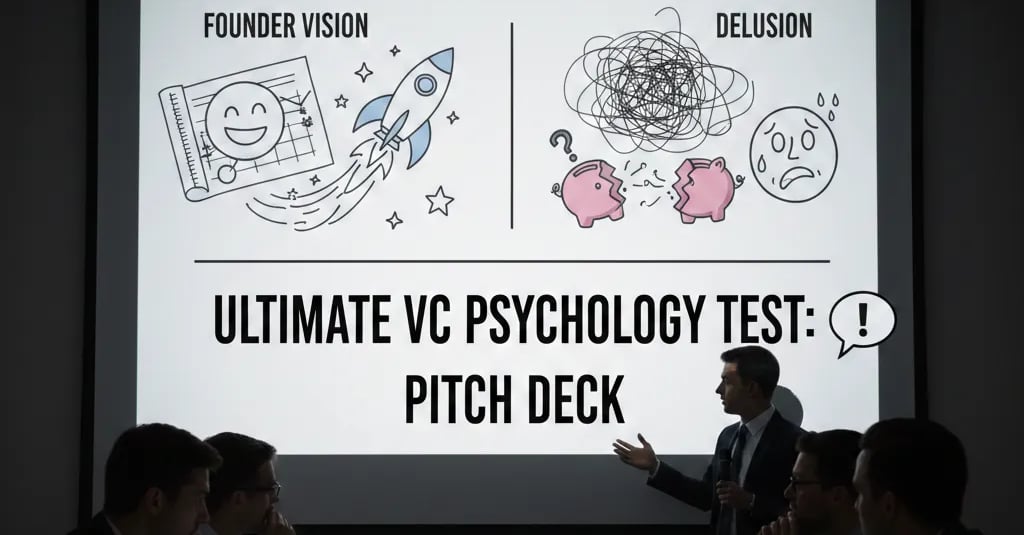
Founder Vision vs. Delusion: Passing the Ultimate VC Psychology Test
A Series A founder in B2B SaaS raised $2.8M in seed funding, had 14 paying customers, and walked into a partner meeting at a top-tier Chicago fund with a deck that opened with a slide titled "Our Vision: Redefining How the World Works." He did not get a second meeting. The partners passed before his Solution slide loaded. The vision was not the problem. The framing of it was.
There is a precise psychological test every VC runs — consciously or not — when a founder begins presenting. It is not "is this person smart?" It is "does this person know the difference between what they believe and what they can prove?" That gap, when visible, reads as delusion risk. It is one of the most common silent killers in Series A decks, and it operates directly inside your Problem and Solution framing, which is why it sits at the core of the investor psychology framework behind high-conversion Problem and Solution slides.
Why the Vision-Delusion Line Is a Series A Valuation Event, Not a Soft Impression
The VC sitting across from you is not evaluating whether your vision is inspiring. They are running a forensic check on your epistemic calibration — whether the claims you make are proportional to the evidence you hold. This is not a personality judgment. It is a risk model.
A founder who presents a $180B TAM on slide three and supports it with a top-down percentage calculation is not being bold. They are signalling that they either do not understand how VCs model outcomes, or they do understand and are hoping the VC does not notice. Neither reading is good. The first suggests inexperience. The second suggests a trust problem. Both compress your pre-money.
The specific failure pattern looks like this: the Problem slide describes a massive, systemic market failure with no cited evidence — "the entire logistics industry is broken" — and the Solution slide presents the founder's product as the categorical fix. No wedge. No sequenced expansion logic. Just the vision stated as fait accompli.
In a deck reviewed last quarter, a SaaS founder framing a workforce intelligence platform made this exact error across three consecutive slides — the VC's analyst flagged it in the pre-meeting brief, and the partner entered the room already in diligence-skeptic mode.
The psychological root is almost always genuine conviction that has not been translated into the VC's language. Founders who have lived inside a problem for three years develop a compressed certainty about the market. That compression feels like clarity to them. It reads as overreach to an investor who needs to defend the check to an LP committee.
The Mathematical Boundary Between Vision and Delusion
The line between vision and delusion is not subjective. It is measurable, and it has a direct expression in your funding terms.
As of early 2026, top-tier US funds are applying a harder evidence threshold at Series A than at any point since 2019 — burn multiples above 2.0x are being flagged in initial screening, and funds are stress-testing 18-month runways as a floor condition before entering diligence. This context matters because it means the margin for "vision tax" — the valuation discount applied when a VC cannot verify the founder's claims — has contracted significantly.
Here is the structural test applied to every vision claim in a deck:
Market size ($B+)
Evidence Required: Bottom-up model with named customer segments and verified ACV
Failure Mode: Top-down TAM percentage = automatic discount
Problem severity
Evidence Required: Quantified customer pain with cited sources or primary research
Failure Mode: Anecdotal quotes = unverifiable severity
Solution uniqueness
Evidence Required: Specific, defensible wedge with competitive moat logic
Failure Mode: "No one else does this" = trust deficit
Expansion vision
Evidence Required: Sequenced logic tied to product milestones
Failure Mode: Revenue projection without driver model = delusion flag
The calibration equation is this: Vision Credibility = (Claims Made) ÷ (Evidence Held). Any ratio above 1.0 — more claims than evidence — is a delusion signal. Every point above 1.0 costs you negotiating leverage at the term sheet.
The target is not 1.0. The target is 0.8: slightly more evidence than you need, so the VC feels they are discovering upside rather than auditing risk.
The Protocol for Reframing Vision as Verified Conviction
This is the mechanical fix. It operates at the slide level and requires precision, not inspiration.
Step 1 — Audit Every Claim for Evidence Class. Go through your Problem and Solution slides and tag every assertion as one of three classes: Verified (cited data or primary research), Directional (logical inference from verified data), or Asserted (stated without support). Any Asserted claim that is not immediately converted to Verified or Directional is a delusion flag. Remove it or replace it before the deck goes out.
Step 2 — Apply the "Skeptical Partner" Reframe. For every vision statement in your deck, write the most skeptical version of the counter-argument a senior partner could make in thirty seconds. If you cannot answer that counter-argument with a specific data point or logical sequence, the vision statement is premature. Either pull it back to a milestone-based claim or replace it with a proven wedge.
Weak Version: "We are building the operating system for the future of healthcare administration." This is asserted vision with no evidence class. A VC reads: "Founder believes their own story. No proof of wedge. High delusion risk."
VC-Ready Version: "We have replaced manual prior authorisation workflows for 11 mid-market health systems in the Southeast. Average time-to-authorisation dropped from 6.2 days to 14 hours. That wedge expands into claims adjudication in 2026 once we clear two existing contract milestones." This version is vision — it describes a large expansion path — but it is anchored to verified operational evidence and sequenced to a milestone gate. The VC can model it. What can be modelled can be priced. What can be priced gets funded.
Step 3 — Structure Your Solution Slide Around the "Proof Stack." The Proof Stack is a three-layer architecture for your Solution slide:
The Wedge — the specific, narrow problem you already solve with evidence
The Bridge — the logical mechanism by which solving the wedge creates access to the larger market
The Vision — the long-term outcome, stated last, after the VC has already accepted the wedge and bridge
Most founders invert this sequence. They open with the vision, attempt to justify it with a wedge, and call that a pitch. The VC experiences it as a founder asking them to buy into the conclusion before reviewing the evidence. The Proof Stack reverses the cognitive load: the VC is already nodding by the time the vision lands.
Three Ways Founders Overcorrect and Still Fail the Test
1. Removing all vision language and presenting only metrics. A deck with no directional ambition reads as a lifestyle business, not a venture bet. VCs need to believe the founder can build something categorically large. Stripping vision entirely does not solve the delusion problem — it creates a different one.
2. Adding evidence to the wrong claims. Founders who load their TAM slide with citations while leaving their solution uniqueness claims unverified have patched the surface while leaving the structural crack. The VC's analyst will find the gap in the pre-meeting brief.
3. Confusing customer enthusiasm with market proof. Quotes from happy customers validate product-market fit in a narrow cohort. They do not validate the expansion logic. Using customer testimonials as evidence for a $50B market claim is a category error that signals the founder does not know the difference between traction and trajectory.
What Passing the Vision-Delusion Test Is Worth in Pre-Money Terms
Every unverified claim in your deck is a discount applied before you reach the negotiation. In a market where US Series A pre-money ranges from $22M–$28M, the difference between a founder who passes the vision-delusion test and one who triggers the delusion flag can be $4M–$6M in headline valuation — not because the business is worth less, but because the VC's risk model prices the uncertainty of the founder's judgment.
Passing this test is not about being less ambitious. It is about proving that your ambition has a structural foundation. The VC is not funding your vision. They are funding their confidence that you know exactly where the vision ends and the evidence begins.
For the complete framework covering every psychological filter that operates across your Problem and Solution slides, the full Problem and Solution Slides system covers the sequence end to end.
Founders who have used the Slide-By-Slide VC Instruction Guide inside the $5K Consultant Replacement Kit go into partner meetings with a Problem and Solution structure that already maps to what the VC's analyst is checking against the vision-delusion line. That is not a marginal advantage — it is the difference between entering a diligence conversation and defending a credibility gap. The full Kit is $497, and it is accessible at the pitch deck framework built to clear the VC evidence threshold.
Vision without a proof stack is not a pitch. It is a belief system. VCs do not fund belief systems — they fund the evidence that makes a belief system unnecessary.
Funding Blueprint
© 2026 Funding Blueprint. All Rights Reserved.