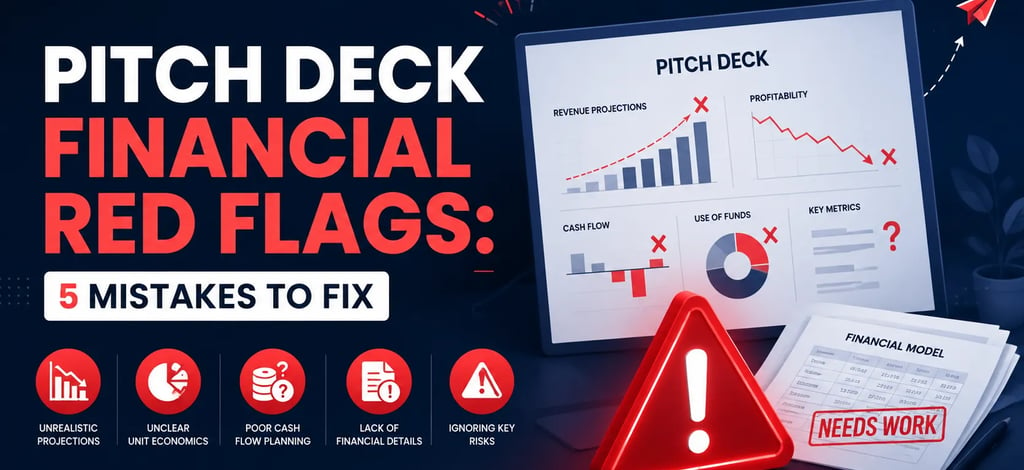
Financial Red Flags & Mistakes: The Forensic Alpha of Fundability

Financial models are forensic records of integrity, not just projections. Master the 2025 standards to avoid red flags in NYC and London. Learn the 'Zombie Cohort' and 'Margin of Safety' secrets.

PILLAR 7: TRACTION & METRICS

12/29/20255 min read

Forensic audit of financial red flags and metric integrity for venture capital fundraising.

Financial Red Flags & Mistakes: The Forensic Alpha of Fundability

Your financial model is not a projection of the future; it is a forensic record of your integrity. If your data doesn't "bleed" with the reality of your operations, you aren't fundraising—you’re storytelling in a vacuum. In 2025, investors don’t buy growth; they buy the reliability of your "Operational Grip."

This sub pillar is part of our main Pillar 7: Traction & Metrics

The 3-Second Logic

Investor conviction is a binary state triggered by the absence of friction. If a General Partner (GP) looks at your financials and experiences Cognitive Load—meaning they have to work to understand your logic—they will reflexively mark the deal as "High Risk." To win, your model must pass the Squint Test: the macro-narrative of your profitability must be visible even if the specific numbers are blurred.

The Trench Report (A $15M Lesson in Metric Drift)

In Q3 of 2024, I was brought in to salvage a $15M Series B for a Toronto-based SaaS firm. They had a Tier-1 NYC fund ready to lead, but the deal stalled in the 11th hour during technical due diligence.

The Fracture: The founder had used a "Blended CAC" (Customer Acquisition Cost) that looked phenomenal on a slide. However, the forensic audit revealed that their organic traffic was subsidizing a catastrophically inefficient paid search channel. Their Metric Integrity was compromised. To the investor, this wasn't just a math error; it was a sign of a "System 1" founder who was blinded by their own optimism.

The Pivot:

We halted the fundraise for 14 days. We implemented a "Channel-Specific Attribution Model" and rebuilt the deck around the "Forensic Truth": our paid acquisition was failing, but our referral loop was world-class.

The Result: By proactively "confessing" the inefficiency and showing a data-backed plan to reallocate capital to the referral engine, we restored Trustworthiness. The lead investor didn't just stay; they increased the valuation because they now trusted the founder's Operational Grip over the data.

The Psychology of Technical Depth

To understand why financials fail, we must look at the cognitive architecture of a VC.

System 1 vs. System 2 Thinking

  • System 1 (The Pitch): This is the "gut feeling." It’s the excitement, the vision, and the "big market" story.

  • System 2 (The Model): This is the analytical, skeptical, and slow-thinking process.

The Red Flag: A "Fatal Disconnect" occurs when your pitch (System 1) makes promises that your model (System 2) cannot verify. If you claim to be "AI-First" but your R&D spend as a percentage of revenue is declining, the System 2 brain triggers a "Deception Alert."

Cognitive Load & The Squint Test

If your spreadsheet has 40 tabs and hidden circular references, you are increasing the Cognitive Load of the Associate reviewing it. In VC physics, High Friction = Low Valuation. > The 18pt Font Rule: Your core financial assertions—Gross Margin, Burn Multiple, and Payback Period—should be so clearly highlighted that they could be read from a printed page across a boardroom table. This is the Forensic Alpha: making the truth undeniable.

Regional Calibration (SF vs. London vs. Toronto)

Fundraising is a local language. A mistake in San Francisco is a "visionary stretch," but in London, it’s a "material misrepresentation."

The Strategy: For a London or Toronto investor, your model must be "Audit-Ready" from Day 1. They will look for Metric Integrity—the ability to trace a single revenue line back to an individual contract or cohort. For a San Francisco investor, your financials must prove that for every $1 they give you, you can predictably manufacture $5 in enterprise value.

The "Red Flag" Logic in Due Diligence

Due Diligence is not a search for truth; it is a search for a reason to say "No." The following are the forensic triggers that kill deals:

  • The "Dirty" Cap Table: If your early-stage investors have "Veto Rights" or "Full Ratchet Anti-Dilution," you are unfundable to a Tier-1 VC. This is a financial red flag of the highest order.

  • Deferred Liabilities: Unpaid taxes, "handshake" advisor equity, or deferred founder salaries are "Financial Debt" that scares away professional capital.

  • The "LTV/CAC" Lie: Most founders calculate LTV (Lifetime Value) based on "Hopes and Dreams." Forensic investors calculate it based on Historical Churn and Net Dollar Retention (NDR). If your NDR is below 100%, your LTV is a fiction.

Earned Secrets for the 2025 Founder

These insights are not found in "standard" AI training data or generic blog posts. These are the secrets earned in the boardrooms of Mayfair and Sand Hill Road.

Secret #1: The "Zombie Cohort" Audit

Investors are now looking for the Engagement Decay Rate. Most models show "Active Users," but they don't show "Users who haven't opened the app in 30 days but haven't canceled their sub yet." This is the Shadow Churn. If you proactively show a "Cleaned Cohort" (removing inactive users from your LTV calculation), you prove a level of Operational Grip that puts you in the top 1% of founders.

Secret #2: The "Margin of Safety" Variable

In a 2025 high-interest-rate environment, the "Standard Case" model is useless. Elite founders include a "Macro-Stress Test" tab. What happens to your burn if your CAC doubles? What happens if your top 3 enterprise clients churn? Showing you have modeled for the "Worst Case" builds System 2 Trust faster than any growth chart.

Secret #3: The "Narrative Breadcrumb" Technique

Never send a massive Excel file as your first interaction. Instead, use a Semantic Innovation I call the "Financial Teaser." * The Tactic: Send a high-resolution screenshot of a "Sensitivity Analysis" table that shows how a specific investment in engineering will reduce your "Customer Support Load."

  • The Goal: This creates a Continuing Conversation. The investor sees the visual, recognizes the logic, and must ask for the full model to understand the underlying "Metric Integrity." You have moved them from a passive "No" to an active "How?"

The Forensic Financial Checklist

Before you hit "Send" on that deck, run this audit. If you can't check every box, you are leaving your fundability to chance.

  • The Squint Test: Can an investor see the "Path to Profitability" in 3 seconds?

  • Zero Hidden Tabs: Are all "Workings" visible? (Hidden tabs suggest you are hiding flaws).

  • Regional Calibration: Does the tone match the investor's geography (SF Vision vs. London Logic)?

  • Metric Lineage: Can every number on Slide 12 be traced back to a specific cell in the model?

  • The "Pivot" Story: Have you included a narrative about a financial mistake you made and how you corrected it?

Expert FAQ: The Unasked High-Level Questions

Q: "If my margins are low now, but will scale later, how do I avoid the 'Red Flag'?"

A: Use Forensic Decomposition. Break your COGS into "Structural Costs" vs. "Scale Costs." Prove with data that as volume increases, the "Structural Costs" amortize. Don't ask them to believe it; show them the contract quotes that trigger at scale.

Q: "How much 'Buffer' should I include in my cash ask?"

A: The "Rule of 1.5x." Calculate your "Plan A" capital requirement and add 50% for "Experimental Slack." In 2025, being "Lean" is good, but being "Under-capitalized" is a death sentence.

Q: "What is the biggest 'Soft' Red Flag in a model?"

A: Over-precision in the outer years. If you claim to know your revenue in Month 48 to the nearest dollar, you lack Metric Integrity. Real founders know that the future is a range, not a point.

From Data to Conviction

Building a world-class financial infrastructure is the hardest part of fundraising. It requires a blend of accounting precision and psychological design.

Most founders spend months trying to "design" their way out of a bad model. Our $497 Blueprint Kit was built to solve this exact problem. It provides the elite financial frameworks and "Forensic Design" standards used by the top VC consultants in London and NYC. It automates the "Squint Test" and ensures your Operational Grip is undeniable.

If you are tired of being "Ghosted" after the first data-room access, it’s time to upgrade your financial architecture. Visit our home page to see how we turn financial red flags into a roadmap for fundability.

Regional Calibration (SF vs. London vs. Toronto)