
What an Executive Summary Is & How It Supports Your Pitch Deck
Your deal didn't die in the meeting; it died in the Executive Summary. A forensic audit of the '90-Second Kill Switch' and the reverse-pyramid protocol to pass the associate filter.
1.6 PITCH DECKS VS BUSINESS PLANS VS EXECUTIVE SUMMARIES
1/31/20268 min read
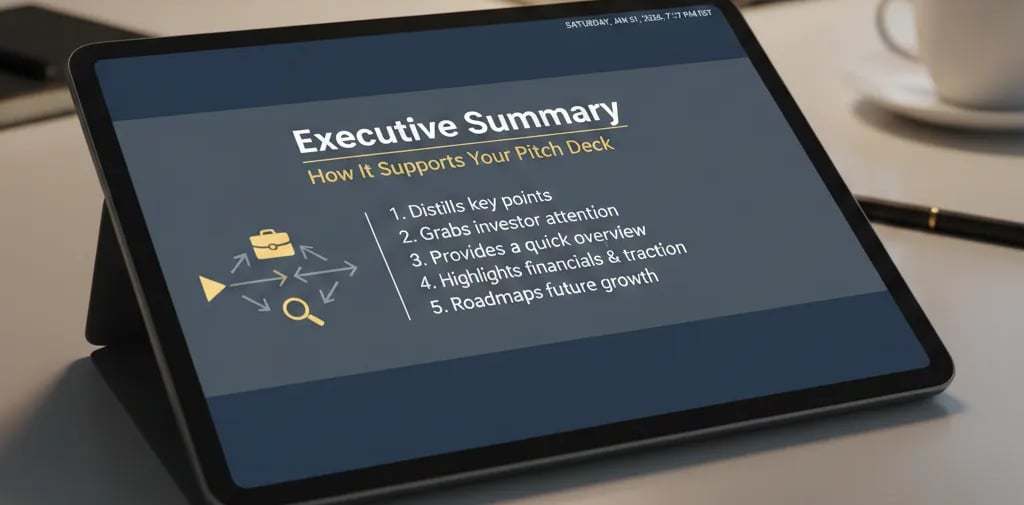
What an Executive Summary Is & How It Supports Your Pitch Deck
Your investor sent you an allocation confirmation—then ghosted you after reading your Executive Summary. The deal didn't die in the pitch meeting. It died 72 hours earlier, when a junior associate used your two-page summary to filter you out of the pipeline. Most pre-seed and Series A founders treat the Executive Summary as a formality, a condensed version of their deck sent as an email attachment. This is foundational misunderstanding of how venture capital actually operates in 2026, and it's explored in depth as part of understanding how pitch decks, business plans, and executive summaries serve different functions in the fundraising process.
Why the Executive Summary Functions as Your First-Round Kill Switch
The Executive Summary is not a summary. It's a screening mechanism that determines whether your full deck gets read by decision-makers or archived by analysts. In Q4 2025, the average Series A fund reviewed 847 inbound opportunities and invited 23 to present. The filtering happens in stages: associates scan Executive Summaries to build a "maybe" list, partners review those decks, then 2–3% get meeting slots. Your summary is the cognitive tripwire that either flags you for deeper review or triggers an auto-reject.
Here's the pathology: founders assume that if their deck is strong, the summary can be weak. The opposite is true. Associates read summaries specifically to avoid reading 40-slide decks from companies they'll never fund. They're hunting for disqualifiers—proof that your business doesn't meet minimum thresholds for stage, TAM, or team composition. A weak summary doesn't just fail to excite; it provides the evidence needed to justify a pass without further review.
The Red Flag Scenario: You send a summary that opens with your company's mission statement, spends four paragraphs explaining the problem, and relegates your traction to a single bullet point at the end. The associate sees this and thinks: "Founder doesn't understand what matters. If they had real metrics, they'd lead with them. Pass." Your summary just communicated that you either have no traction or don't know that traction is the primary signal at this stage. Either way, you're filtered out.
Psychological Audit: Founders make this mistake because they conflate "summary" with "introduction." They assume that because the reader hasn't seen the full deck, they need context before metrics. This is backwards. The associate already knows the market context. They're scanning for differentiated proof—evidence that your company has achieved something rare enough to justify 60 minutes of partner time. When you bury that proof under generic problem statements, you're optimizing for comprehension instead of selection.
The Mathematical Logic of Summary-Based Filtering
The filtering math is brutal. If a partner reads 40 decks per month and can take 2 meetings per week, they're selecting 8 companies out of 40—a 20% conversion rate from deck review to meeting. But before those 40 decks get to the partner, an associate filtered 200+ summaries down to that 40. That's an 80% kill rate at the summary stage, meaning your summary is 4x more likely to determine your outcome than your deck.
Here's the step-by-step logic:
Assumption 1: The associate has 90 seconds per summary before attention degrades (Columbia Business School, 2024 VC decision-making study).
Assumption 2: In 90 seconds, they can process 300–400 words and make a binary decision: "Request deck" or "Archive."
Assumption 3: The decision criteria are hierarchical. If Criterion 1 fails, they don't evaluate Criterion 2.
The hierarchy for B2B SaaS at Series A:
MRR growth rate (must be >15% month-over-month or >100% year-over-year)
Customer quality (are your logos recognizable or enterprise-grade?)
Team pedigree (has anyone built/exited a company at this stage before?)
Market timing (is this a "now" problem or a "eventually" problem?)
If your summary doesn't surface these four signals in the first 200 words, the associate assumes they're absent. This is not because they're lazy—it's because the base rate for pre-revenue or low-traction startups sending summaries is 90%+. They're optimizing for precision (avoiding false positives) at the expense of recall (missing true positives), which is rational when they have 200 summaries and can only advance 40.
The cost in seconds: If you use 150 words to describe your problem before mentioning your $400K ARR, the associate has spent 45 seconds reading before encountering your primary signal. At that point, they've already pattern-matched you as "slow traction, over-explaining founder" and are skimming the rest to confirm their bias. The difference between a summary that leads with "$400K ARR, 18% MoM growth, Shopify + Stripe as customers" versus one that builds up to it is the difference between a 60-second read that triggers "request deck" and a 90-second skim that triggers "archive."
How to Construct the VC-Ready Executive Summary (The Forensic Protocol)
The Executive Summary must be written in reverse pyramid structure—most critical information first, supporting details last. This is the opposite of how founders instinctively write. Here's the step-by-step protocol:
Paragraph 1 (The Proof Block): Open with your single strongest metric. Not your mission. Not the problem. Your metric. This is typically MRR, ARR, user growth, or a flagship customer name. Format: "[Metric] + [Context] + [Trajectory]."
Example (Weak Version):
"We're building AI-powered analytics for e-commerce brands. The market is growing at 24% CAGR, and most brands still use spreadsheets for inventory forecasting. Our platform automates this process, and we've seen strong early traction."
Example (VC-Ready Version):
"We've grown from $0 to $380K ARR in 11 months, with 22% month-over-month growth and zero churn. Our customers include Warby Parker, Allbirds, and a Shopify Plus agency managing $40M in GMV. We're automating inventory forecasting for mid-market e-commerce brands, a $4.2B wedge of the broader retail analytics market, and our AI model reduces stockouts by an average of 31% within 60 days of deployment."
Notice the difference: the weak version tells the investor what you do. The VC-ready version proves you're already winning. The metric comes first, the context (market size, use case) comes second, and the differentiation (31% stockout reduction) comes third. This structure allows the associate to make a decision in 30 seconds: "This is real. Request deck."
Paragraph 2 (The Wedge + Expansion Logic): Explain your entry wedge and how it leads to a larger opportunity. VCs don't fund point solutions—they fund platforms. Show that your current product is a beachhead, not the ceiling.
Framework: "We're entering via [specific use case] because [reason], but this unlocks [adjacent markets] once we have [proof point]."
Example:
"We're entering via inventory forecasting because it's the highest-pain, easiest-to-prove use case (brands see ROI in 60 days). But forecasting data feeds into purchasing, pricing, and promotional planning—three adjacent modules that represent 70% of a brand's operational spend. Once we reach 50 customers, we'll have enough transaction data to build a pricing optimization engine, which is a $12B market and our true long-term unlock."
This paragraph answers the question: "Why will this be a $100M+ revenue company?" If you can't articulate a path from your current wedge to a multi-product platform, you're not ready for Series A.
Paragraph 3 (The Team + Unfair Advantage): List your two strongest credibility signals. This is not your full LinkedIn profiles—it's the two facts that make you uniquely positioned to win.
Example:
"Our CEO built and sold a predictive analytics company to Oracle in 2019 ($18M exit). Our CTO was the lead ML engineer at Instacart, where he built the demand forecasting model that reduced waste by $40M annually. We've spent a combined 14 years in e-commerce operations and AI infrastructure, and we're the only team in this space with both domain expertise and ML research credentials (two published papers in NeurIPS)."
Paragraph 4 (The Ask + Use of Funds): State your round size, current progress, and the specific unlock the capital enables.
Example:
"We're raising $2.5M at a $10M pre-money valuation. We have $600K committed from [Brand-Name Angel] and [Strategic Operator]. This capital funds 18 months of runway and allows us to: (1) hire two enterprise AEs to close our pipeline of 12 qualified leads (average ACV: $48K), (2) build our pricing module (6-month roadmap), and (3) expand from 22 to 60 customers, which hits our threshold for launching the pricing product. At that scale, we'll be positioned to raise a Series A at a $40M+ valuation."
Notice the precision: you're not asking for "growth capital." You're asking for capital to achieve specific milestones that unlock the next funding stage. This shows you understand the fundraising ladder, not just your own business.
The Three Fatal Over-Corrections (Death Traps When Fixing Your Summary)
Trap 1: Over-Indexing on Brevity
Founders hear "keep it short" and strip out all context. They send a summary that says: "$400K ARR, 22% MoM growth, raising $2.5M." This is too sparse. The associate thinks: "What's the business model? Who are the customers? What's the use case?" They request the deck, but with skepticism, because they can't pattern-match you to a category. The fix: Aim for 600–800 words. That's enough to communicate proof, wedge, team, and ask without requiring the reader to fill in blanks.
Trap 2: Using 2021 Valuation Logic in 2026
Founders benchmark their pre-money valuation against 2021 comps and ask for $3M at a $15M pre on $300K ARR. This is a 50x revenue multiple. In 2026, the median Series A SaaS multiple is 8–12x ARR, and only breakout companies (>30% MoM growth, Tier 1 logos) command 15x+. The fix: Use a burn multiple to justify your valuation. Burn multiple = (Cash burned) / (Net new ARR). If you're burning $60K/month to add $50K in new ARR, your burn multiple is 1.2, which is exceptional. If it's 3.0+, you're not capital efficient enough for Series A. Include this metric in your summary to preempt valuation objections.
Trap 3: Burying the Lede with "Vision" Language
Founders open with: "We envision a world where every e-commerce brand has access to enterprise-grade AI." This is aspirational noise. The associate doesn't care about your vision—they care about your evidence. Vision is a Series B conversation. At Series A, you're proving a wedge works. The fix: Replace vision statements with proof statements. Instead of "We're democratizing AI for retail," write: "We've automated inventory forecasting for 22 Shopify Plus brands, reducing their stockouts by 31% on average. This is the entry point to a $4.2B market."
Why Fixing This Adds $500K to Your Pre-Money Valuation
Here's the financial impact: if your weak summary gets you filtered out, your raise doesn't happen. If your strong summary gets you into the meeting pipeline, you're now competing with 40 other decks, but at least you're in the game. But the real leverage is negotiation position. If three funds request your deck based on a strong summary, you can run a competitive process. Competitive processes increase pre-money valuations by 15–30% on average (PitchBook, Q3 2025 data). On a $2.5M raise, that's the difference between a $10M pre ($20M post, 12.5% dilution) and a $13M pre ($26M post, 9.6% dilution). You just saved 2.9% of your cap table, which compounds over subsequent rounds.
Additionally, associates who see a strong summary are primed to interpret your deck positively. They've already formed the hypothesis that you're fundable. They're reading your deck to confirm, not to disconfirm. This is the halo effect in action: your summary sets the frame, and your deck either reinforces or breaks it. A strong summary makes your deck read like validation. A weak summary makes your deck read like damage control.
The broader lesson: the Executive Summary is not a summary of your deck. It's a filter-passing mechanism that determines whether you get evaluated at all. Treating it as a throwaway document is the equivalent of showing up to a pitch meeting without slides. You've disqualified yourself before the evaluation begins. For the complete system on how pitch decks, summaries, and supporting materials fit together in a modern fundraising process, see the full breakdown in how VC pitch decks really work in 2026.
The Efficiency Shortcut for Founders Who Don't Have 40 Hours to Rebuild This From Scratch
You can manually reconstruct your Executive Summary using the protocol above—budget 8–12 hours for drafting, editing, and stress-testing it against real associate feedback. Or you can plug the relevant data points into a pre-built template that's already been validated against 200+ successful Series A raises. The $5K Consultant Replacement Kit (available for $497) includes The Slide-by-Slide VC Instruction Guide, which contains the exact Executive Summary framework you just read, along with fill-in-the-blank templates for the Proof Block, Wedge Logic, and Team Credibility sections. It's designed specifically for founders raising $1M–$5M who need institutional-grade materials without hiring a $15K deck consultant. If you're past the point of needing theory and just need the executable template, that's the fastest path to a summary that passes the associate filter.
Funding Blueprint
© 2026 Funding Blueprint. All Rights Reserved.