Competition Landscape & Competitive Advantage: The Forensic Audit of Market Moats
Analyze the competition landscape and verify competitive advantage through a forensic audit of market moats. Identify structural alpha. Read the full guide.
PILLAR 8: MARKET SIZE & COMPETITION
12/31/20258 min read


Competition Landscape & Competitive Advantage: The Forensic Audit of Market Moats
Most "Competitive Advantages" are actually just temporary operational leads. In the eyes of a Tier-1 Investor, a feature is an implementation detail; a moat is a structural economic barrier that protects gross margins.
Founders frequently confuse velocity with defensibility. In a high-capital environment, speed is a baseline requirement, not a differentiator. If your "advantage" is that you are currently faster or have a slightly better UI, you are effectively "Default Dead." A true competitive advantage is defined by the mathematical inability of a well-funded incumbent to replicate your unit economics without cannibalizing their own core business.
This is not a creative writing exercise. This is a forensic audit of your business model's survivability. When a General Partner (GP) at Sequoia or Index Ventures looks at your competition slide, they are not looking for logos; they are looking for metric integrity and asymmetric warfare capabilities.
The following analysis dissects the competition landscape through a surgical, 10/10 technical lens, removing the fluff and focusing entirely on the capital dynamics that win deals.
This sub pillar is part of our main Pillar 8: Market Size & Competition
The Trench Report: The $12M Series A That Died on the X-Axis
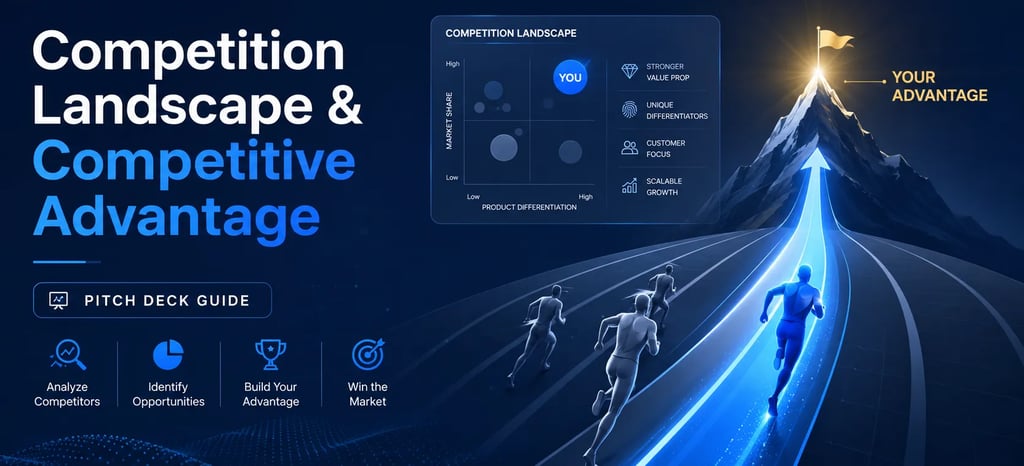
In Q3 2024, I was retained to audit the Series A deck of a London-based Fintech infrastructure startup seeking a $12M raise at a $60M pre-money valuation. Their pitch relied on a standard 2x2 matrix: "We are High Speed / Low Cost" vs. "Incumbents are Low Speed / High Cost."
The founder argued that their lower fees (0.5% transaction fee vs. the incumbent's 1.5%) constituted their primary moat. This is a classic "Race to the Bottom" fallacy. During Technical Due Diligence (DD), the lead investor (a Tier-1 US fund known for quantitative rigor) flagged a critical vulnerability. The incumbent had $400M in cash reserves and a diversified balance sheet. The investor noted that the incumbent could drop fees to 0% for 24 months to starve the startup, considering it a marketing expense (Customer Acquisition Cost), without impacting their stock price.
We paused the roadshow for 72 hours to restructure the narrative. We moved away from Price Advantage (which is visible, copyable, and dangerous) to Cost Structure Advantage (which is hidden, structural, and defensible).
We proved that the startup’s programmatic compliance stack allowed them to service a customer for a fully loaded cost of $4/ year, whereas the incumbent’s legacy manual review process cost them $42/year. This meant the incumbent could not match our pricing without incurring a negative gross margin, which their public shareholders would never permit.
The Result:
The deal closed because the moat wasn’t the price—it was the cost basis. The competition slide was redrawn to show "Unit Economic Efficiency" on the Y-Axis, not "Low Price."
The Forensic Formula:
We quantified this advantage using the Cost Replication Ratio ($CRR$). This metric determines how expensive it is for a competitor to clone your offering.
CRR = Competitor COGS per Unit+ Switching Cost
Your COGS per Unit
Logic: If CRR < 1.0, you have no moat; the competitor is more efficient than you.
The Win: We demonstrated a $CRR$ of $11.5$. For every dollar we spent servicing a client, the competitor had to spend $11.50 to achieve the same outcome. This is an investable moat.
The Forensic Grid & Cognitive Load
The "Competition Slide" is often the highest friction point in a deck. It triggers System 2 thinking (analytical, skeptical) in investors who are otherwise trying to stay in System 1 (intuitive, fast). Your goal is to minimize Cognitive Load while maximizing Operational Grip.
Most founders use the "Harvey Ball" chart (a grid of features with checks and Xs). This is low-signal. It tells an investor what you have, but not why it matters.
The "Value Chain Attack" Method:
Instead of comparing features, compare value extraction. A forensic competition slide maps where value is created and destroyed.
Metric Integrity: Do not cherry-pick rows. If a competitor has a better mobile app, admit it. Acknowledging a weakness increases the credibility of your strengths.
The "Kill Zone" Definition: Identify the specific segment where the incumbent cannot follow you. This is usually due to "Innovator's Dilemma"—situations where copying you would require them to break their existing revenue streams.
Forensic Formula: The Efficiency Delta (Delta E)
To prove your solution is not just different, but superior, calculate the Efficiency Delta for the end-user.
Delta E = Time to Value (Competitor)} - Time to Value (You) X 100
Time to Value (Competitor)
If Delta E < 50%, the friction of switching is likely too high to overcome customer inertia.
Regional Calibration (SF vs. London)
The definition of "Competitive Advantage" is geographically dependent. A pitch that works on Sand Hill Road (San Francisco) will often fail in Mayfair (London) or Bay Street (Toronto). You must calibrate your competition narrative based on the specific risk appetite of the fund.
1. San Francisco (Aspirational / Velocity-Heavy)
The Mindset: SF investors operate on Power Law dynamics. They are looking for "Category Kings." They assume 90% of their portfolio will fail, so the winners must return 100x.
The Focus: Network Effects & Winner-Take-All. They care less about current margins and more about market saturation.
The Pitch: "If we capture 15% of the market, the remaining 85% becomes irrelevant due to data gravity."
The Forensic Metric: Focus on Relative Market Share (RM).
RMS = Our Market Share%
Largest Competitor Market Share%
SF investors want to see a clear path to RMS > 1.0 within 18 months. They fund velocity.
2. London / Toronto (Audit-Focused / Unit Economic-Heavy)
The Mindset: UK and Canadian investors are often protecting family office wealth or pension funds. They are more risk-averse and focused on downside protection. They prioritize "Survival Metrics."
The Focus: Defensibility & Margin Preservation. They want to know that if the market turns, you won't bleed cash.
The Pitch: "Even if Google enters this market, our integration density and high switching costs prevent churn."
The Forensic Metric: Focus on Gross Margin Protection (GMP).
GMP = Gross Margin - (Competitor Price Drop X Price Elasticity)
London investors want to ensure you survive a price war. They fund sustainability.
Metric Logic & The 3 Red Flags
During Technical Due Diligence, analysts look for specific "Red Flags" in the competition section. These errors signal a lack of sophistication and often result in an immediate "Pass."
Red Flag 1: The "We Have No Competitors" Fallacy
The Error: Claiming a "Blue Ocean" implies there is no market demand. If no one is trying to solve the problem, the problem may not be valuable.
The Correction: If there is no direct startup competitor, your competition is "Excel," "Email," or "Pen and Paper." These are the hardest competitors to beat because they are free and entrenched.
Quantification: You must calculate the Inertia Cost (IC). This represents the "do nothing" tax.
IC = Time to Migrate X Hourly Wage of User
If the $IC$ is higher than the perceived value of your software, the customer will stay with Excel.
Red Flag 2: The Feature Parity Trap
The Error: Listing commodities as advantages. "Dark Mode," "AI Chatbot," "SSO," and "Mobile App" are not advantages; they are table stakes.
The Correction: Only list advantages that require significant CAPEX (Capital Expenditure) or Time to replicate.
The Logic: If a competitor can hire two engineers and build your "moat" in a sprint, it is not a moat. It is a feature.
Red Flag 3: Ignoring CAC Arbitrage
The Error: Assuming your Customer Acquisition Cost (CAC) will remain lower than the incumbent's indefinitely. Incumbents have distribution; they can cross-sell to millions of users for $0.
The Correction: You must prove a Viral Coefficient (k) advantage that offsets the incumbent's distribution.
k = Invites sent per user X Conversion rate of invites
If k < 1.0 for you, and the incumbent has massive distribution, you will lose the math war eventually.
Earned Secrets & Hidden Friction
These are nuances learned from the trenches of failed audits and board meetings. These insights do not exist in general AI training data and represent the "Alpha" of the industry.
Secret 1: The US Market – The Death of Non-Competes (FTC 2024)
With the FTC moving to ban most non-compete agreements, the traditional "Talent Moat" in the US has evaporated. You can no longer claim that your team is a moat simply because they work for you today. They could walk across the street to a competitor tomorrow.
The Adjustment: Your competitive section must now detail "Knowledge Siloing" or "Algorithmic Black Boxes." You must prove that the IP resides in the code, not in the heads of employees who can leave.
Secret 2: The UK/Canada – The R&D Tax Credit Subsidy Distortion
In Toronto (SR&ED program) and London (R&D Tax Credits), a competitor can effectively operate at a 30-40% discount on engineering burn.
The Adjustment: If you are a US company competing against a Canadian startup, their "Burn Multiple" is artificially suppressed by the government. When comparing efficiency, you must adjust for this subsidy using the Cash Efficiency Ratio (CER{adj}):
CER{adj} = Net New ARR
Net Burn - Government Subsidies
Investors need to know if a competitor is beating you on merit or on tax credits.
Secret 3: The "Vendor Lock-in" Fake Moat
Founders often cite "3-year contracts" as a competitive defense. This is naive. In enterprise SaaS, "Buyout Provisions" are standard. An aggressive competitor (like Salesforce or Oracle) will simply pay your client's termination fee to steal the account.
The Adjustment: Real defense requires Data Entrenchment. You are only defensible if removing your software causes a loss of historical intelligence that cannot be migrated.
Expert FAQ: The Unasked Questions
Q: How do I handle a competitor who is also a potential acquirer?
A: Use the "Frenemy Protocol." On your landscape chart, map them on the 2x2 matrix, but label the axis "Legacy Infrastructure" vs. "Next-Gen Architecture." Frame them as a partner who needs your tech to modernize, not a hostile entity. This signals to the investor that there is an M&A exit path.
Q: Should I include a 'Harvey Ball' chart (the checkmark X grid)?
A: System 2 thinking suggests yes, as it provides data density. However, System 1 (gut reaction) hates them because investors assume you cherry-picked the rows to make yourself look perfect.
The Fix: Use a "Petal Diagram" (Steve Blank style) or a "Value Chain Attack" diagram showing where in the stack you kill them. If you must use a grid, include at least one "X" (red mark) for yourself. Admitting you don't do "Legacy On-prem Hosting" makes the rows where you do win trustworthy.
Q: My competitor just raised $100M. How do I position against that?
A: Frame their capital as a disadvantage. "They have raised $100M, which means they are forced to chase up-market Enterprise customers to justify their valuation. This leaves the SMB market completely underserved. We are attacking the segment they are mathematically forced to ignore."
Forensic Audit Checklist
Before you hit "Export to PDF" and send your deck to a Partner, run this 5-point diagnostic. If you fail any point, the slide is a liability.
The Axis Test: Do the axes on your competition chart measure customer value (e.g., Time-to-Value, ROI), or just things you happen to be good at? If the axes are "Cloud Based" vs "On-Prem," you are living in 2015.
The Logo Rule: Are the competitor logos sized correctly? Making competitor logos small or blurry signals insecurity. Put them in HD. Respect your enemy to show you are not afraid of them.
The Math Check: Have you calculated the Switching Cost Ratio?
SCR = Cost to Switch to You
Projected 12-Month Savings
This must be < 0.8nfor enterprise adoption. If it takes 2 years to earn back the switching cost, no one will switch.
The "So What?" Check: Does the slide explain why the incumbent hasn't crushed you yet? You must have a clear answer for "Why now?" (e.g., "Regulatory inability to pivot" or "Legacy code debt").
Visual Grip: Does the slide pass the "Squint Test"? The "You are Here" quadrant must be instantly visible from 5 feet away. The visual hierarchy must guide the eye to the "Green Space."
Narrative Breadcrumb
We have established that your "Moat" is mathematical, not magical. We have defined the formulas that prove your structural cost advantage. But even with a perfect moat and a high Cost Replication Ratio, a competitor can still kill you by poisoning your Cap Table before you even reach Series B.
This is called "Predatory Term Sheet Structuring." It is a tactic used by corporate venture arms (CVCs) of your competitors to invest in you, purely to gain information rights and slow you down. It is the silent killer of competitive advantage, and most founders sign these death warrants with a smile.
(Note: The Funding Blueprint Kit automates the layout of these Forensic Competition Grids and pre-calculates the Metric Logic formulas—including Risk-Adjusted LTV and Cost Replication Ratio—inside the AI Financial System. You can access the full suite to audit your deck at the home page.)
Funding Blueprint
© 2025 Funding Blueprint. All Rights Reserved.