
Business Model & Revenue Streams: Market Trends, Timing & Opportunity
Master the architecture of value capture. Learn how to build scalable business models and diverse revenue streams that attract VC investors and drive growth.
PILLAR 8: MARKET SIZE & COMPETITION
12/31/20257 min read
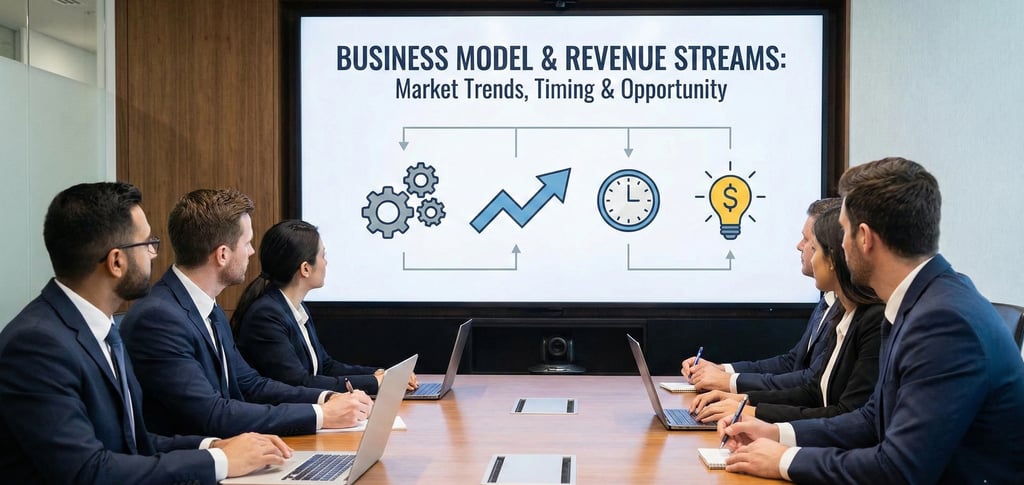

Business Model & Revenue Streams: The Architecture of Value Capture
Your business model is not "how you make money." It is the mathematical logic that dictates your valuation multiple.
In the world of high-stakes venture capital, revenue is not a monolith. A dollar earned from one-time consulting is valued at roughly $0.80. A dollar earned from a recurring, high-retention enterprise contract is valued at $12.00. If you do not understand this arbitrage, you are building a business, but you are not building an asset.
Founders often treat the "Business Model" slide as a menu of pricing options. This is a fatal error. The Business Model is the engine of your unit economics. It defines your Cash Conversion Cycle, your Gross Margins, and ultimately, your investability. When we conduct a forensic audit in London or NYC, we are looking for "Revenue Quality." We strip away the vanity metrics (like GMV or Total Contract Value) to expose the raw machinery of value capture.
This analysis is a 10/10 technical dissection of revenue architecture, designed to ensure your model survives the scrutiny of an Investment Committee (IC).
This sub pillar is part of our main Pillar 8: Market Size & Competition
The Trench Report: The "Fake SaaS" Valuation Collapse
In Q4 2024, I audited a Logistics Tech company in Chicago seeking a $25M Series B. The headline metric was impressive: $8M ARR (Annual Recurring Revenue). On the surface, this commanded a $60M-$80M valuation.
The Structural Error: We dug into the "Revenue Composition." The founder had classified "Implementation Fees" and "Managed Services" as ARR.
The Reality: 40% of their revenue required human labor to fulfill. Every time they sold a contract, they had to hire more account managers.
The Problem: This is not a software business; it is a tech-enabled service agency. Software scales with code (zero marginal cost); agencies scale with people (high marginal cost).
The Technical Pivot: The lead investor threatened to pull the term sheet. To save the deal, we had to re-architect the model.
Decoupling: We formally separated "Platform Revenue" (SaaS) from "Service Revenue" (Consulting).
The Pivot: We shifted the pricing model from a "Heavy Setup Fee" to a "Higher Platform Fee with Self-Serve Onboarding."
The Hard Decision: We fired the bottom 20% of customers who required high-touch manual service, deliberately reducing top-line revenue to improve Revenue Quality.
The Result: The "ARR" dropped from $8M to $5.5M, but the Gross Margin jumped from 45% to 78%. The deal closed at a $55M valuation. The valuation multiple expanded because the revenue was now "High Quality" (scalable), even though the absolute number was lower.
The Forensic Hierarchy of Revenue Quality
Not all revenue streams are investable. We use a "Forensic Hierarchy" to grade your business model during Due Diligence. You must move your revenue up this ladder to maximize valuation.
Level 1: One-Off Transactional (The "Treadmill")
Description: You sell a widget. You get paid once. To make more money, you must sell again.
Valuation Impact: Lowest (0.5x - 1x Revenue).
Forensic Risk: High CAC volatility. You start every month at $0 revenue.
Level 2: "Re-occurring" (The "Illusion")
Description: Transactions that tend to happen often but aren't contractually guaranteed (e.g., Uber rides, eCommerce purchases).
Valuation Impact: Moderate (2x - 4x Revenue).
Forensic Risk: Churn is invisible. You don't know a customer has left until they stop buying.
Level 3: Committed Recurring (The "Gold Standard")
Description: Contractual Subscription (SaaS). The customer must take action to cancel.
Valuation Impact: High (8x - 12x Revenue).
Forensic Risk: "Zombie Accounts" (customers who pay but don't use). These eventually churn.
Level 4: Usage-Based Expansion (The "Diamond")
Description: The "Snowflake" model. Revenue grows automatically as the customer uses the product more.
Valuation Impact: Highest (15x - 50x Revenue).
Forensic Risk: Unpredictability. Revenue can drop instantly if the client optimizes their usage.
Forensic Metric: The Contribution Margin Ratio
Do not confuse "Gross Margin" with "Contribution Margin." Gross Margin includes server costs. Contribution Margin includes the variable cost of selling (e.g., commissions, onboarding).
The Forensic Formula: Contribution Margin 2 (CM2)
This is the only formula you strictly need to prove unit economic viability.
CM2% = Revenue - (COGS + Payment Processing + Variable Sales Commisions + Onboarding Costs)
Revenue
Logic: If your CM2 is negative, you lose money on every unit sold before you even pay for your office or R&D. You are scaling a loss.
Benchmark: Investors demand a CM2 > 40% for SaaS and > 20% for Marketplaces.
Regional Calibration (SF vs. London)
The "ideal" business model changes depending on the zip code of your investor.
San Francisco (The "Land & Expand" Thesis)
The Obsession: Net Dollar Retention (NDR).
The Model: SF investors love Usage-Based Pricing (e.g., AWS, Twilio, Stripe). They want to see a model where you land a customer for $10k, and they naturally grow to $100k without a sales call.
The Pitch: "We tax the usage. As their business grows, our revenue grows automatically."
The Risk: They are tolerant of lower initial ACV (Average Contract Value) if the expansion slope is steep.
London / New York (The "Cash Cycle" Thesis)
The Obsession: Cash Conversion Cycle (CCC).
The Model: London investors prefer Upfront Annual Contracts. They want you to get paid before you deliver the service. This creates "Negative Working Capital," effectively using customers to fund your growth instead of VC dollars.
The Pitch: "We charge 100% upfront on annual contracts. This creates a float that funds our CAC."
The Risk: They dislike "Month-to-Month" plans because of the cash flow drag.
Metric Logic & Red Flags
When we audit the "Business Model" slide, we look for structural flaws that indicate the founder doesn't understand value chains.
Red Flag 1: The "Take Rate" Trap (Marketplaces)
The Error: "We have a $1T Total Addressable Market (TAM) and we take 20%."
The Forensic Reality: If you are a marketplace (connecting buyer and seller), your "Revenue" is only your commission, not the total transaction value (GMV). Furthermore, high take rates (>15%) encourage "Platform Leakage"—buyers and sellers will meet on your platform and then transact offline to save the fee.
The Fix: Show a sustainable Take Rate (e.g., 5-10%) and justify it with value-added services (insurance, escrow, vetting).
Red Flag 2: Complex Pricing Tiers (Cognitive Load)
The Error: A pricing slide with 5 columns, 40 checkmarks, and complex add-ons.
The Forensic Reality: Complexity is the enemy of conversion. If a prospect cannot calculate the price in their head in 10 seconds, the sales cycle lengthens by 3 months.
The Fix: The "Good / Better / Best" model. 3 tiers maximum. Align the price with the value metric (e.g., "Price per Active User" is better than "Price per Server Core" because users understand users).
Red Flag 3: Consulting Revenue Masquerading as ARR
The Error: Combining "Setup Fees" and "Subscription" into one line item called "Revenue."
The Forensic Reality: As seen in the Trench Report, this destroys valuation.
The Fix: Always report Recurring Revenue and Non-Recurring Revenue separately. Be proud of the recurring, and minimize the non-recurring.
Earned Secrets
These are the hidden levers of monetization that experienced operators use to squeeze extra margin.
Secret 1: The "Float" (The Hidden Bank Model)
The best business models act like banks.
The Mechanism: If you are a fintech or marketplace, you hold the money for a period (T+3 days) before paying the merchant.
The Secret: In a high-interest rate environment (like 2024-2025), that "Float" earns 4-5% risk-free interest. For companies like Airbnb or Stripe, this "Interest Income" covers their entire R&D budget.
Application: Structure your payment terms to hold cash as long as legally possible.
Secret 2: Breakage Revenue (The Unclaimed Gift)
The Mechanism: Selling credits, gift cards, or tokens upfront.
The Secret: Statistically, 10-15% of prepaid credits are never used. This is called "Breakage." It is 100% margin revenue.
Application: Switch from "Pay as you go" to "Pre-purchased Credit Packs." You get the cash now, and you keep the margin on the unused portion.
Secret 3: The "Grandfathering" Trap
Founders often promise early customers: "Sign now, and you keep this price forever."
The Secret: This is lethal. Inflation and feature additions mean your costs will rise, but your revenue from these cohorts is frozen.
Application: Never offer "Lifetime Pricing." Offer "Legacy Pricing for 2 Years." Always include a clause for "Annual CPI (Consumer Price Index) Adjustment" in your contracts. It allows you to raise prices by 3-5% annually without friction.
Expert FAQ: The Unasked Questions
Q: Should I display pricing on my website or say "Contact Sales"?
A: System 2 Answer: If your ACV (Average Contract Value) is < $10k, show the price. Friction kills low-ticket deals. If ACV is > $25k, hide the price ("Contact Sales"). High-ticket deals require value-selling, not price-shopping.
Nuance: If you are "Product-Led Growth" (PLG), you must show pricing. Hiding it suggests you are expensive and enterprise-heavy.
Q: Freemium or Free Trial?
A: Forensic Answer:
Freemium: Good for Brand Awareness (Tier 1 Moat) but terrible for support costs. You end up supporting thousands of users who pay $0.
Free Trial: Good for Conversion (Tier 2/3 Moat). It forces a "Go/No-Go" decision.
Verdict: Unless you have a massive viral loop (like Slack/Zoom), avoid Freemium. Use a "Reverse Trial" (give them the Premium features for 14 days, then downgrade them if they don't pay).
Q: How do I price a new AI product?
A: Do not price by "Seat." In an AI world, one user can do the work of ten. If you price by Seat, your revenue shrinks as your AI makes the client more efficient.
The Fix: Price by "Outcome" or "Unit of Work" (e.g., "Price per Processed Loan Application" or "Price per Generated Video"). Align your revenue with the value created, not the humans logging in.
Forensic Audit Checklist
Before you finalize your "Business Model" slide, run this 5-point diagnostic:
The Scalability Test: Does your revenue line grow faster than your headcount line? If they grow parallel, you are a service agency.
The Alignment Test: Does your customer pay more when they succeed more? (e.g., Shopify makes more money when merchants sell more). This is "Incentive Alignment."
The Friction Test: Can a customer understand your bill without a calculator? If your pricing page has a scroll bar, it's too complex.
The Margin Integrity: Have you stripped out "Pass-Through Costs"? (e.g., If you process payments, don't count the interchange fee as revenue. Count only your Net Take).
The Visual Logic: Does your pricing table clearly guide the user to the "Middle Tier"? (The "Decoy Effect": The middle option should look like the best value compared to the cheap and expensive options).
You have defined your Moat and structured your Revenue Engine. Your machine is efficient. But a machine needs fuel. The next failure mode is not the model itself, but the assumptions powering your future projections.
This leads us to the most dangerous slide in the entire deck: "Financial Projections & The Hockey Stick." This is where founders hallucinate growth, and where investors sharpen their knives to dismantle your logic...
(Note: The Funding Blueprint Kit automates the Business Model structuring. It includes the "Revenue Quality Scorer" and pre-built formulas for Contribution Margin 2 and Unit Economics, ensuring your financial model aligns with Tier-1 VC expectations. Access the full forensic suite at the home page.)
Funding Blueprint
© 2025 Funding Blueprint. All Rights Reserved.