
Building VC Trust: Overcoming Investor Skepticism in Early Pitches
VCs don't want to be sold to; they want predictive accuracy. Master the Claim-Evidence Adjacency rule to neutralize investor skepticism in your pitch deck.
2.8 INVESTOR PSYCHOLOGY BEHIND PROBLEM & SOLUTION SLIDES
3/1/20268 min read

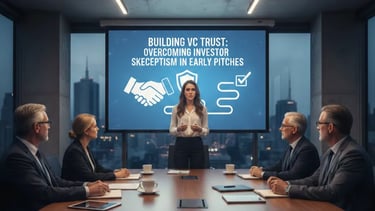
Building VC Trust: Overcoming Investor Skepticism in Early Pitches
$3.2M in seed revenue, a net revenue retention of 118%, and a burn multiple of 0.9x. By every quantitative measure, this was a fundable Series A company. The founder did not close the round on the first attempt. Three top-tier funds passed in the same quarter. The financials were not the problem. The trust architecture of the deck was — and no amount of traction repairs a pitch that has already triggered a VC's skepticism filter before the numbers appear.
Investor skepticism is not the same as investor doubt. Doubt is resolved by evidence. Skepticism is a prior disposition — a defensive posture the VC adopts when the deck's structural signals suggest the founder is managing perception rather than presenting reality. Once skepticism is active, evidence does not close it. It feeds it. Every strong metric becomes something to verify rather than something to believe, and the diligence process transforms from a conviction-building exercise into an audit. That is a deal-killing dynamic that begins on your Problem slide and is either neutralised or confirmed by your Solution slide. It is the mechanism at the centre of the investor psychology framework behind high-conversion Problem and Solution slides.
Why VC Skepticism Is a Structural Response to Deck Architecture, Not a Personality Problem
Skepticism in a VC context is not cynicism. It is a calibrated self-defence mechanism built from pattern recognition across hundreds of evaluated deals. The specific patterns that trigger it are not random — they are structural signatures that experienced investors have learned to associate with founders who are optimising for the appearance of fundability rather than the substance of it.
The three highest-activation skepticism triggers in early pitch decks are: a Problem slide that presents severity without mechanism, a Solution slide that leads with product features rather than outcome evidence, and a transition between Problem and Solution that does not follow logical necessity. When a VC detects any one of these, the skepticism filter activates. When they detect two or three in sequence, the meeting is functionally over — the VC is still in the room, but their evaluation posture has shifted from open assessment to defensive verification.
The specific failure pattern that most reliably triggers all three simultaneously is what experienced analysts call the "confidence gap" — a visible mismatch between how certain the founder sounds and how much evidence supports that certainty. A founder who presents a $4B market opportunity with a single top-down TAM calculation and then transitions immediately into product demo mode has created a confidence gap. The VC's brain registers it as: this person knows what they want me to believe and is moving quickly past the places where I might disagree.
The last four decks reviewed before a partner meeting at a mid-market US fund this quarter all contained a confidence gap between the Problem and Solution slides — none of the four received a term sheet in that cycle, despite two of them having ARR above $800K.
The psychological root is not dishonesty. It is a structural miscalculation about what builds trust in a VC context. Founders who have successfully sold their product to customers know that conviction and momentum close deals. In a sales context, that is correct. In a VC context, it is the exact posture that activates skepticism — because a VC's job is not to be sold to. It is to find the flaw before the LP committee does.
The Skepticism Tax: Quantifying What Distrust Costs in Series A Economics
Investor skepticism has a measurable financial expression. It does not always kill deals — but it consistently degrades their terms.
In 2025, US Series A funds running standard 10–14 week diligence cycles report that deals entering diligence with active skepticism signals require an average of two additional founder-side validation deliverables — customer reference calls, independent financial audits, or third-party market analysis — before a term sheet is issued. Each deliverable cycle adds 12–20 days to the process. In a fundraising environment where runway is leverage, that timeline extension is a direct negotiating cost.
Here is the skepticism tax applied across Series A deal terms:
No skepticism signals
Diligence Behaviour: Conviction-building process
Term Sheet Impact: Top of pre-money range ($26M-$28M)
One confidence gap detected
Diligence Behaviour: Additional customer reference calls requested
Term Sheet Impact: Mid-range pre-money, standard provisions
Two confidence gaps detected
Diligence Behaviour: Independent market validation required
Term Sheet Impact: Conservative pre-money, milestone tranching likely
Three or more signals
Diligence Behaviour: Deal tabled pending "further development"
Term Sheet Impact: No term sheet in current cycle
The benchmark that closes this argument: as of early 2026, top-tier US funds are conducting reference checks on founder claims at the Problem slide level — not just on team background. Market sizing methodology, customer pain validation, and competitive landscape framing are being verified against independent sources before a second meeting is scheduled in competitive sectors. A Problem slide that cannot survive that verification process has not just triggered skepticism. It has failed an audit the founder did not know was running.
The Trust Architecture Protocol: Building Credibility From Your First Claim Forward
Trust in a VC context is not built through rapport or enthusiasm. It is built through predictive accuracy — the experience of reading a claim in your deck, forming an expectation, and having that expectation confirmed by the next data point. Every time that cycle completes successfully, the VC's trust level increments. Every time it fails — when a claim is made that the following slide does not support — the trust level decrements. Your deck is running this cycle continuously from the first sentence of your Problem slide.
Step 1 — Apply the "Claim-Evidence Adjacency" Rule. Every factual claim in your Problem and Solution slides must be followed immediately — not two slides later, not in the appendix — by its supporting evidence. The adjacency matters because VC skepticism activates in the gap between a claim and its proof. If that gap spans a slide transition, the skepticism has time to calcify into a prior judgment that the evidence then has to overcome rather than simply confirm.
Weak Version: "The property management sector is fundamentally broken, leaving landlords and tenants underserved by legacy software." This claim creates a gap the size of a sector indictment with zero evidence adjacent to it. The skepticism filter activates immediately.
VC-Ready Version: "78% of US residential property managers still process maintenance requests via phone or email — generating an average 4.2-day response time against a tenant expectation of under 24 hours (AppFolio Industry Survey, 2024). The software exists to close this gap. The adoption rate among sub-500-unit operators is 23%. That adoption failure is the market." Three claims. Three adjacent evidence points. The VC's predictive accuracy cycle completes three times in four sentences. Trust increments before the Solution slide loads.
Step 2 — Eliminate "Trust Destroyers" From Your Solution Slide. Trust destroyers are specific language patterns that signal perception management rather than transparent reporting. The four highest-impact trust destroyers in Series A Solution slides are:
"We are the only company that…" — An unverifiable superiority claim. The VC's immediate internal response is to start naming competitors you have not mentioned.
"Our proprietary technology…" — Without a one-sentence explanation of the specific technical differentiation, this phrase activates the "black box" skepticism signal.
"Customers love our product" — An emotional assertion in a context that requires commercial evidence. Replace with specific retention, expansion, or referral metrics.
"We are seeing strong momentum" — A directional claim without a number. In 2025, "momentum" without a month-over-month growth rate is a trust destroyer, not a trust builder.
Step 3 — Build the "Transparent Constraint" Signal. The single most effective trust-building mechanism available to a Series A founder costs nothing and is used by almost no one: explicitly naming the primary constraint on your current growth inside your Solution slide. Not burying it. Not minimising it. Naming it precisely and then explaining what the Series A capital does to it.
This works because it inverts the VC's skepticism model. A founder who volunteers their own limiting constraint before being asked is not managing perception. They are demonstrating that they understand their business at a level that makes the constraint manageable rather than unknown. The VC's brain registers this as: this person knows where the edges are. That is the trust signal that opens the diligence conversation at the right posture.
The Trust Architecture Framework: Claim-Evidence Adjacency (no gap between assertion and proof) + Trust Destroyer Elimination (remove the four language patterns above) + Transparent Constraint Signal (name your limiting factor before being asked) = skepticism filter neutralised before the Q&A begins.
Step 4 — Sequence Your Solution Slide Around the "Verification Arc." The Verification Arc is a three-beat structure for your Solution slide that mirrors how a VC processes new information: first, the specific outcome delivered (what does the customer get?); second, the evidence that outcome has been achieved repeatedly (how many times, at what value?); third, the mechanism by which achieving it again is predictable (what in your system makes this repeatable?). A Solution slide that follows this arc gives the VC's verification instinct exactly what it needs to run the cycle to completion — and a VC whose verification instinct completes without finding a gap does not remain skeptical. They become curious.
Three Trust-Building Attempts That Backfire
1. Stacking social proof without commercial context. A Solution slide that lists five named enterprise logos without conversion rates, contract values, or retention data has weaponised credibility signals against itself. The VC sees the logos and immediately asks the questions the slide does not answer — at what ACV? For how long? With what outcome? The logo wall becomes an invitation to probe rather than a trust signal.
2. Over-explaining the technology to demonstrate depth. Founders who interpret skepticism as a signal to go deeper into product architecture are solving the wrong problem. Skepticism in a VC context is almost never about technical credibility. It is about commercial credibility — whether the founder understands the market well enough to build the right thing for the right buyer at the right time. Technical depth on a Solution slide that has not yet established commercial evidence intensifies the skepticism rather than addressing it.
3. Responding to skepticism signals during the meeting with additional assertions. A VC who asks a probing question about your Problem slide framing is not asking for more claims. They are asking for the evidence behind the claim they already heard. Founders who respond to skepticism with expanded assertions — more confident, more detailed, more emphatic — confirm the confidence gap rather than closing it. The answer to every skepticism probe is a data point, a customer reference, or a logical sequence. Never another assertion.
What Neutralising Investor Skepticism Is Worth Before You Reach the Term Sheet
A deck that builds trust systematically from the first claim forward does not just generate better meetings. It generates better deals. In a market where US Series A pre-money sits at $22M–$28M and protective provisions are applied proportionally to the VC's residual uncertainty, the difference between a trust-neutral deck and a trust-building deck can be $4M–$6M in headline valuation and the difference between clean standard terms and a milestone-tranched structure.
Skepticism that is never activated does not need to be overcome. The founders who close the cleanest Series A rounds in 2025 and 2026 are not the ones with the most impressive traction. They are the ones whose decks were structured to make trust the default response rather than something the VC had to decide to extend. The complete architecture for building that trust across every slide in your deck is in the full Problem and Solution Slides system.
Founders who have used the Slide-By-Slide VC Instruction Guide inside the $5K Consultant Replacement Kit go into partner meetings with a Problem and Solution structure that has already been engineered against the specific skepticism triggers a VC's analyst flags in the pre-meeting brief — before a single question is asked. That is not a marginal preparation advantage. It is the difference between walking into a trust-building conversation and spending your first meeting recovering from a confidence gap you did not know you created. The full Kit is $497, and it is available at the pitch deck system built to neutralise VC skepticism before the first meeting begins.
Investor skepticism is not a personality trait you need to charm your way past. It is a structural response to structural signals in your deck. Change the signals. The skepticism does not follow.
Funding Blueprint
© 2026 Funding Blueprint. All Rights Reserved.