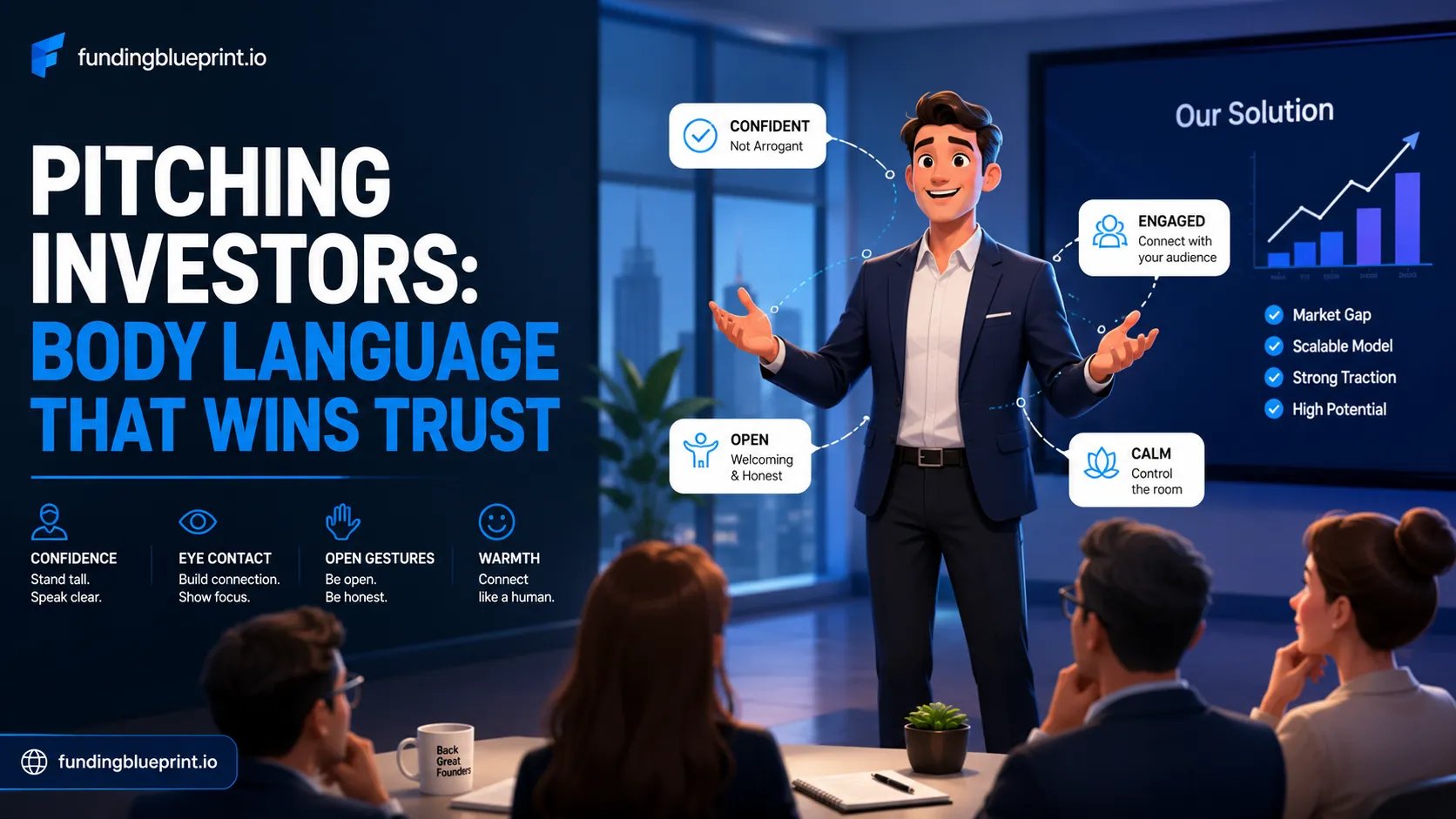
Body Language & Communication Skills: The Physics of Executive Presence
Body Language & Communication: 93% of the pitch is silent. Master the Physics of Executive Presence and Authority Quotient elite London and NYC founders use to command the room.
PILLAR 10 — PITCH DELIVERY
1/5/20266 min read


Body Language & Communication Skills: The Physics of Executive Presence
Your slides tell the story of your business. Your body tells the story of your competence.
In the high-stakes theater of Venture Capital, human beings make decisions based on Cognitive Biases, not just spreadsheets. The famous "Mehrabian Rule" states that 55% of communication is non-verbal, 38% is vocal tonality, and only 7% is the actual words. While the exact percentages in a B2B context are debated, the forensic reality remains: Investors do not invest in victims. They invest in victors.
When a General Partner (GP) watches you pitch, their "Reptilian Brain" (Amygdala) is scanning for signals of fear, deception, or uncertainty. If you fidget, avoid eye contact, or speak with an upward inflection (seeking approval), you trigger a "Beta Signal." You are sub-communicating: "I am not in control. This investment is risky."
Conversely, if you master "Alpha Signaling"—stillness, downward inflection, and spatial dominance—you trigger a "Confidence Loop." The investor assumes your numbers are solid because you appear solid.
This analysis is a surgical dissection of Executive Presence. We will strip away the "public speaking 101" advice and focus on the Bio-Mechanics of Authority—how to hack your own physiology to project the certainty required to close a multi-million dollar round.
This sub pillar is part of our main Pillar 10 — Pitch Delivery
The Trench Report: The "Nervous Tick" That Killed a Series A
In Q2 2025, I coached a FinTech founder in London. He was raising £8M. His metrics were top 1% (Net Dollar Retention > 130%). Yet, he had failed 12 partner meetings in a row.
The Structural Error:
We recorded a mock pitch. The issue was invisible to him but glaring to an auditor.
The Tick: Every time he was asked a difficult question about regulation, he touched his neck.
The Forensic Meaning: In behavioral psychology, touching the neck (the suprasternal notch) is a "Pacifying Behavior." It is a subconscious attempt to protect the jugular vein during stress.
The Investor Reaction: Investors didn't know why they didn't trust him; they just felt "something was off." They assumed he was hiding a regulatory risk. He wasn't. He was just nervous.
The Technical Pivot:
We implemented "The Anchor Protocol."
The Fix: He was instructed to keep his hands "Steepled" (fingertips touching) on the table.
The Constraint: He was forbidden from breaking the steeple during Q&A.
The Result: By physically locking his hands, we eliminated the pacifying tick. His body language shifted from "Defensive" to "Contemplative."
The Outcome:
He secured a term sheet from a Tier-1 UK fund two weeks later. The feedback? "We love how calm he is under pressure." The business hadn't changed; the signal had changed.
The Forensic Formula: The Authority Coefficient Ac
You can quantify your vocal authority using pitch and speed dynamics.
Ac = Pause Duration (s)
Upspeak Frequency (Hz variance)
Forensic Logic: High authority speakers use longer pauses (High Numerator) and avoid "Upspeak" (Low Denominator). If your voice goes up at the end of a sentence, your Ac crashes. You sound like you are asking a question, not stating a fact.
The Three Pillars of Non-Verbal Dominance
To pass the audit, you must master three specific channels of non-verbal communication.
1. Prosody: The Physics of the Voice
Your voice is an instrument. Most founders play it out of tune.
The Error: "The Rush." Speaking at >160 words per minute (WPM). This signals anxiety.
The Fix: "The Executive Cadence." Slow down to 130 WPM.
The Downswing: In English, a statement ends with a downward pitch. A question ends with an upward pitch.
Weak: "We are raising $2M?" (Upward = Asking for permission).
Strong: "We are raising $2M." (Downward = Stating reality).
The Forensic Drill: Practice saying your valuation with a downward inflection until it sounds boring.
2. Ocular Mechanics: The Trust Lock
The Error: "Eye Darting." When thinking, looking up/left/right rapidly. This signals that you are searching for an answer (fabricating) rather than accessing knowledge (remembering).
The Fix: "The Thought Anchor." When asked a hard question, look the investor directly in the eye (or the camera lens) for 3 seconds of silence before you speak.
Why it works: Silence creates tension. By holding eye contact during silence, you prove you are comfortable with tension.
3. Spatial Dynamics: Zoom vs. In-Person
In-Person: "Claiming Space." Do not sit with your legs crossed and arms folded (The Turtle). Spread your papers. Lean forward. Occupy the table.
Zoom: "The Headroom Rule."
Amateur: Too much space above your head (you look small).
Pro: Your head should be 2 inches from the top of the frame. Your shoulders should be visible. You should loom large in their feed.
Regional Calibration (SF vs. London)
Body language dialects differ by geography.
San Francisco (The "Reality Distortion" Field)
The Vibe: High Energy, Animated, Visionary.
The Protocol: "The Steve Jobs Mode."
Movement: It is acceptable to stand up and pace (if presenting). Use large, open hand gestures.
Emotion: Show passion. If you are stoic in SF, they think you don't believe in your own vision.
Key Signal: "The Lean In." When they ask a question, lean in aggressively to show engagement.
London / New York (The "Banker" Field)
The Vibe: Stoic, Controlled, Precise.
The Protocol: "The Clint Eastwood Mode."
Movement: Stillness is power. Minimize gestures. Keep hands on the table.
Emotion: Show competence. If you are too animated in London, you look like a salesperson, not a CEO.
Key Signal: "The Lean Back." When challenged, lean back slightly. It signals: "I am not threatened by your skepticism."
The "Tell" Checklist
Investors (consciously or subconsciously) look for these "Tells" that indicate deception or weakness.
Red Flag 1: The "Self-Soothing" Rub
The Action: Rubbing the back of the neck, touching the nose, or stroking the chin excessively.
The Forensic Meaning: These interactions stimulate nerve endings that release oxytocin to calm the brain. It screams: "I am under threat."
The Fix: "The Table Lock." Keep your hands visible and anchored to the table or your lap. Never touch your face.
Red Flag 2: The "Subordinate Nod"
The Action: Nodding your head rapidly and continuously while the investor is speaking.
The Forensic Meaning: "Please like me. I agree with you. I am lower status than you."
The Fix: "The Still Listen." Keep your head still. Nod only once slowly to acknowledge a point. This rebalances status.
Red Flag 3: The "Zoom Side-Eye"
The Action: Looking at your second monitor (notes) while pitching.
The Forensic Meaning: "I don't know my numbers." Or worse, "I am reading a script."
The Fix: "The Teleprompter Hack." Put your notes directly under the camera lens on the main screen. Or better yet, know your pitch cold so you don't need notes.
Earned Secrets
Hidden levers of bio-hacking for high-performance pitching.
Secret 1: The "Cortisol Flush" (Pre-Meeting)
The Secret: Your brain fog is caused by cortisol (stress hormone).
The Hack: 5 minutes before the pitch, do a "Power Pose" (arms up in V-shape) or 10 pushups.
The Science: This increases Testosterone (confidence) and lowers Cortisol by ~20%. It clears the "Brain Fog" immediately.
Secret 2: The "Palms Up" Vulnerability
The Secret: Showing your palms is an evolutionary signal of honesty ("I have no weapons").
The Hack: When admitting a risk or a weakness, use "Palms Up" gestures.
Context: "Yes, our churn is high in the SMB segment." (Palms Up).
Effect: It disarms the investor. It makes the admission feel like honest transparency rather than a failure.
Secret 3: The "Camera Lens" Eye Contact
The Secret: On Zoom, looking at the person's face means you are looking down (breaking eye contact).
The Hack: Put a sticker of a pair of eyes or a smiley face right next to your webcam lens. Train yourself to talk to the sticker, not the screen. To the investor, it looks like you are staring into their soul.
Expert FAQ: The Unasked Questions
Q: Should I stand or sit for a Zoom pitch?
A: Forensic Answer: Stand.
Why: Standing opens the diaphragm. Your voice projects better (more resonance). You have more energy. You occupy more space. Sitting collapses the lungs and lowers energy. Buy a standing desk converter just for fundraising.
Q: Can I use a virtual background?
A: Forensic Answer: No.
Why: Virtual backgrounds glitch. They cut off your hands when you gesture. They look cheap.
Better: Clean up your real background. A bookshelf or a plain wall is better than a blurry picture of the Golden Gate Bridge. It signals "Real," not "Fake."
Q: How do I handle an interruption?
A: Forensic Answer: Stop Instantly.
The Error: Trying to finish your sentence ("Talking Over").
The Fix: As soon as you hear a sound from them, go silent.
Psychology: It shows respect. It also allows you to hear the nuance of the objection. If you talk over them, you look defensive.
Forensic Audit Checklist
Before you log on, run the "Executive Presence" Diagnostic:
The Eye Level Check: Is the camera lens exactly at your eye line? (If low, you look down/arrogant. If high, you look small/submissive).
The Lighting Audit: is the primary light source behind the camera? (Face fully illuminated).
The Audio Check: Are you using a dedicated mic (or quality headset)? Laptop mics pick up fan noise and echo. Bad audio = Low IQ perception.
The Hands Check: Are your hands visible in the frame (on Zoom)? Trust increases when hands are visible.
The "Umm" Audit: Record the first 2 minutes. Count the "Umms." If >3, slow down.
Narrative Breadcrumb
You have mastered the physical delivery. Your voice is resonant, your hands are controlled, and your eye contact is locked. You have successfully transmitted Competence.
But the meeting is just the start. The real work happens after you hang up. The difference between a "Good Meeting" and a "Term Sheet" is the "Follow-Up Strategy." You need to know how to navigate the "Trough of Sorrow" between the first call and the Partner Meeting.
(Note: The Funding Blueprint Kit includes Founder-Proofed Frameworks built on real-world investor reactions and the Slide-By-Slide VC Instruction Guide. These resources decode the specific VC psychology behind every potential objection, ensuring you don't just memorize a script, but internalize the logic required to survive the audit. Access the full forensic suite at the home page.)
Funding Blueprint
© 2025 Funding Blueprint. All Rights Reserved.