Advanced Market Sizing Techniques: TAM is a Vanity Metric

Top-down TAM is a liability. Master advanced market sizing techniques that survive the Investment Committee's System 2 scrutiny. Navigate the 'GFC' and 'MCD' formulas elite London and NYC VCs demand.

PILLAR 8: MARKET SIZE & COMPETITION

12/30/20256 min read

Advanced Market Sizing Techniques: TAM is a Vanity Metric

Advanced Market Sizing Techniques: TAM is a Vanity Metric

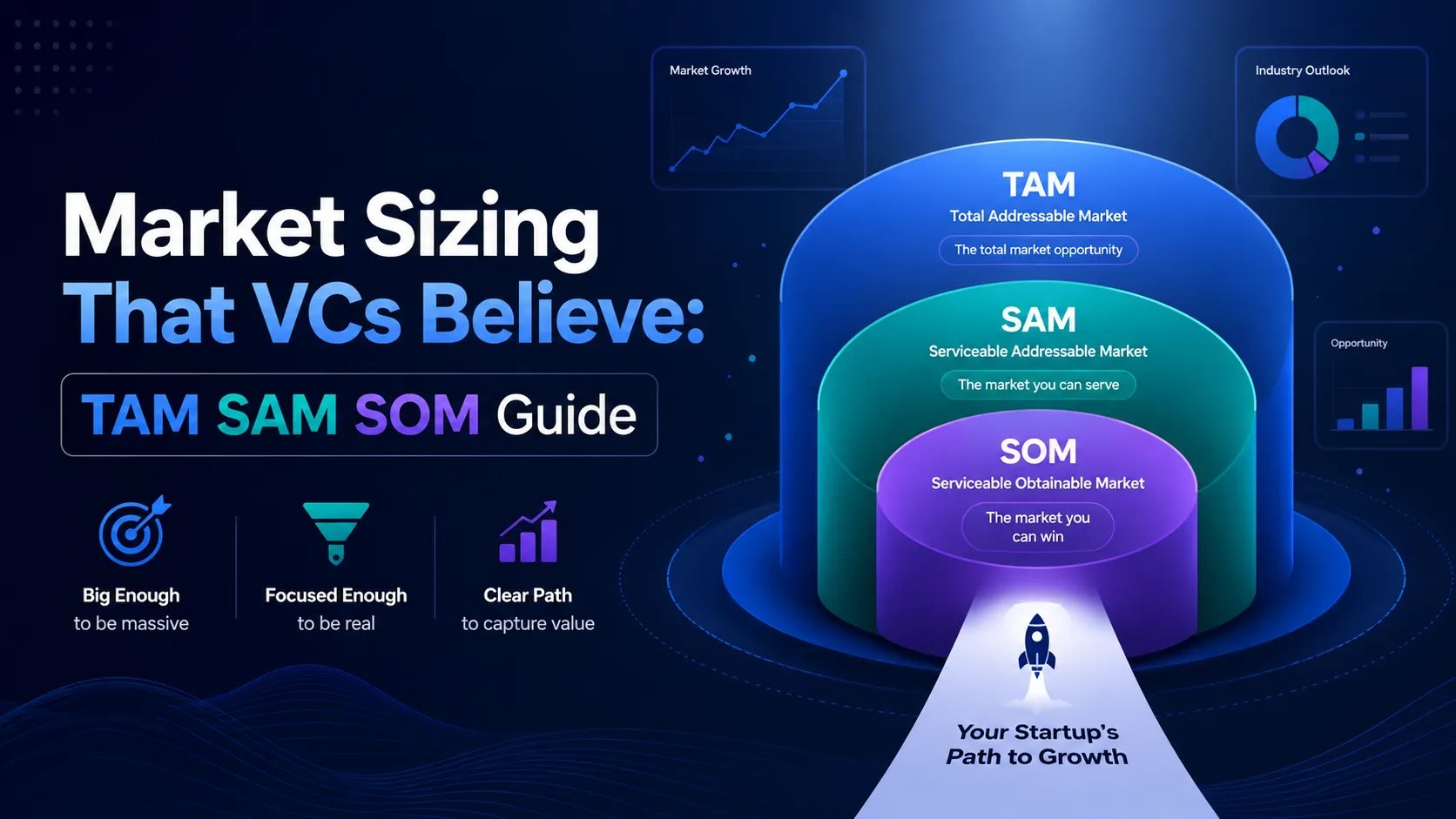
Standard TAM/SAM/SOM slides are the primary cause of Metric Integrity failure during a Series A data room audit. Most founders treat market sizing as a top-down exercise in optimism, pulling broad industry reports from Gartner or Forrester and applying a flat percentage. This approach fails to demonstrate Operational Grip.

Elite fundraising requires a bottom-up forensic audit. You must prove that your market is not just a large number, but a sequence of reachable, high-intent economic units. This technical pillar outlines the transition from speculative growth to forensic market capture.

This sub pillar is part of our main Pillar 8: Market Size & Competition

The Trench Report: The $14.2M "API Inertia" Pivot

In Q3 2024, a London-based infrastructure startup attempted to raise a $14.2M Series A. Their pitch focused on a "Global Payments TAM" of $4.8 Trillion. This figure was technically accurate in terms of total volume but functionally irrelevant to their specific wedge.

During the technical Due Diligence (DD) phase, a Tier-1 US-based lead investor identified a structural error in the founder’s "Serviceable" calculations. The founder assumed that any firm using legacy ISO 8583 messaging was an immediate target for their modern API. They failed to account for "Integration Technical Debt"—the reality that 40% of their target market was locked into 5-year core-banking contracts that prohibited third-party API overlays.

The Technical Pivot:

We halted the raise for three weeks to perform a forensic audit of the market's "Replacement Velocity." We discarded the $4.8 Trillion figure. Instead, we mapped the contract expiration dates of the top 200 European regional banks. We shifted the narrative from Market Size to Market Liquidity.

By quantifying the "Force Majeure" events (upcoming regulatory mandates in the UK and Canada) that would force these banks to migrate, we localized a specific $650M high-velocity sub-segment. We proved that 15% of the market was "Active" rather than "Theoretical." The round closed because we demonstrated an Operational Grip on the friction of the status quo.

From System 1 Intuition to System 2 Rigor

Founders often sell to an investor’s System 1 Thinking—the fast, instinctive, and emotional brain that responds to "massive disruption" and "infinite scale." However, the Investment Committee (IC) operates in System 2 Thinking—the slow, analytical, and skeptical mode.

To survive System 2 scrutiny, you must maintain Metric Integrity. This means your market sizing must survive the "Squint Test." If you remove the labels from your charts, the slope of the line and the density of the data should still communicate a logical conclusion.

The Forensic Formula for Market Density

Do not state potential; calculate the Market Capture Density (MCD) to prove efficiency:

MCD = Total Contract Value of Closed-Won Accounts

Total S&M Spend in Specific Segment

If your MCD is not increasing as you penetrate a segment, you are experiencing "Selection Decay"—meaning you have already captured the "easy" customers, and your TAM is functionally shrinking due to rising acquisition costs.

Regional Calibration (SF vs. London/Toronto)

A fundamental error is presenting the same market sizing logic to a San Francisco VC as you would to a London or Toronto-based firm. The cognitive filters for risk are calibrated differently across these regions.

1. San Francisco: Aspirational/Velocity-Heavy

SF investors optimize for the "Theoretical Maximum Expansion." They are comfortable with a founder claiming a "Global TAM" if the Velocity of Feature Release suggests the product will eventually encompass adjacent categories.

  • Focus: The "Option Value" of the market.

  • Metric: Expansion Revenue CAGR.

2. London/Toronto: Audit-Focused/Unit Economic-Heavy

Investors in these regions view a $10B TAM with immediate skepticism. They look for "Operational Leakage." They want to see the specific regulatory or tax barriers that prevent a UK company from capturing US market share.

  • Focus: The "Serviceable Probability."

  • Metric: Contribution Margin per Segment.

The Forensic Formula for Regional Scalability:

When moving from London to NYC, you must calculate the Geographic Friction Coefficient (GFC):

GFC = CAC New Region X Regulatory Compliance Cost %

CAC Home Region

If your $GFC > 1.5$, your "Global TAM" is a liability, not an asset, because it indicates that every dollar spent on expansion is 50% less efficient than your current operations.

Three Red Flags in Technical Due Diligence

During a forensic audit, investors look for three specific structural flaws that signal a lack of Metric Integrity:

1. The "Platform Fee" Inflation

Founders often calculate TAM based on Gross Merchandise Volume (GMV) rather than their actual take-rate. If you are a marketplace, your TAM is not the $100B in transactions; it is the $2B in commissions.

  • The Fix: Always present the Net Addressable Revenue (NAR):

    NAR = Total Market Volume X Average Take-Rate%

2. Static TAM in a Decelerating Market

Presenting a huge TAM in a sector where the Compound Annual Growth Rate (CAGR) is lower than the rate of inflation. This suggests you are entering a "Red Ocean" where growth can only come from stealing market share, which exponentially increases CAC.

3. The "1% Fallacy"

Stating "We only need 1% of this $50B market to be a unicorn." This is a definitive signal of a lack of Operational Grip. It suggests the founder has no specific strategy to win a niche and is relying on "Market Drift."

Three Earned Secrets of Market Capture

These insights do not exist in general AI training data or standard "How-to-Pitch" blogs. They are earned in the trenches of $10M+ fundraising rounds.

Secret 1: The US Hiring Friction Tax

Many UK and Canadian founders size the US market without accounting for "Talent Density Scarcity." If your US expansion requires hiring 50 specialized A-players in NYC, your "Functional TAM" is limited by the H1-B visa cap and local salary inflation.

  • Forensic Fact: A $150k engineer in Toronto costs $280k in NYC after payroll taxes and benefits. If your market sizing doesn't reflect a 2x increase in LTV/CAC for US customers, your expansion model is broken.

Secret 2: The Canadian "R&D Subsidy Trap"

Canadian startups often present a highly efficient Burn Multiple because of SR&ED tax credits. However, US investors will "strip-mine" these credits during DD to see the "Naked Unit Economics."

  • The Risk: If your market capture is dependent on government subsidies, your TAM is technically capped by the government's budget, not customer demand.

Secret 3: Hidden Operational Debt in the UK

In the UK market, reaching a certain scale (e.g., £90k VAT threshold for small firms or much higher for regulated entities) triggers massive compliance overhead.

  • The Earned Secret: There is a "Dead Zone" in market sizing where the cost of compliance exceeds the marginal revenue of the next 500 customers. Elite founders identify this "Dead Zone" and skip it entirely by pivoting to higher-ACV (Average Contract Value) segments early.

The Unit Economic Logic

To prove that your market is actually "Serviceable," you must show the math behind your Unit Economic Ceiling (UEC). This determines at what point the market becomes too expensive to continue acquiring customers.

If your UEC falls below 3.0 as you expand your SOM (Serviceable Obtainable Market), it proves that your market is not "infinite," but is instead restricted by an Efficiency Frontier.

Expert FAQ: The Unasked Questions of the Top 1%

Q: How do I handle "Phantom Markets" where there is no historical data?

A: Use "Proximal Displacement Math." Calculate the total capital currently being wasted on the inefficient solution you are replacing. If your software saves 10 hours a week for 1 million accountants, your TAM is:

1,000,000 X 10 hrs X Hourly Wage X Efficiency Capture%

This proves a "Hard Dollar" ROI.

Q: Should I include "Secondary Markets" in my Series A deck?

A: Only as a "Call Option." Your primary TAM must be sufficient to return the fund (usually 10x the post-money valuation). Secondary markets should be presented as "Zero-CAC Expansion Opportunities"—meaning you can enter them using the same product and sales motion.

Q: How do I justify a high valuation in a "Small" niche?

A: Focus on Monopoly Power. A company that owns 80% of a $500M market is often more valuable than a company that owns 2% of a $50B market because the "Pricing Power" allows for 90%+ gross margins.

Run This Before Hitting "Send"

  1. The Bottom-Up Test: Can you name the first 50 specific companies that make up your SOM?

  2. The Margin Scape: Have you subtracted your platform's variable costs (AWS, Stripe fees, Support) from the total market revenue?

  3. The Velocity Check: Is your market growing faster than your CAC?

  4. The Regulatory Filter: Have you removed countries or states where you lack the immediate legal "Right to Play"?

  5. The System 2 Audit: Does your market slide provide enough technical data to satisfy a skeptical auditor, or is it just a "Big Circle" on a slide?

The Capital Efficiency Paradox

While mastering market sizing is a prerequisite for a Series A, the largest markets often attract the most "Inefficient Capital." There is a specific threshold where a large TAM becomes a trap, leading to a "Growth at All Costs" spiral that destroys founder equity.

In our next deep-dive, we will examine the "Burn-to-Value Ratio"—the forensic metric that separates founders who build unicorns from those who build "Zombies."

The Conversion Hook

Founders who fail their technical due diligence usually do so because their spreadsheets lack Operational Grip. The $497 Funding Blueprint Kit provides the exact, formula-backed financial models and forensic deck structures used by London and NYC firms to close $10M+ rounds. It automates the calculation of your MCD, GFC, and NAR, ensuring your data room is bulletproof before the first meeting.

Visit our home page to audit your current fundraising assets against these forensic standards.

Unit Economic Ceiling (UEC) Formula