
Deck Requirements for YC, Techstars, and Top Accelerators
YC doesn't read slides; they scan for speed. A forensic audit of the Accelerator Test: Why 'Series A Cosplay' gets you rejected and the 'Rule of 7' slides you actually need.
1.4 HOW PITCH DECKS FIT INTO DIFFERENT FUNDRAISING STAGES?
1/26/20264 min read
Most founders treat accelerator applications like a Series A roadshow.
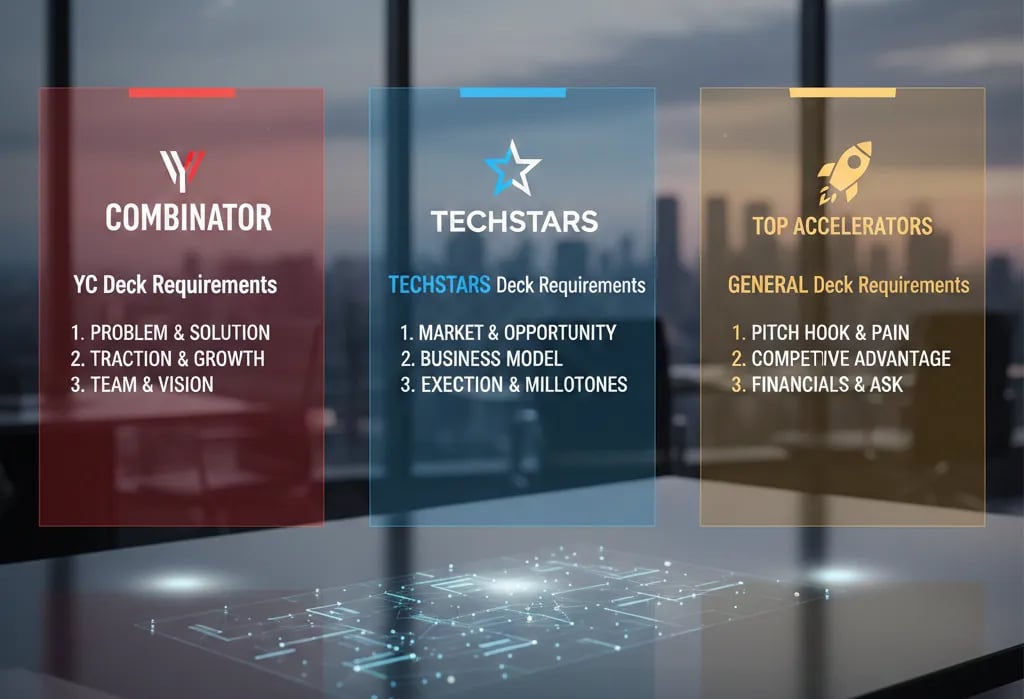
This is a fatal calculation error. Y Combinator does not want your 15-slide "vision document." They are not looking for a business that is already built; they are looking for a team that can build fast. The acceptance rate for YC is approximately 1.5%—statistically harder than getting into Harvard. Your standard "institutional" pitch deck is dead weight here. It signals a lack of understanding regarding How Pitch Decks Fit Into Different Fundraising Stages. If you send a Sequoia-style narrative to a YC partner reading 50 applications an hour, you are optimizing for rejection.
The Diagnosis
The error that destroys accelerator applications is Signal Dilution.
Founders believe that "more context" reduces risk. They pack slides with 5-year financial projections, generic "Why Now" macro-trends, and advisory board logos.
The "Red Flag" Scenario
A partner opens your PDF. Slide 2 is a "Problem" statement referencing a generic McKinsey report about a $500B market. Slide 3 is a solution diagram with four acronyms. The partner checks the "Team" slide—it’s at the very end.
Verdict: Pass.
The VC Thought Process: "If this founder takes 6 slides to explain what they do, they can't sell to customers, and they can't hire engineers. Low velocity."
Psychological Audit
Why do founders commit this suicide? Insecurity.
You don't have revenue. You don't have product-market fit. To compensate for this "emptiness," you inflate the deck with vanity metrics and design flair. You are trying to look like a Series B company to hide the fact that you are two people in a room. Accelerators buy the people in the room, not the fake projection of a Series B company.
The "Time-on-Page" Arbitrage
The logic for a concise accelerator deck isn't stylistic; it is purely arithmetic based on throughput volume.
Let’s analyze the "Cognitive Load" cost of a YC Partner during application season:
Total Applications: ~20,000+ per batch.
Review Period: ~14 days.
Reviewers: Limited partner pool.
Time Allocation Per Application: ~2 to 3 minutes maximum.
If your deck requires 4 minutes to cognitively process, you have exceeded the time allocation by 100%. You are asking for an investment of time that the investor literally cannot afford to give.
The Velocity Equation
Successful accelerator decks optimize for Insight Velocity (Iv):
Iv = Novel Insight
Seconds to Understand
Low Iv: A "Problem" slide that explains that "Cybersecurity is important." (0 Insight / 10 Seconds = 0).
High Iv: "We reduce AWS bills by 40% using one line of code." (High Insight / 3 Seconds = High Velocity).
Every second spent on "fluff" (stock photos, generic market data) drives your Iv toward zero. When Iv drops below the threshold of the reviewer's attention span, the application is discarded.
The "Insider" Solution Protocol
Stop building a "Pitch Deck." Start building a "Proof of Velocity" asset.
For YC and Techstars, your deck must answer three binary questions in under 60 seconds:
Are these founders technical/capable?
Is the insight counter-intuitive?
Is the market massive?
The "Before vs. After" Comparison
The Weak Version (Series A Cosplay):
Slide 1: "Empowering the future of work." (Vague).
Slide 2: "The Problem: Remote work is hard." (Obvious).
Slide 3: "The Solution: An AI-driven holistic platform." (Buzzword salad).
Slide 10: "Team." (Buried).
The VC-Ready Accelerator Protocol:
Slide 1: The One-Liner. "Stripe for Africa." or "GitLab for Designers." Specific, comparable, immediate.
Slide 2: The Team (Up Front). "CEO: Ex-Google, built X. CTO: PhD in ML, built Y." This is the primary asset.
Slide 3: The Secret/Insight. What do you know that nobody else does? "Competitors do X, which is slow. We do Y, which is instant."
Slide 4: Traction/Velocity. "Launched 2 weeks ago. 15% WoW growth. $2k MRR."
The "Rule of 7" Framework
For an accelerator deck (often uploaded as a PDF or video script), apply the Rule of 7:
No more than 7 slides.
No more than 7 seconds to understand any single slide.
Font size never below 24pt (Reviewers often read on mobile/tablets).
The "Death Traps"
Warn your team about these specific failure modes when refining the deck:
The "Consultant Polish" Trap:
Founders often hire designers to make the deck look "professional." Stop. YC prefers raw, ugly, high-content slides (black text, white background, Arial font) over highly polished marketing brochures. Slick design signals "Sales Focus." Raw data signals "Builder Focus."
The "Video Demo" Illusion:
Do not embed a 2-minute Loom video inside a PDF slide. It will not play. If a demo is required, provide a hyperlink, but assume it will never be clicked. The screenshots on the slide must tell the full story without the video playing.
The "Global TAM" Error:
Do not say "The market is $1 Trillion." Everyone knows the global market is big. Drill down to your Serviceable Obtainable Market (SOM). "We are targeting the 50,000 SMBs using X software today." Precision equals credibility.
The "High-Ticket" Conclusion
The difference between a generic deck and a high-velocity accelerator deck is not just "acceptance"—it is leverage. Getting into YC or Techstars sets a valuation floor for your subsequent rounds, often adding $2M–$5M to your post-money valuation overnight. It is an arbitrage on your company's reputation.
For a comprehensive breakdown of how this integrates into your wider capital strategy, review How VC Pitch Decks Really Work in 2026 — And Why Most Founders Get Them Wrong.
The Filter Plug:
You can build this manually, or use the Slide-By-Slide VC Instruction Guide included in our $5k Consultant Replacement Kit ($497) available on the home page. This guide strips away the design fluff and forces you to input only the high-velocity data points that YC partners actually read.
Funding Blueprint
© 2026 Funding Blueprint. All Rights Reserved.