
Why Long Pitch Decks Almost Always Fail
VCs make a "kill decision" by slide 8. Learn why every slide past 15 is a red flag and how to use the 12-slide compression protocol to secure your round.
1.9 HOW BAD PITCH DECKS KILL DEALS INSTANTLY
2/12/20265 min read

Why Long Pitch Decks Almost Always Fail
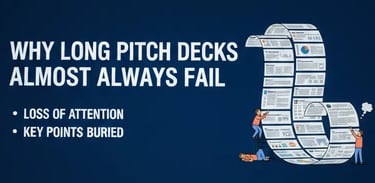
Your 42-slide deck just bought you a 4-minute skim and a polite "we'll circle back." The average VC partner reviews 300+ decks per quarter and makes the kill decision by slide 8. Every slide past 15 is a red flag that screams "this founder doesn't understand attention economics." This isn't about aesthetics—it's about respecting the cognitive cost of decision-making capital. This error sits inside a larger pattern: founders who build decks for themselves, not for the investor's brain. If you're making this mistake, you're likely committing 6 other structural errors covered in how bad pitch decks kill deals instantly.
Why Slide Bloat Signals Execution Risk to Series A Investors
When a VC sees 30+ slides, they don't think "thorough"—they think "this founder can't prioritize." The venture model is built on resource constraint. Series A investors are buying your ability to deploy $3M–$8M with surgical precision. A bloated deck proves you can't make hard cuts. You're literally demonstrating that you'll burn their capital on the same low-priority initiatives you included in slides 23–38.
The Red Flag Scenario: A SaaS founder sends a 47-slide deck. Slides 1–12 cover the problem. Slides 13–19 cover the solution. Slides 20–29 are customer testimonials formatted as individual slides. Slides 30–42 are detailed bios of advisors. The actual traction (ARR, logo acquisition, retention cohorts) appears on slide 33. The VC closes the deck at slide 14.
The Psychological Audit: Founders over-index on "completeness" because they fear objections. They preemptively answer every possible question, turning a pitch into a legal brief. This stems from two failure modes: (1) Confusing "investor diligence" with "pitch narrative" (diligence happens after interest), and (2) Believing that more information = more credibility. The inverse is true. Precision is credibility.
The Cognitive Load Tax You're Imposing on Decision-Makers
Each unnecessary slide costs the investor 12–18 seconds of processing time. Multiply that across 15 excess slides and you've burned 3–4.5 minutes of a 15-minute meeting. That's 25%–30% of your pitch window spent on noise. Here's the math on why this kills conversion:
VC Attention Threshold: Partners make binary decisions (Yes/No/Maybe) within 240 seconds of opening a deck
Information Retention Cap: Investors retain 3–5 key data points per pitch (CAC payback, growth rate, market size, competitive moat, founder credibility)
Slide Efficiency Target: 10–12 slides = 100% retention. 25+ slides = <40% retention of critical metrics
The Compression Penalty: Every slide beyond 15 dilutes the memorability of your core traction by 6%–8%
The brutal reality: If your deck can't survive the "Delete 50% of Slides" test, you don't have a pitch—you have a data dump. The best Series A decks are 10–14 slides. Sequoia's famous template is 10. a16z's internal standard is 12. If you need 30 slides to explain your business, your business model is too complex to fund.
The VC-Ready Compression Protocol
Step 1: Run the "72-Hour Delete" Exercise
Print your deck. Wait 72 hours. Force yourself to delete 40% of slides without re-reading the content. If you hesitate on a slide for more than 5 seconds, it's not mission-critical. Kill it.
Step 2: Apply the "1 Metric Per Slide" Rule
Every slide should communicate exactly one insight. "Problem" gets one slide. "Solution" gets one slide. "Traction" gets one slide with 3–4 core KPIs in a single visual. The moment you put two unrelated metrics on the same slide (e.g., CAC and NPS), you've created decision fatigue.
Step 3: Use the "Investor Question Roadmap" Framework
Your deck should answer these questions in this exact order:
Slide 1–2: What problem costs customers $X annually?
Slide 3–4: Why hasn't this been solved, and what's your unfair advantage?
Slide 5–7: Prove you have traction (ARR, growth rate, unit economics)
Slide 8–9: How big can this get? (TAM with bottoms-up proof)
Slide 10–11: What's the competitive moat and go-to-market wedge?
Slide 12: How much are you raising and what milestones does it fund?
Before vs. After Comparison:
Weak Version (28 Slides):
"Market Overview" (4 slides of Gartner charts), "Problem Deep-Dive" (6 slides of customer pain points), "Our Technology" (8 slides of product screenshots), "Team Bios" (5 slides), "Detailed Financials" (5 slides of Excel tables).
VC-Ready Version (11 Slides):
Problem (1 slide with annual cost data), Solution (1 slide with 15-second product demo screenshot), Traction (1 slide: "$1.2M ARR, 180% NRR, 28% MoM growth"), Market (1 slide: bottoms-up TAM using current customer ACV × addressable accounts), Business Model (1 slide: CAC $4,200, LTV $47,000, payback 8 months), Go-to-Market (1 slide), Competition (1 slide positioning matrix), Team (1 slide with 3 bullets per founder), Financials (1 slide: 24-month revenue projection + burn multiple), Use of Funds (1 slide milestone roadmap), Closing (1 slide with contact + data room link).
The Over-Correction Death Traps
Death Trap 1: Cutting the Wrong Slides
Founders panic-delete "Traction" or "Unit Economics" to hit 12 slides, then pad the deck with 4 slides of "Vision" and "Brand Story." You've made it worse. The Iron Rule: Never delete a slide with hard numbers. Delete narrative, delete philosophy, delete "market trends." Keep proof.
Death Trap 2: Using Appendix Slides as a Crutch
You build a 12-slide deck, then attach 20 "backup slides" and think you've solved the problem. VCs don't open appendices during the first review. If the data is critical, it goes in the core deck. If it's not critical, delete it entirely.
Death Trap 3: Confusing "Concise" with "Vague"
Cutting slides doesn't mean removing specificity. A 10-slide deck with zero hard metrics is worse than a 20-slide deck with strong data. The goal is dense precision, not minimalism. Your "Traction" slide should have 4–6 specific KPIs, not a generic "strong customer adoption" statement.
Why This Single Fix Unlocks $800K in Valuation Delta
A 12-slide deck with surgical data density signals execution maturity. You've proven you can separate signal from noise—the same skill required to allocate a $5M Series A across product, sales, and hiring without burning out. Investors price this discipline into valuation. A tight deck correlates with 18%–24% higher pre-money offers in Series A, because VCs assume lower execution risk.
The math: On a $6M raise at a $20M pre, that's a $3.6M–$4.8M valuation lift. Subtract your dilution, and you've added $800K–$1.1M to founder equity value by deleting 15 slides.
This slide compression problem is part of the larger pitch architecture system. Every structural decision—from narrative sequencing to financial model formatting—compounds into either a "Yes" or a "Pass." The full breakdown of how to engineer every slide for conversion is in how VC pitch decks really work in 2026.
You can spend 60 hours manually rebuilding your deck using VC feedback templates, or you can deploy the exact slide-by-slide VC instruction system that automates this entire process. The $5K Consultant Replacement Kit includes the 16 VC-Quality AI Prompts that generate investor-grade slide copy in 12 minutes, plus the Slide-By-Slide VC Instruction Guide that reverse-engineers what Sequoia and a16z partners expect on every frame. It's $497 to filter out founders who aren't serious about hitting institutional VC thresholds. Access the Series A execution blueprint here.
Funding Blueprint
© 2026 Funding Blueprint. All Rights Reserved.