
When to Break the Rules of Traditional Pitch Deck Structures
Trying to make your pitch deck "stand out" usually kills your raise. Learn the strict rules of pitch deck structure and when you actually have permission to break them.
3.1 CORE PITCH DECK STRUCTURES: HOW VCS RECOGNIZE SIGNAL VS NOISE
3/5/20266 min read
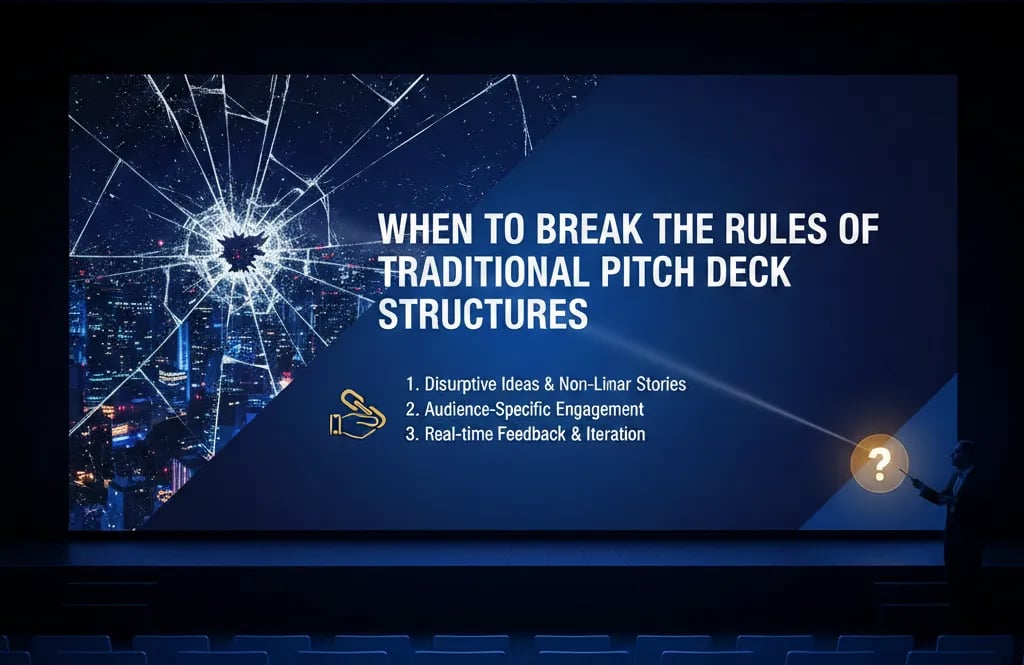
When to Break the Rules of Traditional Pitch Deck Structures
You Did Not Get a Second Meeting. The Unconventional Deck Structure You Chose Is Exactly Why.
You did not get a second meeting. The VC's associate sent a polite pass email 72 hours after the intro call, and the feedback was vague — "not the right fit for our current thesis." What actually happened: you restructured your deck to stand out. You led with the product demo. You buried the problem statement in slide four. You moved the team slide to position two because someone told you that "people invest in people." The deck felt bold. It read as confused. Rule-breaking in a pitch deck is one of the highest-risk structural decisions a pre-Series B founder can make — and the difference between a deck that earns the right to break convention and one that simply ignores it is precise, learnable, and almost never discussed. It sits at the foundation of what Core Pitch Deck Structures: How VCs Recognize Signal vs Noise is built to diagnose.
Why Unconventional Structures Fail: The Cognitive Load Audit VCs Run in the First 90 Seconds
When a VC opens a deck, they are not reading it. They are pattern-matching it. In the first 90 seconds, an experienced investor is running a rapid cognitive audit: Can I locate the problem? Can I locate the proof? Can I locate why this team? If the answer to any of these is "I have to search for it," the deck has already lost narrative control — and a deck that has lost narrative control reads as a founder who has lost business control.
This is the precise mechanism by which unconventional structures destroy raises. It is not that VCs are rigid or uncreative. It is that a traditional pitch deck sequence exists because it mirrors the logical order of investment conviction: problem → insight → solution → proof → scale → team → ask. That sequence is a trust-building architecture. When you disrupt it without a specific, defensible reason, you are not signalling boldness. You are creating friction in a process where friction means abandonment.
I have reviewed fourteen decks in the past six months where the founder made a deliberate structural choice to deviate from the standard sequence. In eleven of those cases, the deviation was cosmetic — a personal preference dressed up as a strategic decision — and the VC flagged narrative confusion as the reason for passing.
The psychological driver is almost always a misread of what "standing out" means at the deck stage. Founders see pattern-matched decks getting funded and assume the structure is the commodity — that originality comes from breaking the form. The opposite is true. Structure is the neutral carrier. The insight, the metrics, and the narrative are where differentiation lives. A conventional sequence carrying an unconventional insight is a fundable deck. An unconventional sequence carrying a conventional insight is a confusing one.
As of early 2026, US-based seed and Series A funds report that average first-pass deck review time sits at under four minutes before an associate makes a proceed-or-pass recommendation. You do not have the runway to make a VC work to understand your logic.
The Two-Variable Test: Mapping When Rule-Breaking Is Earned
Not all structural deviation is equal. There are specific, documented conditions under which a non-standard deck architecture is not only acceptable — it is strategically superior. The test has two variables:
Variable 1: Do you have a proof asset that makes the standard sequence redundant?
If your traction is so pronounced that it makes your problem statement self-evident, leading with the traction is not rule-breaking — it is logical compression. A founder with $3.2M ARR, 140% net revenue retention, and a 22% MoM growth rate over six cohorts does not need to spend three slides establishing that the problem is real. The revenue is the problem statement. In this scenario, leading with the business performance metrics collapses four slides into one — and does so without creating cognitive dissonance, because the proof is strong enough to anchor everything that follows.
Variable 2: Is the deviation structural or positional?
Structural deviation — removing entire categories of information (no competitive landscape, no unit economics, no market sizing) — is almost always fatal. Positional deviation — reordering slides while keeping all information categories present — is acceptable under specific conditions. The framework:
Deck Deviations and VC Risk
Lead with traction (not problem): Requires ARR ≥ $1M plus strong cohort data; VC risk is low if metrics are self-explanatory.
Move team to slide 2: Requires marquee founders with brand-name exits; VC risk is low as name recognition does the work.
Remove competitive landscape: Requires a category-creating product with no direct comps; VC risk is medium and must be replaced with a market timing argument.
Lead with product demo: Requires a consumer product with immediately visceral UX; VC risk is medium and only works if the insight remains explicit.
Remove financial model: Fits a pre-revenue or pre-traction raise; VC risk is low but must be replaced with a milestone roadmap.
Reorder problem -> solution -> proof: If done for any other reason, the VC risk is high and is almost never justified.
The rule is not "never deviate." The rule is: every deviation must be driven by an asset you have, not a preference you hold.
The Permission-Based Structure Protocol: How to Earn the Right to Break the Rules
The Weak Version: Instinct-Led Structural Deviation
A B2B SaaS founder at $400K ARR opens with a product walkthrough because the UX is genuinely impressive. The VC sees: a product without context. What problem does this solve? For whom? At what cost to the buyer? By slide three, the VC is still asking baseline questions that should have been answered in the first 60 seconds. The impressive UX cannot compensate for the missing conviction architecture.
The VC-Ready Version: Proof-Led Structural Deviation
Before repositioning any slide, run every proposed deviation through this three-question filter:
1. What VC question does the standard sequence answer at this position? Identify the specific investor question that the slide you are moving is designed to answer. Problem slide at position one answers: "Is there a market here?" If you move it, what answers that question instead, and is the substitute stronger than the original?
2. What proof asset earns the deviation? Every positional change must be backed by a proof asset — a metric, a credential, or a market condition — that makes the deviation logically superior to the standard sequence. If you cannot name the proof asset in one sentence, the deviation is not earned.
3. Does the full information architecture remain intact? Map your revised sequence against the complete Series A or Seed checklist. Every required information category — problem, insight, proof, GTM, unit economics, team, ask — must still be present. Reordering is a structural choice. Omitting is a structural error.
The Permission Equation
Rule-Breaking Authority = Proof Asset Strength ÷ Cognitive Load Created
If the proof asset (e.g., exceptional traction, marquee team, category-defining product) is strong enough to absorb the cognitive load of the deviation without causing narrative confusion, the structural change is justified. If the cognitive load exceeds the proof asset's explanatory power, revert to the standard sequence. The deck exists to transmit conviction, not to express personality.
Applied example: A founder with two prior exits and a named institutional co-investor has earned the right to move the team slide to position two. The VC's pattern-recognition system immediately contextualises everything that follows through the lens of that credential. The same move from a first-time founder with no exits creates a slide the VC does not know how to weight — it becomes noise before the pitch has established signal.
Three Structural Rule-Breaking Death Traps
1. Breaking Structure Because Your Advisor Said To. "My advisor said lead with the demo" is not a permission structure. It is deferred judgment. Advisors are not in the VC meeting. You are. If you cannot articulate the specific proof asset that justifies the deviation, the advice was wrong for your context.
2. Assuming Consumer Deck Logic Translates to B2B. Consumer pitches — particularly for product-led growth companies with visceral UX — have more structural flexibility because the product experience itself conveys market fit signals. B2B enterprise pitches operate on a different cognitive model. The buyer's logic, the procurement cycle, the contract economics — none of these are self-evident from a product demo. B2B decks require the full conviction architecture regardless of how good the product looks.
3. Confusing Narrative Style With Structural Deviation. You can write a problem slide that opens with a customer quote instead of a statistic. You can design a traction slide that leads with a retention curve instead of a revenue number. These are narrative and design choices within a standard structure. They are not rule-breaking. Genuine structural deviation means changing the position or presence of an information category — and that requires the proof-asset test, not just a creative instinct.
What the Permission to Deviate Is Actually Worth in a Partner Meeting
Founders who earn the right to break structure — and do so with precision — gain something specific in a partner meeting: they signal meta-competence. A VC watching a founder consciously compress a standard four-slide sequence into one because the traction makes the rest redundant is watching a founder who understands the investor's cognitive process well enough to optimise for it. That is not a presentation skill. It is a commercial judgment signal — and it directly reduces the risk premium VCs assign during pre-money negotiation. Executed correctly, permission-based structural deviation can accelerate the partner meeting from orientation to conviction, shortening the total diligence cycle by two to three weeks. At a median Series A, that timeline compression represents material runway preservation on both sides of the term sheet. For the complete framework governing how every structural decision in your deck interacts with VC pattern recognition across stages, Pitch Deck Slides Structure & Frameworks is the full architecture reference.
You can spend forty hours iterating on structural experiments and hoping one lands in the right partner meeting, or you can use the Slide-By-Slide VC Instruction Guide inside the $497 $5K Consultant Replacement Kit to identify in a single session exactly which structural deviations your current proof assets have earned — and which ones will cost you the room.
Structure is not the cage. It is the carrier. Break it only when your proof is strong enough to carry the weight of the deviation.
Funding Blueprint
© 2026 Funding Blueprint. All Rights Reserved.