
The Team Test: What Investors Scan for in 20 Seconds
Your 'Stanford' degree is irrelevant. Investors don't read bios; they scan for 'Competency Gaps.' A forensic audit on the Team Test: Why 'Advisor Bloat' triggers an automatic pass.
1.3: THE STEP-BY-STEP INVESTOR EVALUATION WORKFLOW
1/22/20265 min read
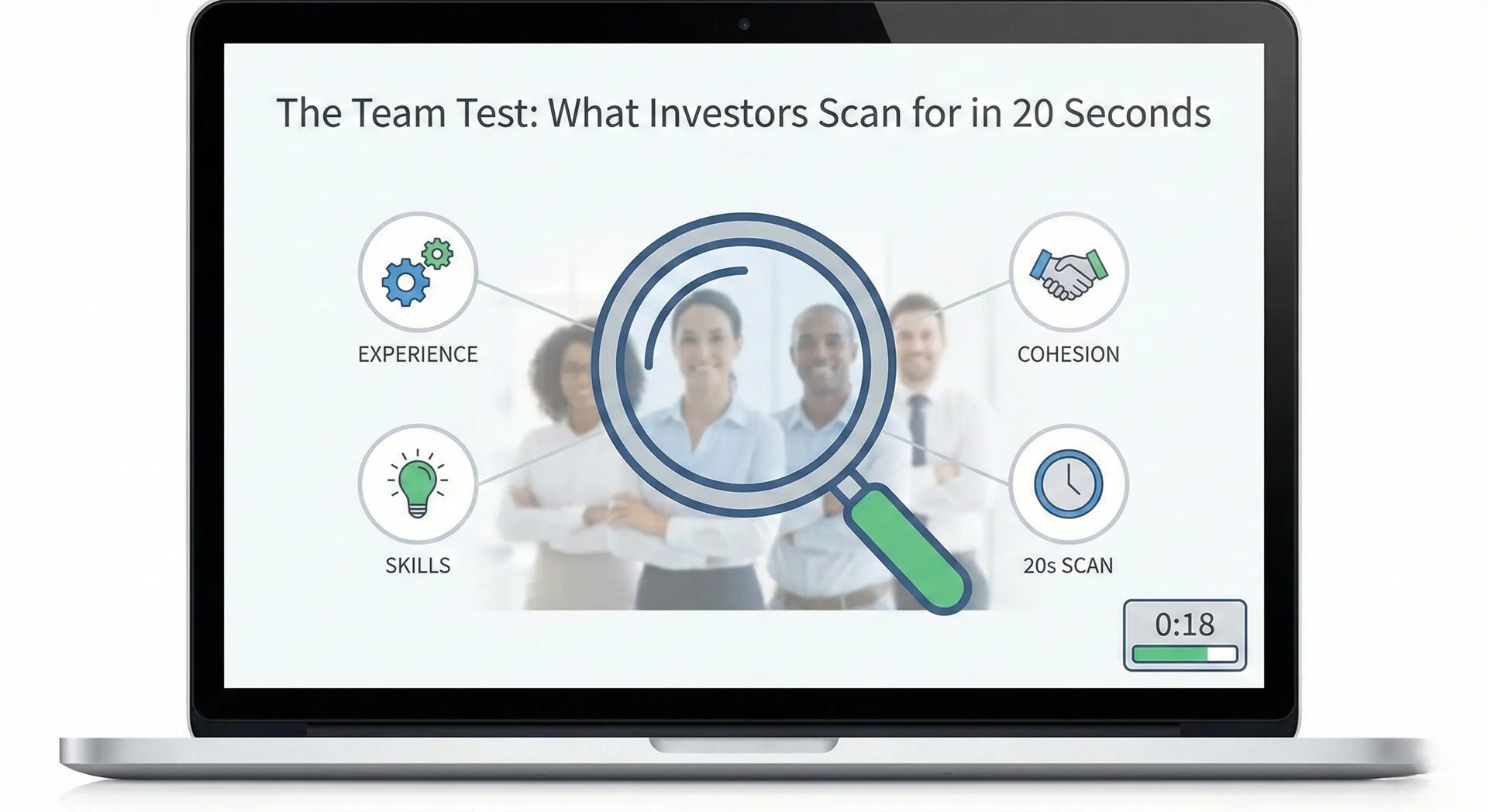

The Team Test: What Investors Scan for in 20 Seconds
If you are raising a Series A in 2026, your pedigree is irrelevant if your team slide creates friction. Most founders operate under the delusion that placing a "Stanford" logo or an "Ex-Google" badge on a slide grants them immunity from scrutiny. It does not. In fact, relying on past affiliations without quantifying current execution capability is the fastest way to trigger a "Pass" in a Partner Meeting.
Here is the counter-intuitive truth: Investors do not read your team bios. We scan for competency gaps. We are not looking for reasons to say "yes" based on your resume; we are aggressively hunting for the single missing skill set that will cause this venture to implode within 18 months. This is a foundational component of the pattern recognition described in The Step-by-Step Investor Evaluation Workflow (How VCs Decide What Moves Forward). If your team slide forces an investor to think, you have already lost the leverage. You have approximately 20 seconds to prove you are not just employable, but capable of capital deployment.
The Forensic Diagnosis
The majority of Series A fundraising efforts die not because of the market size or the product, but because the team slide signals "operational incompetence." When a VC opens your deck, they are performing a forensic audit of your human capital.
The "Red Flag" Scenario
Imagine a slide populated with six headshots. Three are "Advisors" with grey hair and vague titles. One is a "Part-Time CFO." The CEO has listed "Visionary" as a skill.
The VC Reaction: “This is a lifestyle business masquerading as a venture scale opportunity. They don't have a technical lead. They are hiding their lack of traction behind the advisors' reputations. This is a pass.”
This specific error—Advisor Bloat—is lethal. It signals that the core operating team lacks the gravity to stand on its own. It screams insecurity. Founders make this mistake due to the "Authority Bias." You believe that borrowing credibility from a semi-retired industry veteran validates your existence. It does not. It dilutes your equity story and suggests you are dependent on external validation rather than internal execution.
Furthermore, generic descriptors destroy momentum. Phrases like "10+ Years Experience" or "Marketing Guru" are empty calories. They provide zero data regarding your ability to scale a company from $1M to $10M ARR. In a high-interest rate environment, capital is priced for execution, not tenure. If your slide looks like a LinkedIn summary, you have failed the forensic audit.
The Cost of Cognitive Load
Let’s strip away the narrative and look at the math of attention economics in a deal flow funnel. A standard Series A Partner reviews 2,000 decks a year. They fund 2 to 4. The average time spent on a first pass of a deck is 2 minutes and 41 seconds. Your deck is likely 15 to 20 slides.
The Math: 161 seconds/ 18 (approx) 8.9 seconds per slide
However, the distribution is not linear. Financials and the Problem slide get the bulk of that time. The Team slide gets a cursory glance—often less than 5 seconds—unless it captures attention immediately.
If you clutter the slide with paragraphs of text, you increase Cognitive Load.
Low Cognitive Load: "CTO: Scaled Uber’s dispatch engine to 10M concurrent users." (Instant value recognition).
High Cognitive Load: "John is a passionate technologist who loves solving hard problems and spent a decade working at top tier firms..." (Investor stops reading).
The Logic of Dilution & Burn:
From a financial perspective, the team slide is a proxy for your Burn Multipler.
Heavy Executive Team: If you show five C-level founders, the VC calculates high salary burn with slow decision-making.
Outsourced Devs: If the "Team" is an agency, the VC calculates zero IP retention and an uninvestable technical debt risk.
The Investor's Mental Equation:
Investability = Proven Execution Capability
Operational Risk
If your team slide increases the denominator (Risk) by being vague, the value of the equation drops to zero instantly. You must mathematically prove that the human capital in the room is capable of converting cash into equity value at a rate higher than your competitors.
The "Insider" Solution Protocol
To survive the 20-second scan, you must abandon the "Resume Format" and adopt the "Outcome-Based" Team Matrix. You are not listing who you are. You are listing what you have shipped.
The Framework: Role + Quantitative Win + Relevance
Stop using "Co-Founder." Start using specific functional titles that map to the risks of your business model.
Before (The Weak Version):
Name: Sarah Jenkins
Title: CMO & Co-Founder
Bio: Sarah has 12 years of experience in digital marketing. She previously worked at Salesforce and HubSpot. She is passionate about B2B growth and leading diverse teams.
Why this fails: It tells me she was employed. It does not tell me if she was the coffee runner or the person who architected the demand gen engine. It’s "AI Fluff" humanized.
After (The VC-Ready Version):
Name: Sarah Jenkins
Title: CMO
Metric: 0 to $5M ARR in 18 months.
Proof: Led User Acquisition at HubSpot (Series C to IPO). Reduced CAC by 40% via automated content funnels. Managed $2M/mo ad spend profitably.
The Step-by-Step Fix:
Kill the Advisors: Move your Advisory Board to an appendix slide. If they aren't working 40+ hours a week, they aren't the team. They are decor.
The "Super-Power" Bullet: Under each founder’s name, place exactly two bullet points.
Bullet 1 (The Anchor): The single most impressive numerical achievement from their past. (e.g., "Managed P&L of $50M," "Patented the core algo," "Sold previous exit to Oracle for $200M").
Bullet 2 (The Relevance): Why this skill solves your startup's current bottleneck.
Logo Hygiene: Use logos of past employers only if they are globally recognizable (Fortune 500 or Unicorns). If the company is obscure, describe the sector and exit outcome instead.
The "Missing Piece" Address: If you lack a CTO or a VP of Sales, do not hide it. Put a "Hiring" silhouette with the text: "Role Scoped. Pipeline Active. Hired post-close." This shows self-awareness and operational planning.
The Insider Rule: If a partner cannot determine who builds the product and who sells the product within 3 seconds of looking at the slide, you have failed the test.
The "Death Traps"
In correcting your slide, avoid these three specific failure modes that signal amateurism to institutional capital:
The "All-Chief" C-Suite: A seed stage company does not need a CPO, CTO, CMO, CIO, and COO. This signals title inflation and ego issues. Stick to "Head of Product" or "Lead Engineer" if the person isn't truly C-level material yet. VCs prefer honesty over title inflation.
The "University Flex": Unless you are spinning out a deep-tech IP directly from a PhD lab, your university logo is less relevant than your last job. Relying on "Harvard '22" signals you have no professional wins to stand on.
The "Equally Distributed" Equity Signal: While not always on the slide, the team structure hints at the cap table. If the slide implies four co-founders with equal decision-making power, VCs smell a deadlock. Highlight the CEO clearly. There must be a captain.
The "High-Ticket" Conclusion
Your team slide is not a biography; it is a risk mitigation document. By converting generic bios into quantitative assets, you reduce the perceived execution risk of your venture. A optimized team slide can effectively increase your pre-money valuation by millions simply by silencing the "can they actually build this?" doubt in the investor's mind.
This level of precision is not optional; it is the entry fee for Series A. For the complete logic on how every single slide must interlock to secure funding, review How VC Pitch Decks Really Work in 2026 — And Why Most Founders Get Them Wrong.
The Filter Plug (CRITICAL):
You can attempt to reconstruct this narrative manually and risk the "Red Flag" rejection, or you can use The Slide-By-Slide VC Instruction Guide included in our $5k Consultant Replacement Kit. It provides the exact copy-paste frameworks and design constraints used by top-tier analysts to audit decks before they reach the Investment Committee.
Get the kit for $497 on the home page. If you are serious about capital, this is the cost of doing business. If $497 is a barrier, you are not ready for Series A.
Funding Blueprint
© 2026 Funding Blueprint. All Rights Reserved.